
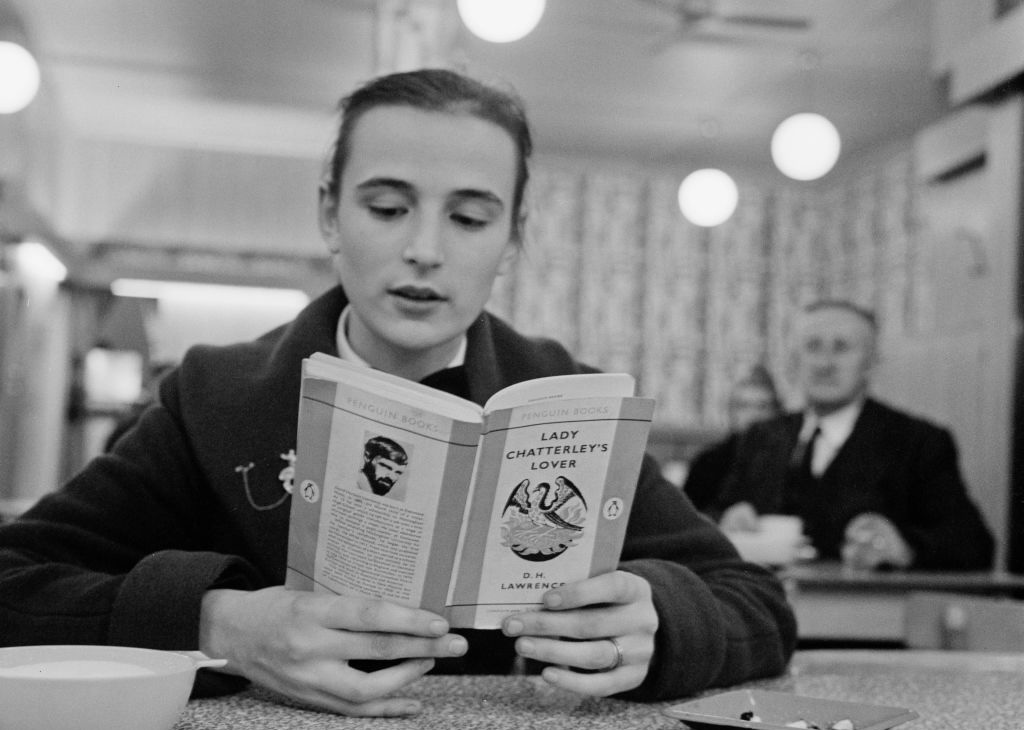
One of the bigger recent pieces on the supposed new trend in anti-literacy was an Atlantic piece called “The End of Reading Is Here,” and it was typical in its emphasis on the failures of the society that is degenerating outside the walls of the Big Five. The piece gives us the history of publishing from Mesopotamia to Ptolemy to Johannes Gutenberg and emphasizes the importance that our nation’s founders and civil war heroes placed on long-form print.
Marshall McLuhan, Neil Postman, Walter J. Ong, and Alexander Luria are name-checked. The tech-happy media and educational industries are decried, and the system that allows kids to spend 4.5 hours a day on social media is called out, but nowhere in the massive piece is any shade thrown at the book publishing industry with whom The Atlantic, for 169 years, has been cozy, and to which the article’s Yale-educated writer likely — as with most staff writers — means to sell manuscripts over the course of a career.
There is plenty of good reason for gloom. We are told that 80 percent of elementary school teachers report that their students have, by kindergarten, received school-issued personal video devices. But the Atlantic piece contains no implication that one possible reason books and long-form reading are falling away, a theoretically contributory factor to the mass market’s extinction and the plummeting demand for books, involves the supply-side of the equation. Any thought that what the publishing industry is printing, or how it has been pricing it, or where it has been placing it, just might have harmed our nation’s reading habit is never mentioned. The writer has good company in blaming the people on the outside. None of the publishing executives and pundits that attended the mass-market paperback’s funeral ceremonies last year did any self-implication either.
“We follow the consumer,” said Dennis Abboud, CEO of ReaderLink, America’s largest book distributor, upon announcing the death of the mass-market paperback. “It seems the consumer has spoken,” said Steve Zacharius, CEO of one of the biggest publishers in the format. “As a format, I would say it’s pretty much over,” said Ivan Held of Penguin Random House. All this shrugging and hand-washing for the book format that, as one regretful publisher eloquently put it, saved (or at least forestalled the decline of) America. “I believe that mass-market paperbacks democratized America,” said Esther Margolis of Newmarket Press. “For basically the equivalent of a dollar or two, you know, you could be educated. You could pick them up at the school book fair. You could pick them up at a local gas station . . . You didn’t have to be an elitist.”
But could the mega-consolidated Big Five American publishing industry bear any blame for this state of affairs?
Consumer scientists have long understood that that popular habits are not just among the hardest things to break but are also very difficult to make. Many companies try to integrate their products into preexisting habits, but it’s rare that a company touches off an entirely new one, much less one at the scale of the mass-market paperback. Those 8.5 million paperbacks sold by Pocket Books from 1939 to 1941 were arguably proof of a bigger, more instantaneous habit birth than that of even the iPhone, which sold a comparable amount of their own product but to a population that had grown three times larger.
But America’s decades-long mass-market paperback binge (which in 1979 topped out at 387 million annual units sold) suggests that we, as a people, are capable of — and perhaps even prone to — falling into a book-reading habit. So was there anything publishers could have done to prevent the death of the mass-market paperback and the decline of our national reading habit?