
Ask five assistants the same question and you’ll often get five different numbers. On 28 of the 71 questions where all five gave a percentage, we got four or five different figures.Note 6We compared each assistant’s headline figure for the same question. A range counts at its middle, and figures within 2 points count as the same.
One question, five answers, from 49% to 96%
Asked “What percentage of marketers use marketing automation tools?”, word for word, on the same day.
 49–51%AI Overviews
 62%ChatGPT
 70–79%Gemini
 81%Perplexity
 96%Claude
ChatGPTThere isn’t one universal figure, it varies by survey and what counts as “marketing automation.” One commonly cited survey found 62% of U.S. digital marketers used automation software, but that data is from 2020, so it may not reflect current adoption.
PerplexityApproximately 81% of marketing organizations use marketing automation.
GeminiAcross major industry benchmarks, between 70% and 79% of marketers and companies use marketing automation tools in some capacity
Claude96% of marketers have used a marketing automation platform or plan to use one
AI OverviewsRoughly 49% to 51% of companies and marketing teams currently use marketing automation tools, according to industry benchmarks from Moosend and related research studies.
It wasn’t one odd question. The typical gap between the highest figure and the lowest was 16 points.
On 31 of 71 questions, the five figures were 20 points or more apart
Every question where all five gave a percentage, one line each, from the lowest figure to the highest. Closest at the top.
Agreement feels like proof. It isn’t. All five gave the same figure on 10 questions, and of the 5 we traced, 2 were sourced. The statistics they repeated most, quoted by three or more, did no better: 11 of 29.
And four were quoted by all five assistants, with no study anywhere behind them.
Quoted by all five. Sourced by none.
Four statistics every assistant gave us, each with a trail that ends at a page citing no research.
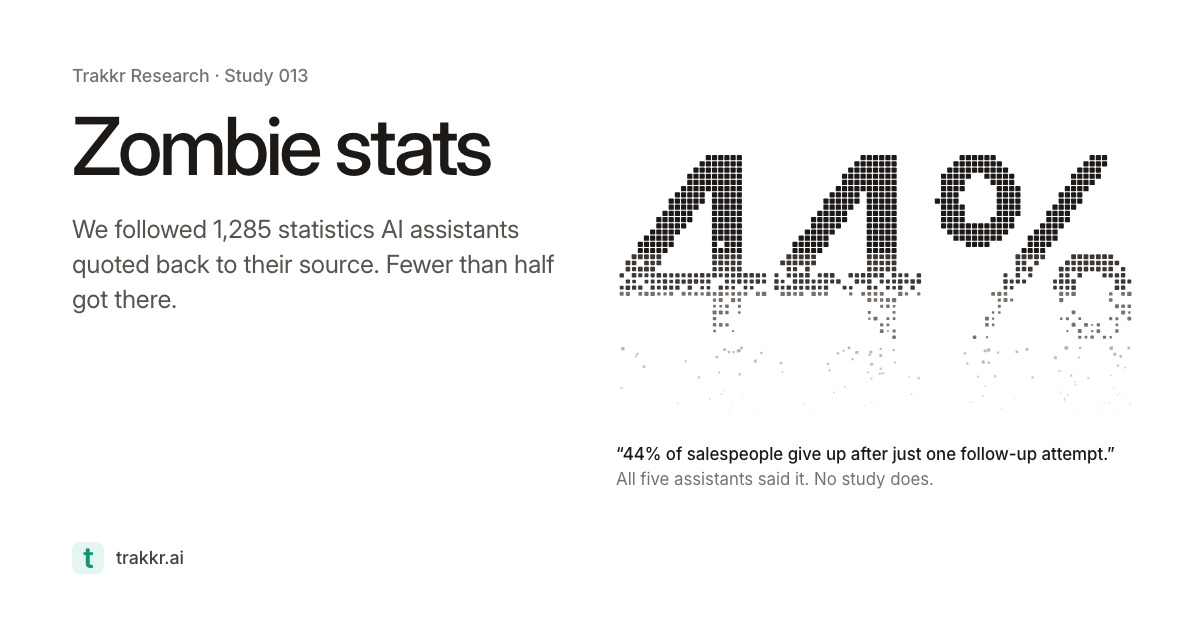
- 44%
Salespeople who give up after one follow-up
Every trail ends at a page that cites no research, one of them a freelance writer’s sample article. Its full trail opens chapter 1.
Quoted by all five - 90%
Social media users who follow at least one brand
Stated with no source. No study with this figure was found.
Quoted by all five - 75%
Searchers who never scroll past the first page of results
Repeated with no source, often credited to an old marketing roundup that no longer carries it. No study was found.
Quoted by all five - 5 to 25 times
How much more it costs to win a customer than to keep one
A 2014 Harvard Business Review article gives the range “depending on which study you believe”, and names none.
Quoted by all five
The 29 statistics AI repeats most
Each was quoted by at least three of the five assistants, most often first, and its trail checked by hand.
- 95%5 of 5ChangedStudy from 2025
Generative AI pilots that fail to deliver a measurable financial return
MIT NANDA’s 2025 report says 95% of organizations got no return from generative AI. That isn’t the same as 95% of pilots failing.
- 44%5 of 5Nowhere
Salespeople who give up after one follow-up
Every trail ends at a page that cites no research, one of them a freelance writer’s sample article. Its full trail opens chapter 1.
- 4% to 10%5 of 5ChangedStudy from 1979
Unhappy customers who actually complain
Goes back to TARP’s 1979 research for the White House consumer office. Its author says rates that low apply to small purchases; in 2016, 22% to 41% complained about their most serious problem.
- 2 hours 21 minutes5 of 5SourcedStudy from 2025
Time people spend on social media each day
DataReportal’s Digital 2025 report, from GWI survey data: the typical internet user spends 2 hours 21 minutes a day on social media.
- 46%5 of 5Can’t check
Google searches with local intent
Traces to a 2018 social post about a slide at a search conference. Google never published it, as far as we could find.
- 90%5 of 5Nowhere
Social media users who follow at least one brand
Stated with no source. No study with this figure was found.
- 94%5 of 5ChangedStudy from 2004
First impressions of a website that are about its design
Began as a 2004 study of how 15 women judged health websites. Its full trail is in chapter 4.
- 75%5 of 5Nowhere
Searchers who never scroll past the first page of results
Repeated with no source, often credited to an old marketing roundup that no longer carries it. No study was found.