
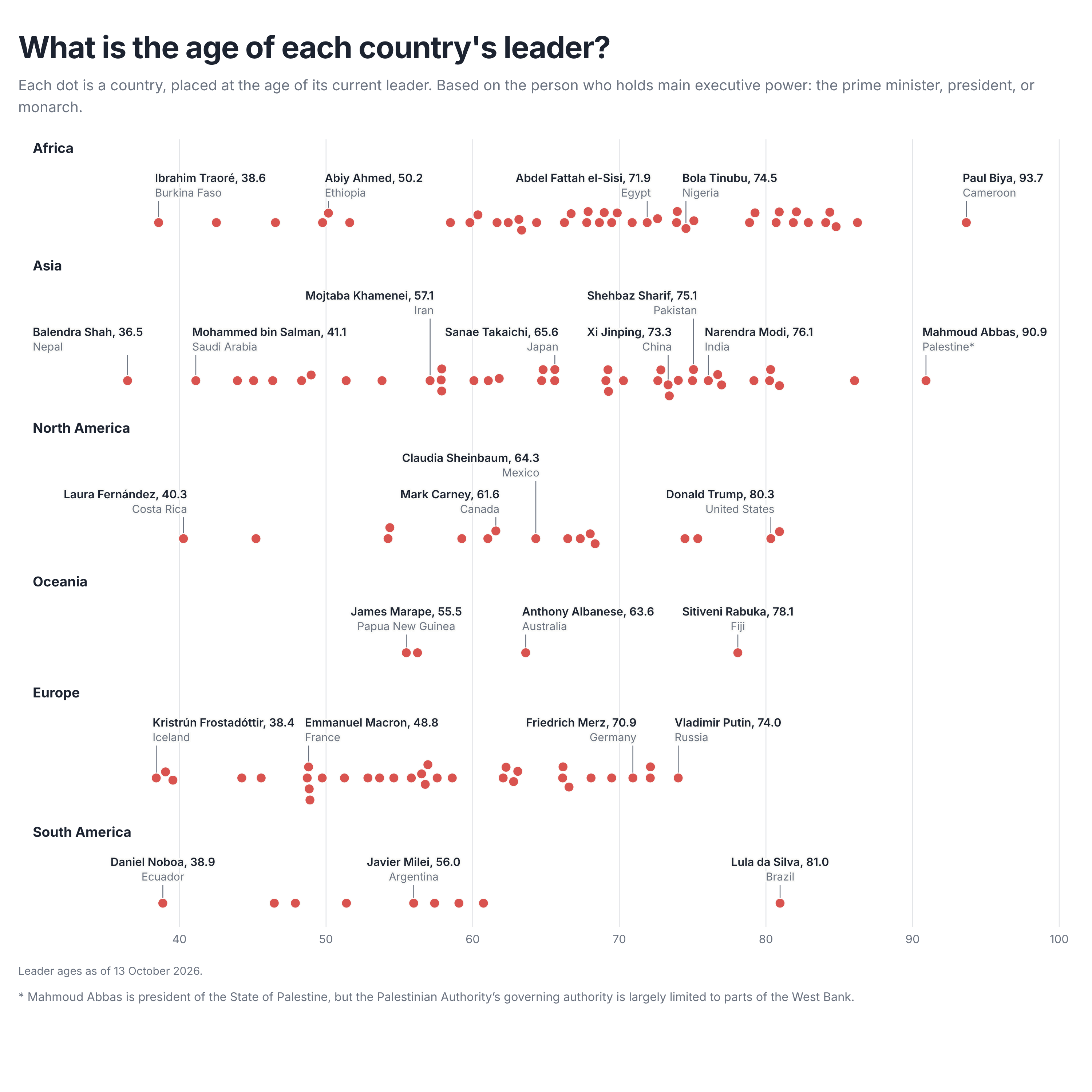
Paul Biya, Cameroon’s president, is 93 years old. He leads a country where the median age is just 18. A staggering 75-year age gap.
Biya is the most extreme example, but he reflects a pattern we see almost everywhere in the world. Leaders are often a lot older than the populations they govern. Three in four people globally live in a country led by someone over 65. Two in three have a leader older than 70. Most of the world lives under a leader who is past the age when most people retire.
With some help from Claude, I’ve compiled a dataset on the age of each country’s current leader and how long they’ve been in power across more than 140 countries.1 The leader, here, is the person with the main executive power. This can be the prime minister, president, or monarch.2
In this article, I’ll present some of the key charts and statistics. But you can also explore this data on your own in this interactive visualisation.
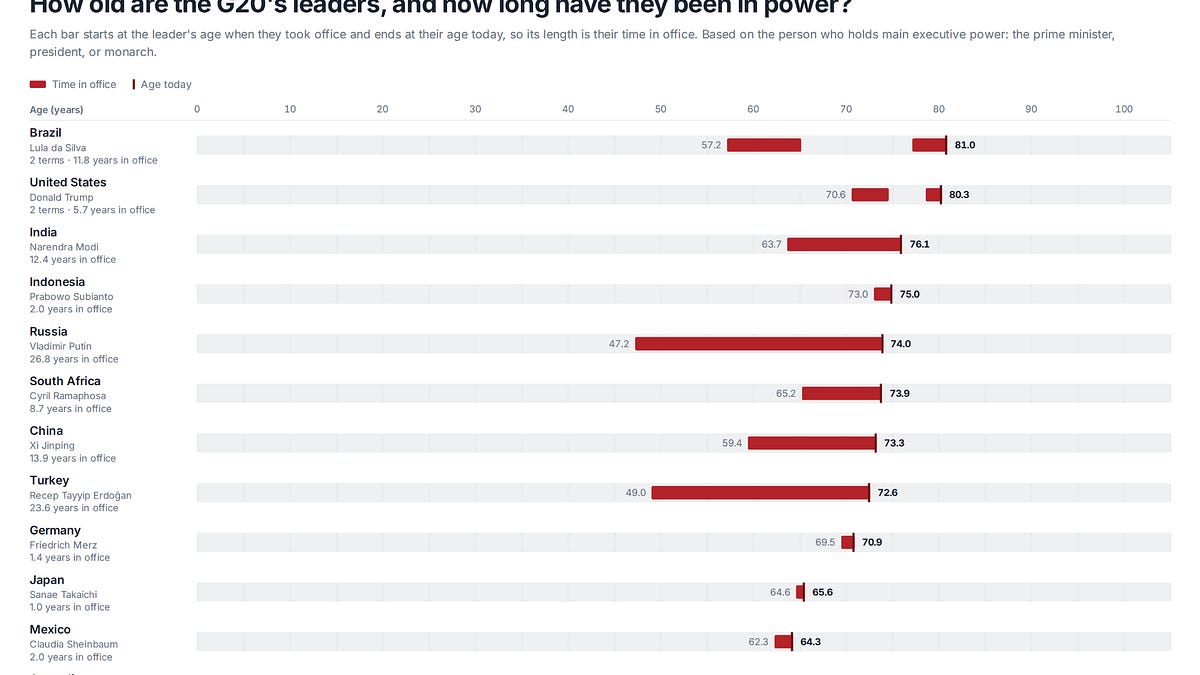
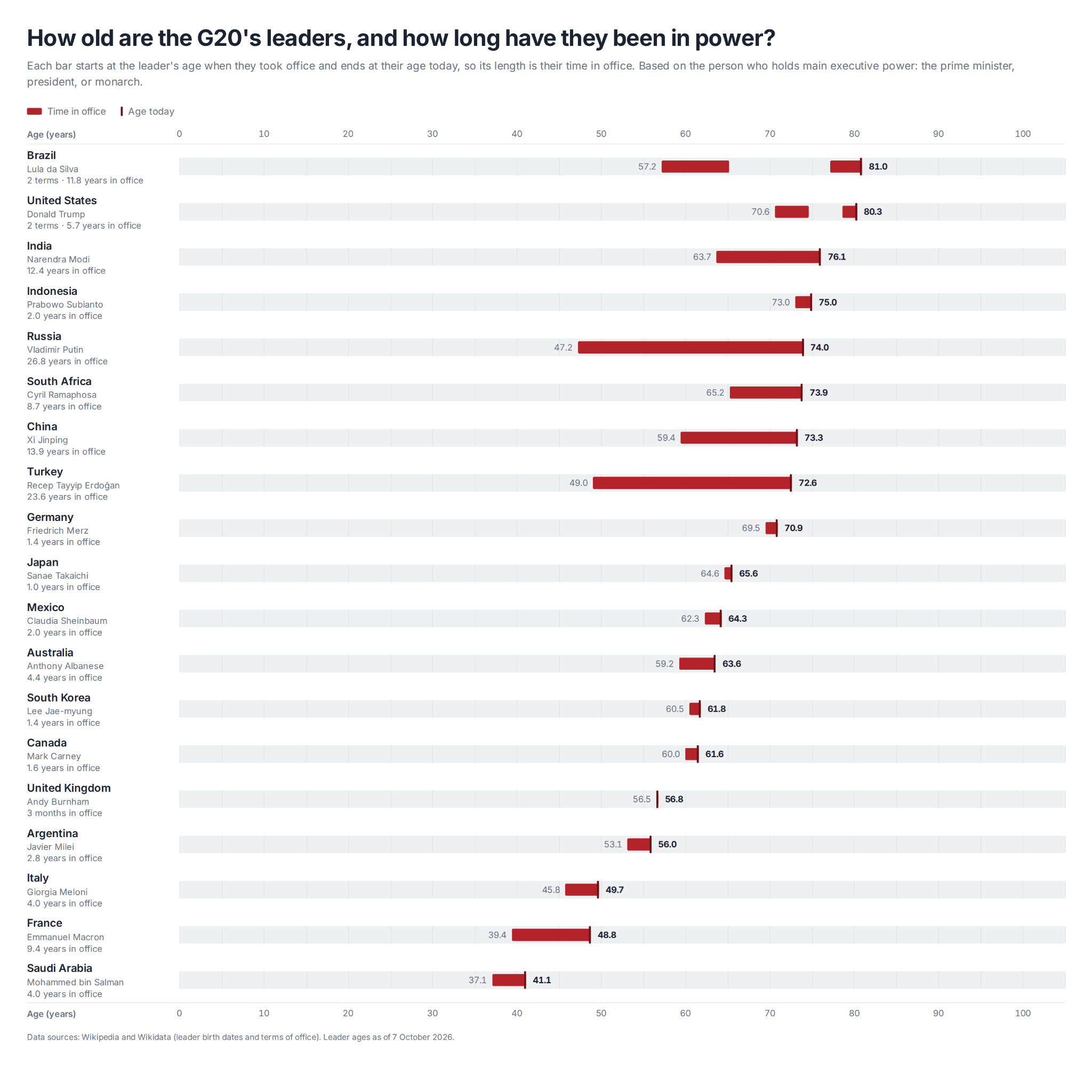
Let’s start with the 19 countries in the G20; it brings together a mix of countries from different regions. Two leaders are over 80: Brazil’s Lula da Silva (who might not be in office for much longer), and Donald Trump. Another seven are in the over-70s camp. Only three — Italy’s Meloni, France’s Macron, and Saudi Arabia’s Mohammed bin Salman — are younger than 50 (if you take King Salman to be Saudi’s executive leader instead, it’s just two).
Vladimir Putin has been in office for 27 years (including four years as prime minister), followed by Turkey’s Erdoğan with 24 years (including eleven as prime minister).
I won’t go through every region one by one, but you can explore each for yourself in the interactive version.
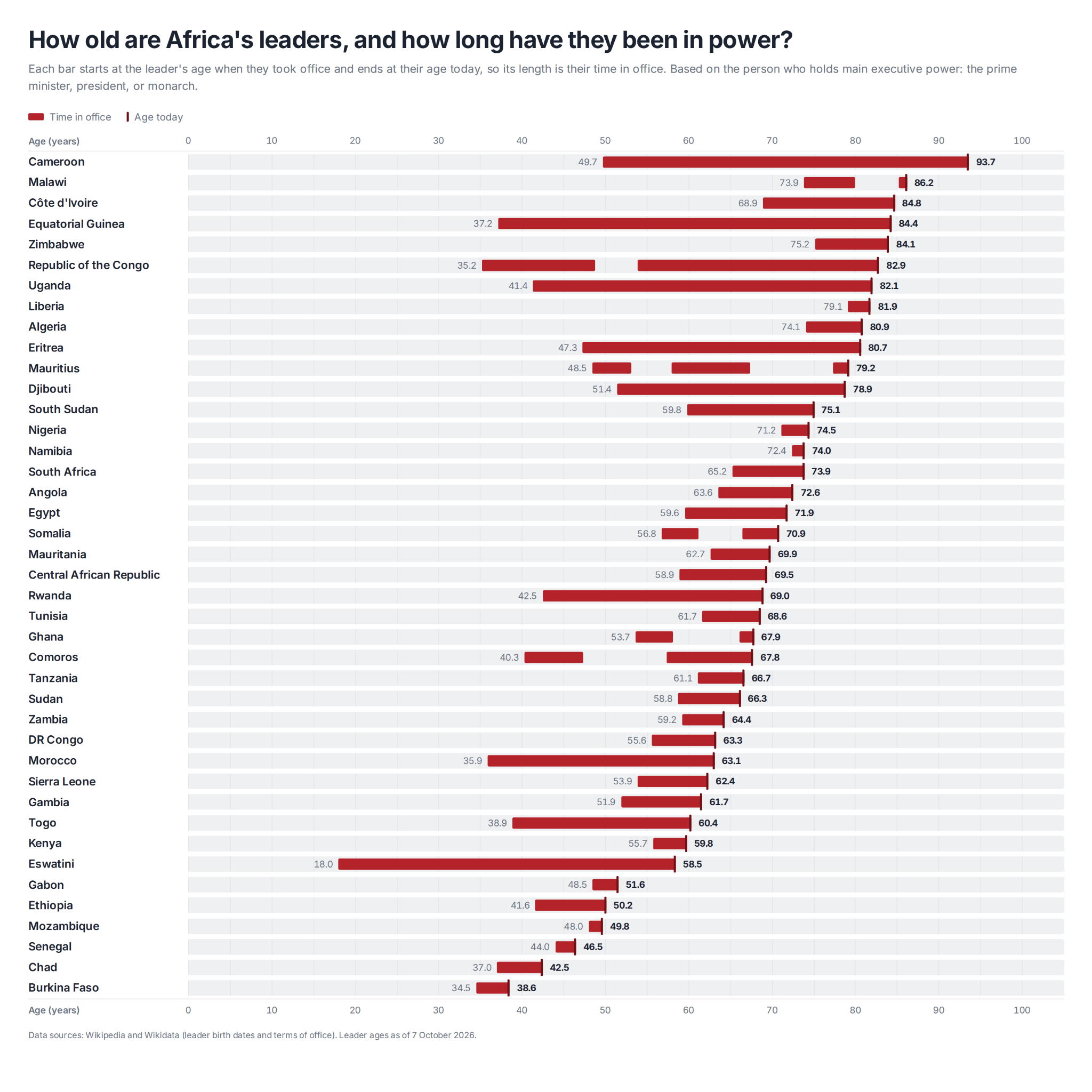
I do want to look at Africa’s distribution, though. It has many leaders who have been ruling for decades.
Cameroon’s president, Paul Biya, is 93 years old and has been in office since he was almost 50. Several are in their eighties and have been leading since their mid-30s.
Of course, many African countries are not democracies, so their leaders have not been kept in office through free and fair elections. 31 of the 41 African countries in this dataset are autocracies, and they’re home to 8 of the 10 continent’s oldest leaders.
Explore this interactive visualisation
European and South American leaders tend to be younger
How does the age of leaders vary by region?
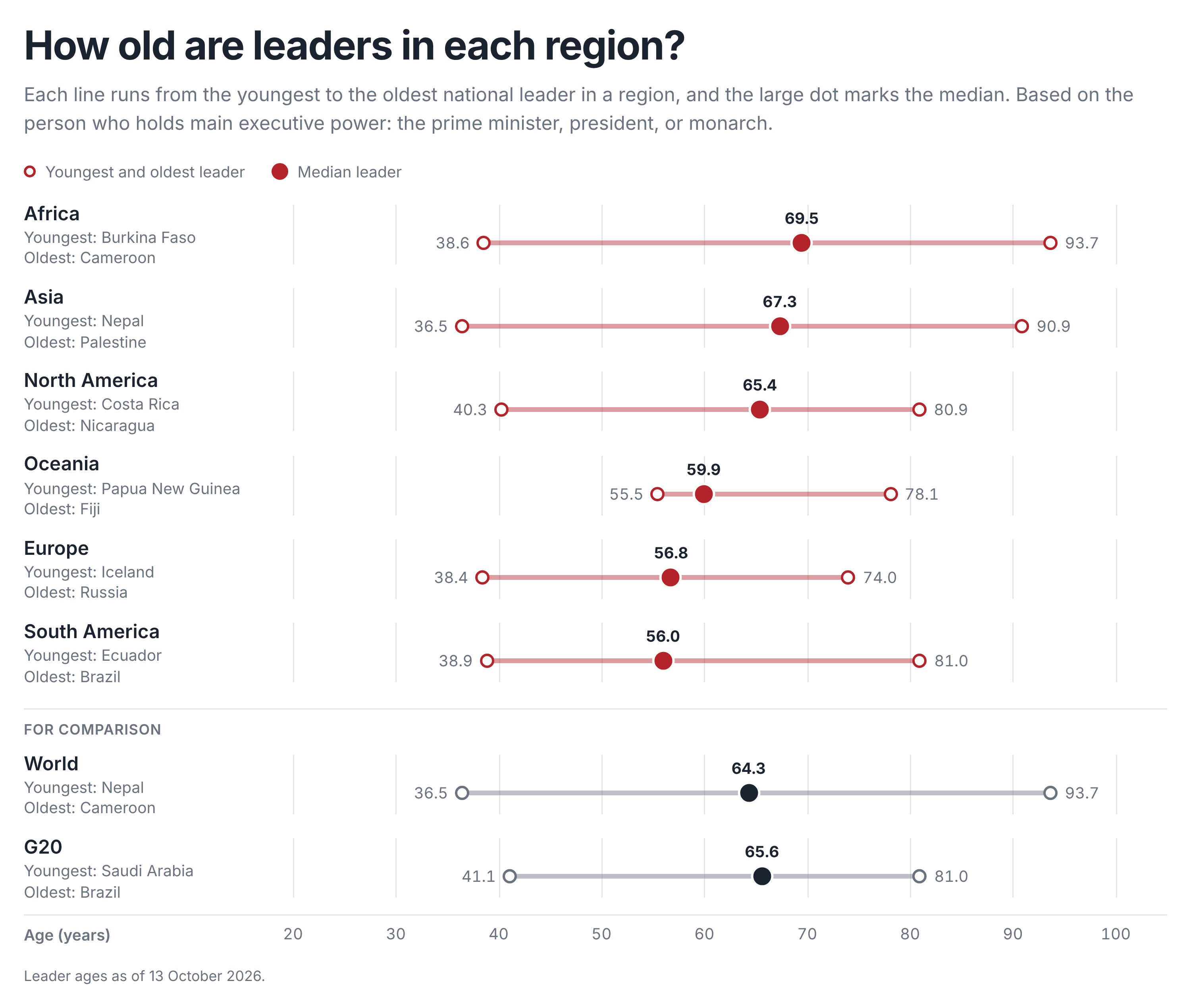
The median age — that is, the person in the middle if we lined them all up from youngest to oldest — of leaders globally is around 64 years.
The chart below shows this median age by region. Africa is the oldest, at nearly 70 years. Asia and North America are in the mid-60s, while European and South American leaders are younger, with a median age in the mid-50s.
Africa and Asia also have a wider age span than elsewhere, with the oldest leaders in their late nineties and the youngest in their thirties.
Here’s a similar view, but with all the countries (that I have data for) plotted for each region. The interactive version is more fun, so you can find your country, or hover to see specific country details.
There are lots of interesting things to find. One of the first things that jumped out at me is how much of an outlier Lula da Silva is in South America. Almost all of the region’s leaders are younger than 60, unlike in the rest of the world.
Explore the interactive version
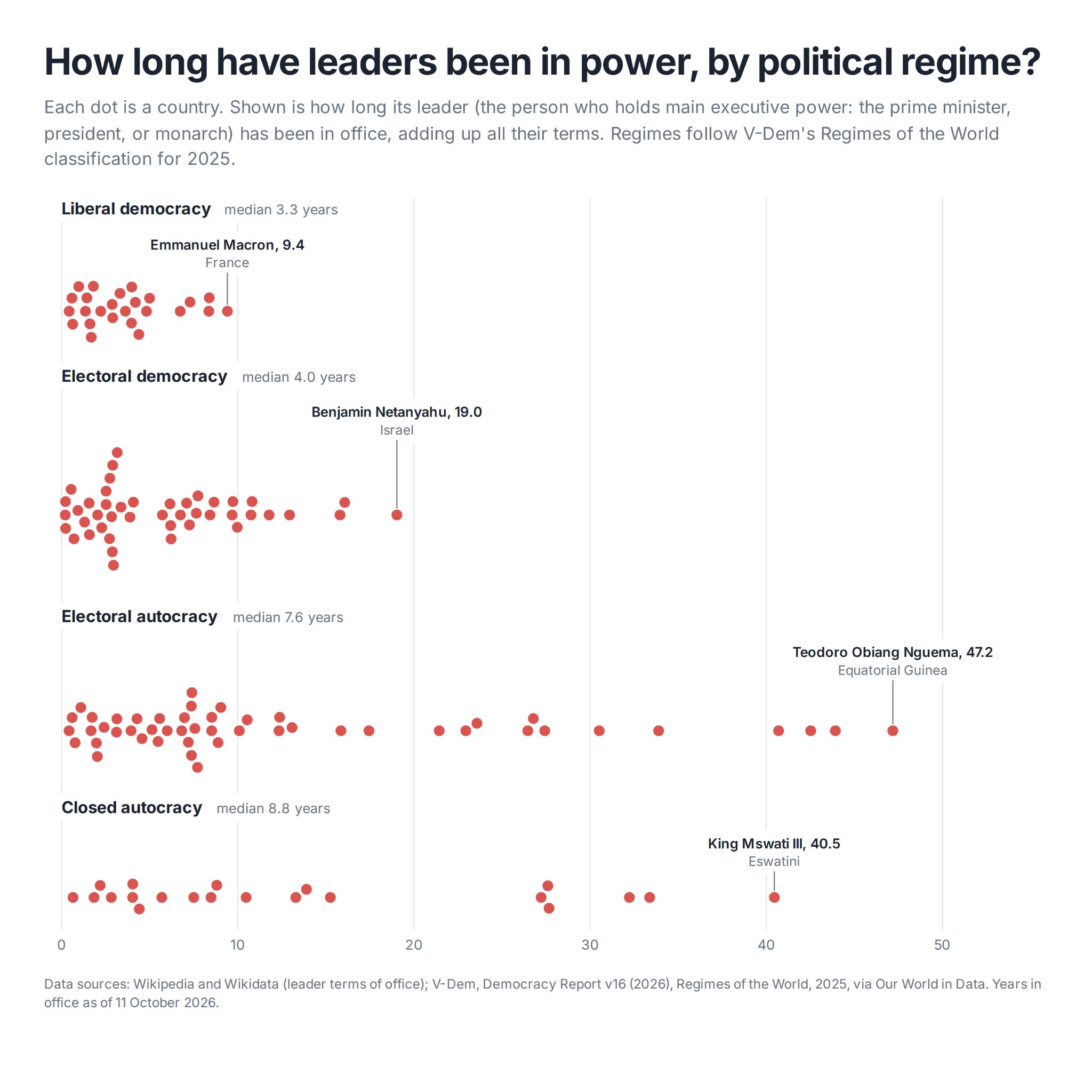
Autocratic leaders tend to be in power for longer
This is not exactly surprising. Democracies will often have term limits on how long leaders can serve. If not, the public eventually wants a change and votes them out. Autocratic leaders are often reluctant to give up power.
Below we have the total tenure of current leaders, split by their political regime. There are several sources that classify political regimes and democratic scores in different ways. Here, I’ve used V-Dem (Varieties of Democracy), which is one of the most well-known.3
None of the 25 liberal democracies in my dataset has a leader who has served more than 10 years in office. Autocracies have plenty; some more than four decades.
Almost every leader in the world is far older than the public they govern
How does the age of leaders compare to the age of the public?
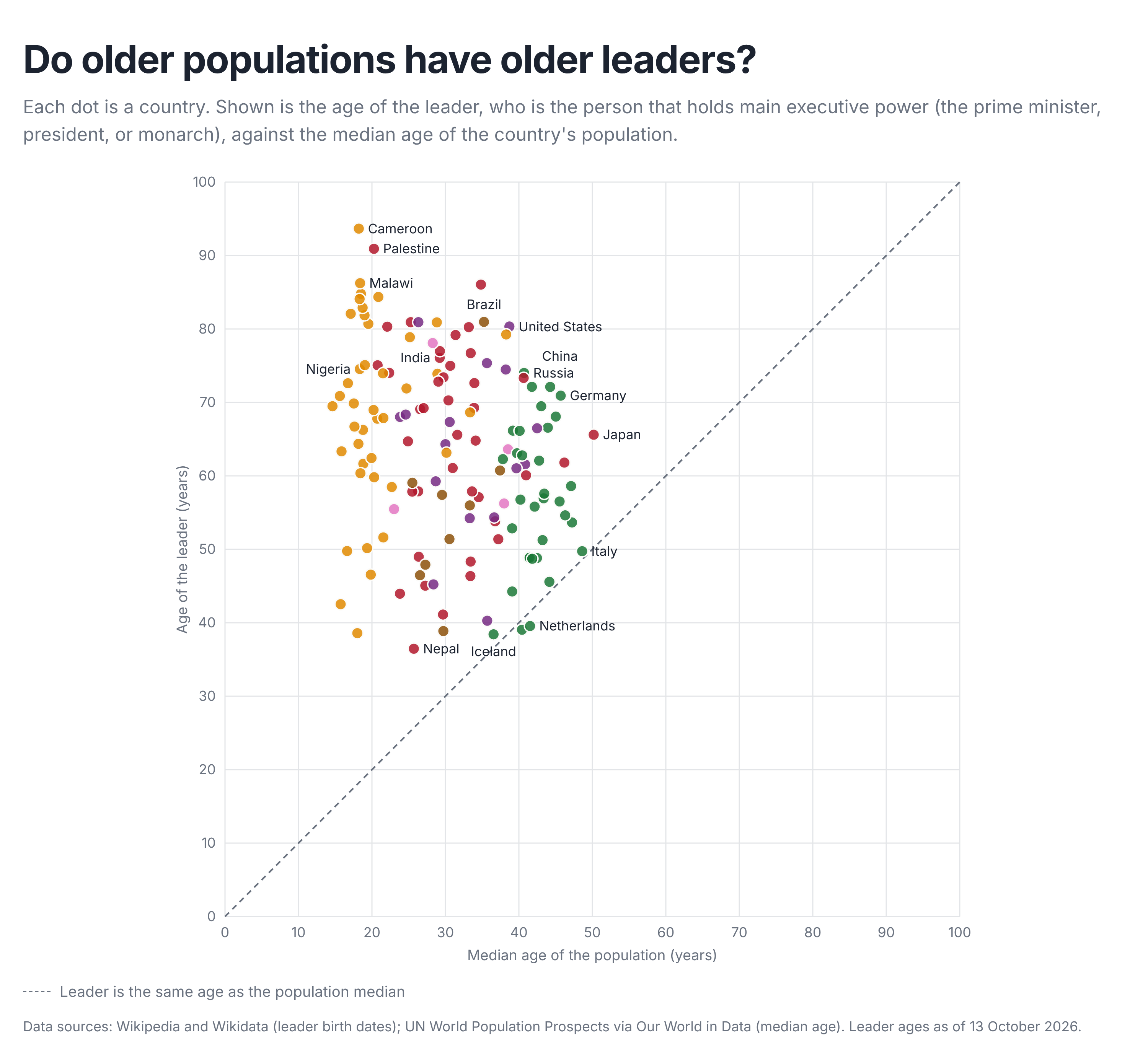
Below, on the y-axis, we have the age of the leader. On the x-axis, the median age of the country’s population. Again, the median age is the age of the person in the middle of a youngest-to-oldest line-up.
All countries above the grey dashed line have leaders older than the median age. It is basically all of them, with the exception of two: the Netherlands’ leader, Rob Jetten, is two years younger, and Montenegro’s Milojko Spajić, just one year.
The orange dots represent African countries, and many of them have huge age gaps between their leaders and their populations. Yes, the continent has many older leaders, but it also has an extremely young population. Niger, Chad, and the DRC, for example, have a median age of just 16.
Part of this gap we’d expect, simply because only adults govern, but children are included in the median age of the population. If we only look at the age of the adult population in each country, leaders are still 20 years older, on average. The leader is still older than the median in 129 of the 143 countries.
Explore the interactive version
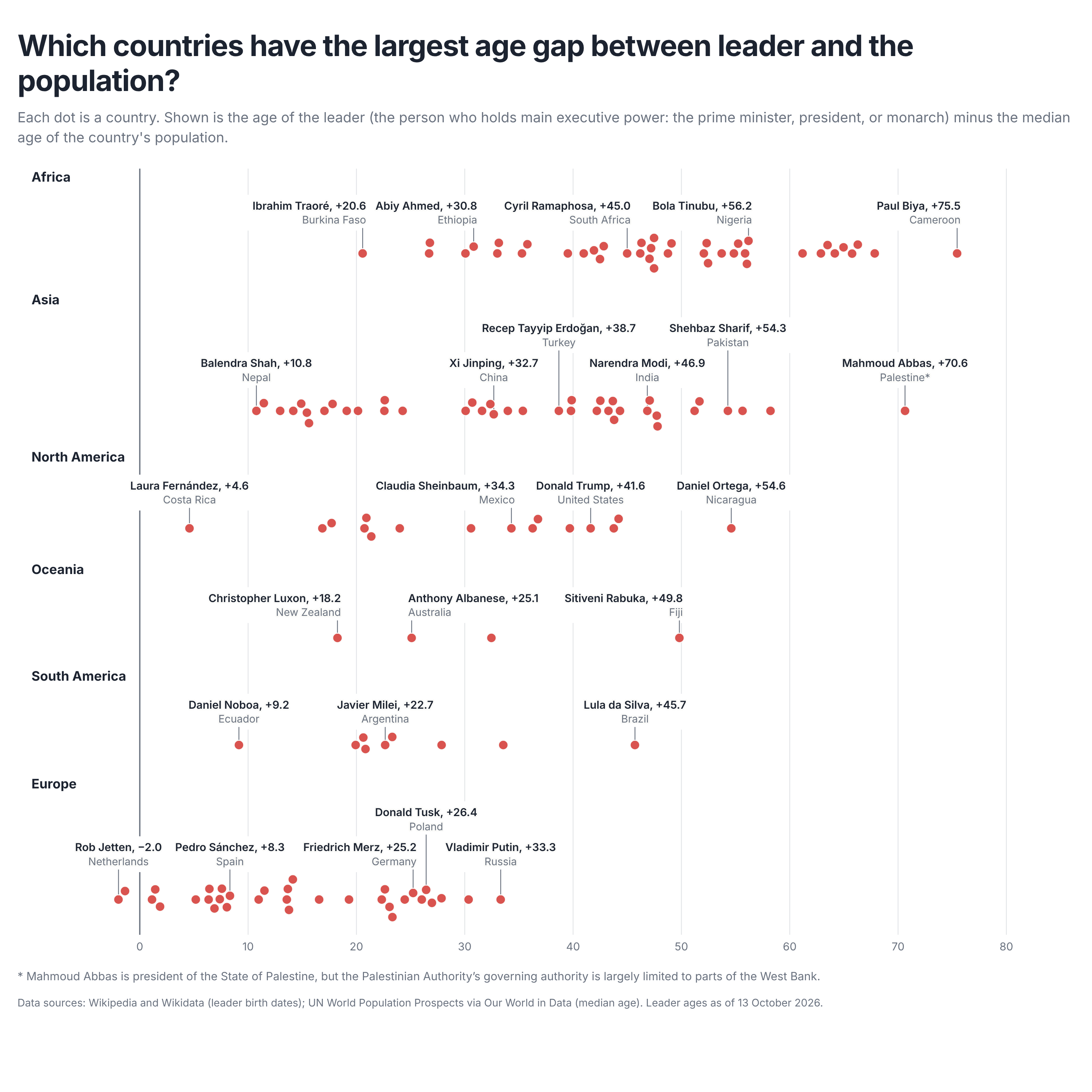
This next plot looks at the same data, but as the age gap. As we saw in the opening, Cameroon’s Paul Biya is not just exceptional because he’s 93. He also governs a country where the median age is 18. A 75-year age gap.
Europe also stands out as having relatively small age gaps. Its leaders tend to be younger, and its population is also older. It’s rare to have a gap of more than 30 years, and most are smaller than 20.
Explore the interactive version
It’s quite hard to verify the exact age of every leader, down to the month. If you spot any errors, please let me know.
Pew Research did a similar analysis earlier this year, but only based on leader ages, not their tenure: https://www.pewresearch.org/short-reads/2026/06/09/as-trump-turns-80-who-are-the-oldest-and-youngest-current-world-leaders/
In most cases, the data matches exactly. In a handful of cases, the definition of "leader" differs.
For example, it counts King Salman as the leader in Saudi Arabia; in this dataset, I use Crown Prince Mohammed bin Salman (who is more likely to be the answer to the question of who runs the country).
There are other edge cases like this, particularly in countries where the leader does not control all of its territory. Palestine is one example; I’ve included Mahmoud Abbas, who is the President of the State of Palestine. However, the Palestinian Authority’s governance is limited to parts of the West Bank. Palestine hasn’t held legislative elections since 2006, and it just postponed its upcoming elections until next year.
There are other cases like this, where the government does not control all of its territory, including in Sudan, Syria, Somalia, and Ukraine.
These classifications are not without their critics. V-Dem is just one source of several (which don't always agree).
But if we were to use another classification, the results might be slightly different, but not much.
Electoral democracies have free and fair elections, with multiple parties, and people have free speech, the right to organise, and can get independent information.
Liberal democracies have all of the features of electoral democracies, but with individual liberties and checks and balances on executive power.
In Closed autocracies, citizens cannot choose their leaders through multiparty elections.
In Electoral autocracies, elections are held but are not deemed to be free and fair.