

Article published by: Leah Rowe
Date of publication: 15 October 2026
You can find today’s release in https://rsync.libreboot.org/stable/26.10/ or you can use one of the mirrors.
Libreboot is free, open source boot firmware replacing proprietary BIOS/UEFI firmware on supported Intel/AMD and ARM64 hardware. It initialises the hardware inside your computer such as the CPU or memory controller, configuring the machine in such a way as to enable use of an operating system like Linux or BSD at boot - and now Microsoft Windows is also compatible because Libreboot has added full UEFI support via MrChromebox EDK2 payload. Libreboot offers greater security and customisation compared to proprietary firmware; its goal, plainly, is to rid the world of proprietary software and to do that, we therefore try to provide firmware that is extremely easy for non-technical users to understand.
Today’s release changelog is relative to the previous Libreboot 26.01 release.
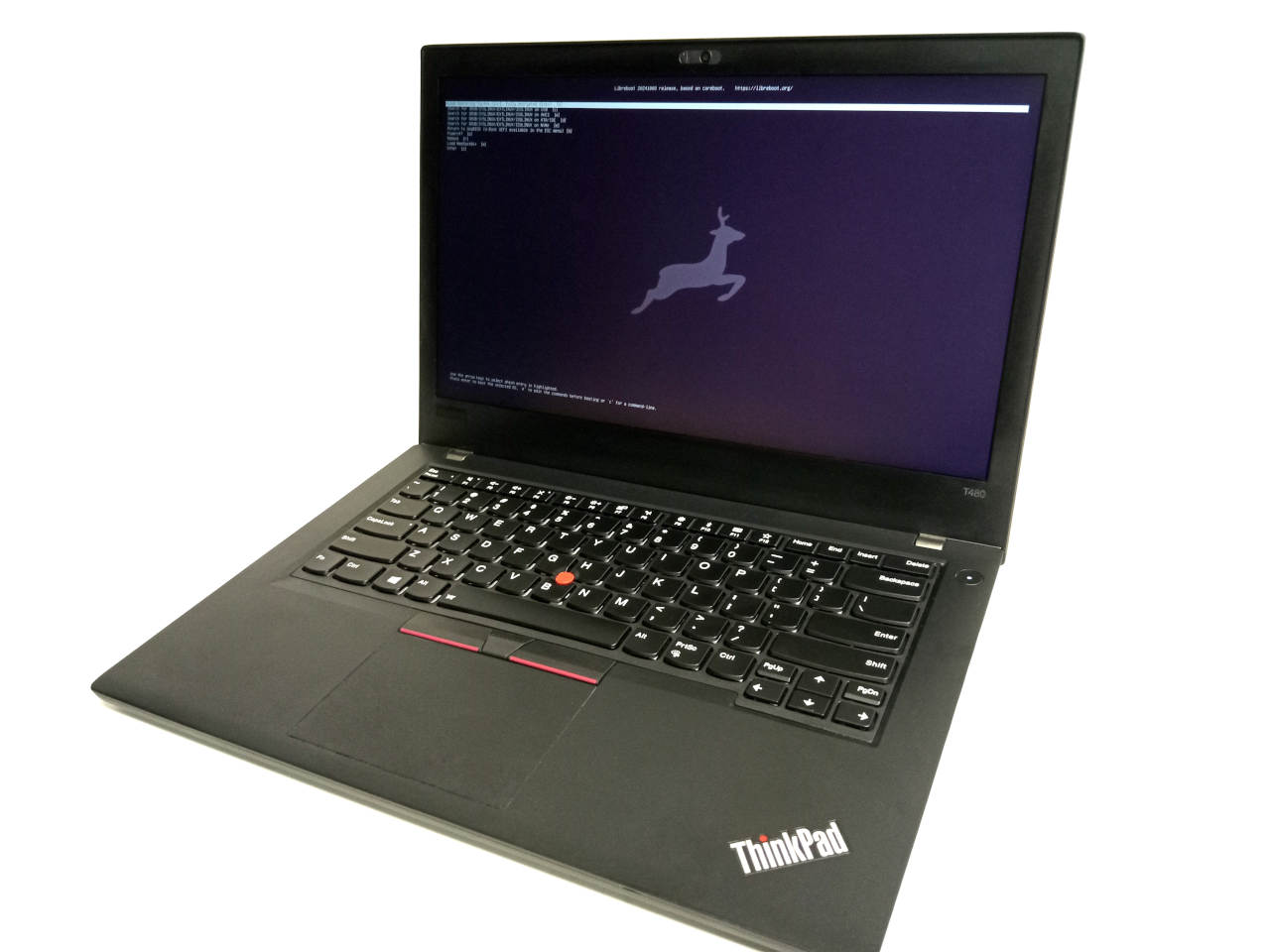
This is a very special release, with several major design changes made regardless of hardware changes, so users should read this changelog very carefully - and read it twice.
First thing’s first. (and yes, you read the previous paragraph correctly)
A strongly anti-AI policy was added to a new file: AGENTS.md in lbmk. This is the most important change in the release. Now everything else:
WARNING: MAJOR design changes were made to this release, in ways that may affect lots of existing setups. We now use EDK2 as the default payload, with GRUB/SeaBIOS provided in flash as EFI builds for backward compatibility. Everything works, but there are some caveats so please read this release changelog very carefully.
The first major change is:
233 Intel/AMD Chromebooks added
[link]The full list of boards is quite long, so it’s shown at the end of this article. All 233 of them!
MrChromebox supports nearly every Chromebook, and this release imports all boards from that project. This includes everything up to the most recent Intel and AMD hardware.
Imported all 233 currently supported Chromebooks from the MrChromebox coreboot distro. Baytrail (Kip) tested - others need testing. Source-only in this release (must build from source, no binaries provided).
This was done with a utility I wrote at util/mrimport/ which generates configs for lbmk, including revisions and submodules. I made further tweaks manually; further updates upstream can be synced in Libreboot by diffing again the output of mrimport between revisions, adapted into Libreboot irrespective of the latter’s modifications which are numerous - and will be covered next.
Libreboot makes these modifications to MrChromebox coreboot, in its version:
- Uses the EDK2 UEFI payload for coreboot, provided by MrChromebox; we set the background colour to Libreboot purple, and use the Libreboot rainbow logo instead of the coreboot logo. Our EDK2 build is otherwise currently identical except for the next changes:
- Set HAP bit by default, at build time, to disable Intel ME. It is not reliably disabled in MrChromebox coreboot by default as most people using it do so via software-based flashing scripts alongside disablement of Google’s security as shown in MrChromebox documentation. We disable it here. NOTE: We also support numerous AMD Chromebooks, which are unrelated in this context.
- Unlock IFD regions via ifdtool (with quirks properly handled), setting them read-write at build time. This is done instead of modifying every Intel Flash Descriptor provided by MrChromebox, of which there are hundreds.
- CSMWrap added inside EDK2 (SeaBIOS CSM wrapped in EFI) for backward compatibility with bare metal SeaBIOS as in older Libreboot releases.
- GRUB EFI build provided inside EDK2, for backward compatibility also - it behaves, from a user’s perspective, exactly like the coreboot-payload version of GRUB and even reads configs from CBFS in the same way.
- MemTest86+ added inside EDK2.
- Haswell chromebooks: native raminit used instead of MRC as in upstream.
- All Intel chromebooks up to Kabylake: use libgfxinit instead of GOP; upstream has since done this on newer gens as well, and this will be integrated post-release.
The additional payloads are, as above, available in the boot menu via ESC keypress at startup. iPXE is also enabled by default, as in upstream, on specific boards. EFI GRUB and CSM SeaBIOS have replaced the coreboot payload versions of these; bare metal SeaBIOS/GRUB are now deprecated and may be removed in a future Libreboot release, although they can be re-enabled by those willing to build Libreboot from source.
This is NOT a fork of MrChromebox, which is to be regarded as Libreboot’s upstream on Intel/AMD Chromebooks. Efforts will be made, as with regular coreboot, to remain as closely in sync with it as possible at all times. I have worked extensively with MrChromebox, and even submitted a few minor fixes to his project; he also implemented CBFS-based VBT and GOP handling per my request, which I will integrate post-release.
Regardless, MrChromebox’s own installation scripts should work, with Libreboot images, so check out MrChromebox documentation for installation. Despite changes, Libreboot’s setup remains behaviourally compatible with the MrChromebox one and, thus, MrChromebox tooling should still work alongside corresponding documentation.
This is made possible by a new feature in Libreboot’s build system: support for an arbitrary number of upstreams per project. We still provide regular coreboot on non-Chromebook mainboards.
Yes, 233. I counted. All automated. My scripting and my fastidiousness ensured that what I imported and configured in lbmk closely matched upstream, and I’m quite careful at maintaining my own divergence from it inside Libreboot.
Yes, Libreboot runs on Chromebooks now!
15h.org fork for Fam15h
[link]E.g. KGPE-D16. We use the coreboot fork from 15h.org now, on AMD Fam15h mainboards. This uses AMD AGESA source code instead of Timothy’s custom init code. It has much more reliable raminit and CPU initialisation; more RAM also supported. Many bugs are fixed. IOMMU works, I also saw that they mentioned TPM is fixed in their version, now our version also.
Regular binaries with SeaBIOS and GRUB payloads provided - we also have experimental EDK2-based images, currently source-only (no binaries available). EDK2 requires a framebuffer to be set up, and the integrated AST2050 chip only starts in text mode on native initialisation; the vendor VGA ROM can set up VESA, but we will not use the VGA ROM. The EDK2-based images are source-only on these boards, intended for use with graphics cards.
Basically, these boards actually work for the first time.
EDK2 UEFI payload by default
[link]EDK2 is Intel’s reference implementation of the UEFI specification, for booting. It’s typically used by vendors, in proprietary forks of Intel’s BSD-licensed code, but Intel’s reference code is Free Software. We use their reference code, and full source code is provided in this Libreboot release. EDK is short for: EFI Development Kit.
More specifically:
We use a fork of EDK2 provided by MrChromebox, which specifically offers use of EDK2 as a generic coreboot payload. This is a complete, industry-standard UEFI implementation capable of booting any compliant operating system.
All. Nearly all boards use it in Libreboot now, even older ones e.g. ThinkPad X200. Tested on all platforms. Older, 32-bit-only mainboards still use the setup from the previous release, while virtually all 64-bit-compatible hardware now use EDK2. EFI builds of GRUB and SeaBIOS are provided in flash, accessible from the EDK2 setup menu (press ESC at boot time when prompted), for backward compatibility with existing Linux/BSD installations in Libreboot.
EDK2 support was integrated as a prerequisite for Chromebooks, but then it was extended for use on all previously existing supported mainboards in Libreboot. It even runs well on really old machines e.g. ThinkPad T500.
All Libreboot boards now use an open source UEFI implementation by default, where feasible. All of them, and it’s by default - the bare metal GRUB and SeaBIOS coreboot payloads have been removed, replaced by EFI versions that are backward compatible.
We previously did not provide UEFI at all, except for U-Boot on a few select mainboards. We now provide full UEFI, with all four freedoms intact, on nearly every mainboard that Libreboot supports.
All of the following operating systems were tested and confirmed working, on various Libreboot machines using EDK2:
- Windows 10 and 11
- 9front (fork of Plan 9)
- various other UEFI-compliant operating systems
- Linux UKI bootloaders, systemd-boot, etc. UKIs work perfectly now, booting from EDK2. Modern Linux distro setups now work (GRUB not required).
- OpenBSD with EFI bootloader and GPT partitioning (older SeaBIOS txtmode can only do MBR partitioning in Libreboot)
- FreeBSD in UEFI mode - txtmode no longer required!
- ReactOS did not work, unfortunately (no UEFI support)
- RedoxOS probably works too.
Modern computers and operating systems are all UEFI, and this new setup can boot basically all of it reliably. More testing will be required, but this is battle-tested code and it has been used extensively in coreboot by many users, for many years. Libreboot finally has it as well.
This change alone is part of a much wider effort to modernise Libreboot, and I’m only getting started. The next Libreboot releases will draw heavily on this, as EDK2 is pretty much the expected payload on a lot of modern coreboot setups these days. Integration of EDK2 removes all limitations in Libreboot, allowing us to support much newer hardware and it basically makes Libreboot much easier to use; I expect Libreboot to become much more popular and useful over time, as a result.
Some caveats and extra notes are provided at the end of this release page, for migration purposes. For example, despite boasting about all, older 32-bit-only hardware still use bare GRUB/SeaBIOS. Nearly all boards use EDK2 however!
Modern GPU support (via EDK2)
[link]Finally, some notes about graphics cards that may be of interest to the more demanding users.
EDK2 alongside PCI-E relocatable BAR (rebar) means that you can now use modern graphics cards that require allocations above 4GB. Rebar is not enabled by default, but you can enable it in menuconfig (coreboot). Enabling it causes breakage of Intel GPU video output on libgfxinit in testing, and no fix was found yet, so rebar is disabled by default.
PCI-E Option ROMs are enabled by default where necessary, for EDK2 builds. This means you can use it on desktops with graphics cards. Tested on several desktops (Dell OptiPlex 9020 SFF and 5050 SFF).
On boards with only external GPU, rebar can be left enabled by default. On systems with functioning integrated graphics, accidental enablement of rebar can be remedied by inserting a graphics card; when the video output in the payload does become broken, the Linux i915 video driver still initialises video framebuffer properly in KMS/DRM.
This will be added to general documentation, pending fixes upstream. Note that even with this issue, Linux video output works fine. This will be corrected and rebar enabled by default, on a future Libreboot release.
Upstream revisions
[link]Nearly all major upstream revisions updated:
- Flashprog: updated to 24 September 2026 revision
- EDK2: imported version 26.09.2
- GRUB: updated to version 2.16
- Coreboot (default tree): Updated to 8ce4c91c41da3f042979f92095149a85bc93227d commit ID as of 18 September 2026.
- Coreboot (mrchromebox): imported e5997cf9384b29082a1bf3101813d8ac3dadda42 commit ID of MrChromebox coreboot, for use on Chromebooks.
- Coreboot (fam15h): removed (
4.11_branchtree) and replaced with: - Coreboot (fam15h_15h): 57e26bdcd959808c0171164f3c6197d4a347c3b2 commit ID as of 27 May 2026. This is a heavily improved fork of coreboot from version
4.11_branch, for improved initialisation reliability on AMD FAM15H hardware e.g. ASUS KGPE-D16. - SeaBIOS (non-CSM): Updated to 81ec9ec0bcf45df11fb7f98339ec9036b546fca0 commit ID as of 28 July 2026.
The 4.11_branch tree of coreboot was removed, because we now use the 15h.org fork of coreboot on AMD Fam15h hardware. This is much improved, with proper AGESA-based initialisation which initialises CPUs and memory controller more reliably. More RAM is supported, and several features were fixed too e.g. IOMMU and TPM.
The use of multiple coreboot upstreams was enabled by a design improvement in lbmk that makes all projects multi-tree, just with some projects ony having one tree in use. We can have N number of upstreams per project now, enabling use of forks.
The coreboot update brings in GCC 15.2, MPC 1.4.1, Nasm 3.02, acpica 20251212 and binutils 2.46.1 on crossgcc.
NEW hardware support
[link]All 233 chromebooks currently supported by MrChromebox have been imported and adapted for use in Libreboot. They all compile. All of them. I repeat:
- 233 Chromebooks imported from MrChromebox. Every Chromebook supported by the MrChromebox project can now also be built in lbmk, with lbmk’s changes. Thank you Matt DeVillier for your amazing project!
More hardware added besides Chromebooks:
- Dell OptiPlex 5050 SFF support, courtesy of Ron Nazarov.
- Supermicro X11SSH-F mainboard support - improvements made by Ron Nazarov e.g. use of regular Intel ME neutered through
deguard- no bootguard, but deguard can also be used generally to provide a pre-configured ME per board. This board otherwise uses SPS. With use of regular ME, we do need a larger ME region than with cleaned SPS. Use of regular ME means that the MRC caching works, and thus raminit training is much faster on reboots (no need to retrain on literally every boot). - ThinkPad X280 support courtesy of AlguienSasaki
- ThinkPad X270 support courtesy of Kat Inskip
- Dell OptiPlex 3040 Micro support courtesy of Todd Baker
- Removed
release="n"on the ThinkPad X301 target. It actually boots just fine, although it is quite slow. EDK2 even works.
We add SeaBIOS CSM and GRUB EFI builds inside EDK2, for parity with Libreboot’s older GRUB/SeaBIOS payload setups. The EFI payloads work very much the same.
Use of EDK2 makes it easier to support newer machines, which will be the focus from now on. EDK2 came first, as part of a general modernisation effort; newer Intel and AMD hardware will be added over time, making exclusive use of EDK2 payload by default.
Feature changes
[link]This is very much a features release. A lot of feature changes were made!
- EDK2 payload support on all Intel/AMD boards with at least 4MB flash. This uses the MrChromebox version of EDK2, and Libreboot has made extensive modifications e.g. add GRUB EFI and SeaBIOS CSM (CSMwrap) builds to it; these are provided as backward compatibility with older lone SeaBIOS/GRUB payload setups and should still boot existing Linux/BSD installations.
- iPXE boot method added via EDK2 payload (ESC menu) - only EDK2 (not available in the lone SeaBIOS payload on older boards).
- Added new command
./mk import_ubootfor auto-importing U-Boot configs that can then build in lbmk. Not yet used, but this will be used to add tested U-Boot boards in future releases (U-Boot itself providing its own initialisation). Libreboot can already build U-Boot images from any config, without code changes, only config changes, but testing is needed on hardware. - New util at
util/mrimportthat is used to automatically import/update new configs from MrChromebox coreboot. This was also used for the initial import of 233 chromebooks from MrChromebox, importing them into the Libreboot build system with our own modifications. - Added
fwsetupcommand in a GRUB menuentry on the EFI version, which boots back into the edk2 setup menu. - Modified IFD on Kabylake boards, for supporting pin mod. This enables use of six- and eight-core Intel CPUs.
- Randomised MAC addresses at build time, only when
XBMK_RELEASEis unset. You can export a MAC address via environmental variableXBMK_MACto set it arbitrarily. This avoids the need to extract NVM post-build and re-insert, when working directly on.romfiles instead of release tarballs, which already have this capability via./mk inject. - GRUB
at_keyboarddriver: always force scancode set 2 with translation. This was already done, but only on the coreboot target; it is now also done on the EFI target, by just applying it universally to all targets. This is because it’s possible to use it with PS/2 keyboards on EDK2. It mitigates buggy PS/2 controllers that might not report modes correctly even when set, as on the Dell Latitude E6400. - I made Memtest86+ purple (on the EDK2 build). Libreboot purple. Red value 0x28, green value 0x0b and blue value 0x22. This is Libreboot Purple.
- I made EDK2 purple too, and added Libreboot’s rainbow logo to it.
- Scan every ESP directory in a given partition, via asterisks, on the GRUB payload (EDK2 and coreboot targets). This means that it will boot a larger number of non-UKI Linux distro setups if they use GRUB or Syslinux configs.
- TPM enabled where available, on all targets that use EDK2.
- Added
./mk cbtestcommand which tests board names versus lbmk and coreboot defconfig, in case it changes upstream. Otherwise, we can invisibly change the actual board that builds for a given target if the default one is then chosen by Kconfig rules. There is no way to detect this automatically at build time in a way that is clean, so this command should be used when updating coreboot revisions. - Added
./mk testcommand which aggressively builds everything, much more than even./mk release- it intentionally disables use of caching, so that downloads are aggressively tested as well. Config-related commands are also tested. This is a brutal stress test command used to find build errors. - Flashprog: always keep the flash IC hot during command loops, rather that doing it in a toggle. The
--workaround-mxoption is retained, but no longer does anything as its behaviour is always applied. This improves general reliability as a lot of users don’t know about this option anyway. More people can reliably flash their boards now. - New mkhelper type added: preconfig. This lets you run custom logic prior to configuration on a given project that uses config files. It also works on noconfig projects. This is used for example on coreboot, to build utils.
- Removed used of ccache everywhere in the build system, as it was causing subtle build errors (and possibly code bugs) in several stress test scenarios. We’d rather wait a bit longer for a reliable build. CCache is really only meant for development, not production.
- Removed the
-candx(clean and xgcc-clean) flags in lbmk, as they are largely superfluous; lbmk already auto-cleans everything before build anyway, to remove all build artifacts, and aggressively caches builds out of tree based on config metadata, deleting and re-fetching sources from local cache as required. These options were useless. - Properly skip builds if makefile checks fail; this allows single-tree projects to build, by preventing error-prone use of copy_elf where no files exist.
- mk: Removed GCC/GNAT version pairing as upstream (coreboot) now does this its its buildgcc script. It’s redundant in lbmk. The coreboot version is better because it simply errs and exits, instead of trying to continue; the latter is what we did, which might actually cause more bugs in some cases. Better to fail hard, than corrupt the build.
- Danish keymap added for GRUB.
Design changes
[link]A lot of major design changes have been made!
- GRUB boot config simplified; only one menuentry now for boot, which boots everything, trying USB first. It selects the first config it finds, but you can press ESC to cycle through to the next one in the loop. Useful for dual-booting multiple Linux distros.
- Short defconfigs now used on coreboot, instead of full configs. This allows for easier maintenance, and lbmk has been modified to accomodate them. The inject scripts still resolve full configs automatically at runtime, needed for scanning paths at build time. The use of defconfigs reduces the chance of erroneous changes in config during updates, and makes use of olddefconfig possible instead of the less-reliable oldconfig command.
- New safety check: verify that a path prefix is set, when using it in logic. Otherwise, it’s possible that we might have directory escape bugs in lbmk. This is checked relentlessly, throughout the build system.
- No longer export
XBMK_CACHEas it’s now hardcoded in config. The new handling is much stricter, and less likely to regress in future revision. This was done to reduce the possibility of a directory escape bug in lbmk. - Fixed GRUB module list no longer used per GRUB tree. Instead, all modules are added per target but a blacklist is applied, configured per-tree.
- GRUB Syslinux and GRUB scanning now combined into one function, on GRUB configs. General simplifications to the GRUB config.
- GRUB is now one source tree, with multiple targets all re-using the very same tree where differing configurations are used.
- Modified MrChromebox coreboot to only add EDK2 GOP binaries if no video mode is selected in coreboot defconfig. This avoids adding it unnecessarily and thus saving space in the flash, where FSP init or libgfxinit is used.
- Always use
--mirrorgit clones oninclude/env/get.sh. This makes cloning revisions more reliable on all projects, especially ones where we use revs inside branches other than main. - Auto-unlock IFD regions at build time on all Intel IFD-based systems; disable ME automatically, by setting the HAP bit. This is how we do it on chromebooks, but it’s done on all boards; this mitigates the possibility that we might accidentally forget to neuter the ME on specific targets in the future.
- When building EDK2, we use coreboot’s build system, but when doing it this way,
custom_prefix is not used in image file names. Proper edk2 prefix is used. This makes it work for Chromebooks, which build edk2 per-board in this release; generalised EDK2 builds aren’t handled on Chromebooks. On non Chromebooks, we build a dummy ThinkPad T440p build with EDK2 and SMMSTORE, then we extract that for insertion into other boards in a more generalised way via shim logic ininclude/fw/rom.sh. - Removed the
fspcc36ae2b5775fa7400cb3282680afc0f6cb37a3csubmodule in coreboot, used on Topton X2E N150. We now use the latest FSP, but this means breaking older builds when doing vendor injection. This is unavoidable. - Added a
noconfigvariable that can be set by build trees/targets, where they are multi-tree but no configs are used. This makes it appear under a fake name callednoconfig, e.g.elf/grub/default/efi/noconfig/grub.elfwhen compiled. get.sh: use-Lin find command, because some projects now use symlinks to metadata from other projects to ensure rebuilds. For example, edk2 coreboot targets (dummy targets) rely on grub and seabios efi builds. When these builds have to change, we need to ensure that the edk2 coreboot build is re-done. Here, we mean the find command used for finding files to hash when checking whether a given project has changed in build system setup.- Properly sort submodules by directory name, so that recursive submodules can be handled in projects. This is in the submodule handling on
get.sh. get.sh: support arbitrary submodule config path, for projects that use multiple versions of a submodule. For instance, EDK2 uses multiple versions of brotli.- SeaGRUB removed; on boards that still have the coreboot-payload version of SeaBIOS and GRUB, we now only do images that have GRUB or SeaBIOS as the primary payload. SeaBIOS’s payload loading isn’t always reliable, and GRUB has improved its allocator considerably snice a few years ago. We also now use EDK2 on most boards, so testing GRUB is the minority of boards that still use it exclusively is much more feasible. This simplification is permanent, given that standalone SeaBIOS/GRUB are now obsolete; EDK2 is the preferred payload now, with EFI versions of SeaBIOS and GRUB spliced into the EDK menu for backward compatibility with older Libreboot setups.
- Stronger use of
make distcleanon projects before building, made feasible due to Libreboot’s aggressive out-of-tree caching of project builds based on metadata checks in lbmk. - Allow
noconfig=non a project, which allows it to be multi-tree and use the same tree on different targets, even when build configs aren’t required; in some cases, configs are done exclusively in mkhelper settings. This is part of Libreboot’s decision to make all projects multi-tree, alongside allowing use of N upstreams per project instead of just one upstream. - Simplify
release=nhandling in lbmk; don’t execute mkhelpers. Skip source fetches if release=n, so that the corresponding source won’t be downloaded. This is necessary to exclude MrChromebox sources as well as builds in releases, because they aren’t ready for stable release in Libreboot yet. init.sh: Portabledateusage; git’s own date handling now used. We no longer rely on GNU-specific extensions to thedatecommand, for git repository initialisation on release builds.- Allow running
mkfrom outside the main work directory. The build system now changes work directory accordingly. - Enable 3-way-merge when running git am in
get.sh- this enables easier updates on project revisions.
Config changes
[link]- Most boards still use CBFS or NVRAM option table (static option table, or modify CBFS). A few boards, like the HP EliteBook 820 G2 and Topton X2E N150, use SMMSTORE-based option config but it has not yet been set up in lbmk.
- Set
me_statetoDisabledby default, tree-wide in coreboot (default tree). We already set the HAP bit in IFD anyway, but this is an extra layer of disablement, to make sure that the Intel ME is deader than dead. - Optimised GRUB modules; all FS modules now included, fewer errors shown in the GRUB shell at boot. Modules generally optimised to ensure that there is still not a lot of flash space used compared to the default upstream setup.
- Added
xxdto dependencies, needed by CSMWrap when making SeaBIOS EFI builds as it runsxxd -ion SeaBIOS CSM builds to create header files that are then wrapped inside CSMWrapper’s shim code. - Corrected the Dell OptiPlex 5050 DMI string code to say 5050 SFF, not 3050 Micro.
- Don’t use dell.com as primary download mirrors in the vendor inject script. This reduces the number of download errors when people inject images that use deguard.
- Scan all GRUB configs on all devices, without using fixed device lists in GRUB. Instead, asterisks are used. More BTRFS subvolumes are also checked, also via use of asterisks.
- General cleanup on GRUB configs. Redundant features removed e.g. manipulation of gfxterm. The default setup works fine. GRUB never worked reliably for on serial output anyway and most modern computers don’t support any of the interfaces that GRUB supports in this context.
- Added ImageMagick to dependencies (needed for EDK2 boot logo).
- SMMSTORE enabled by default, on all targets that use EDK2 as a payload. This means that Libreboot users can now enter a standard setup menu at boot time, configuring their machines (e.g. boot order) in a way that is both persistent and does not require re-building the firmware.
- Added 4MB and 8MB targets for KCMA-D8 and KGPE-D16 mainboards. This, along with use of the 15h.org fork of coreboot on these boards, for improved raminit and various bug fixes. It uses AMD AGESA source code instead of the custom source code written by Raptor Engineering. The modified AGESA code has better CPU and memory initialisation, supporting more hardware combinations and it supports higher amounts of RAM.
Bug fixes
[link]- Merge patch from Alguien fixing IFD regions (set read-write) and blanking the OEM section on ThinkPad X280. HyperThreading was also disabled.
- Preventative build fixes: removed used of
-Werroron all projects, where feasible. - Fixed a hanging bug on ThinkPad X230 targets, caused by an optimisation - now reverted for this fix - that optimised the CAR setup in coreboot. This fix reverses coreboot revision
97dbfd3098ae12ef3f51e5f95cd6d66c25214205. This revert was done by HustlerOne in their new Snowboot project, and copied from Snowboot into the Libreboot project. - Added fake menuconfig Make options to several projects, so that the related mk options don’t cause build errors (instead, a harmless no-op now occurs).
- mk: Only copy defconfigs back when running config commands if they actually exist. This fixes
./mk -s seabioswhich never saves adefconfigfile. - Backported several build fixes to our early 2025 revision of U-Boot, so that it builds on modern distros e.g. latest Arch Linux updates. (needed so that GRU Kevin/Bob chromebooks can continue to build).
- Removed
src/gpio-scriptsdue to unclear licensing on the version used. (no license given on the changes to it, forked to standalone from coreboot where it fell back to coreboot’s COPYING file, but the fork repo did not have any licensing in it whatsoever - what changes were made was also unclear as a result). - Fixed several broken vendor file paths on Intel/AMD chromebook boards imported from MrChromebox. These fixes were submitted and merged upstream as well, in the MrChromebox project.
- vendor.sh: catch all make variables in coreboot defconfigs, running make-olddefconfig and resolving them all to their proper values, where paths are involved. they are converted in a way friendly to sh, processed in such a way as to avoid accidentally running errant subshells.
- Safer handling of defconfigs; stricter error checks, including on noconfig projects.
- Fixed missing infinite loop detection in
mkwhen resolving trees/revisions in projects. Trees that refer to other trees infinitely are now detected. - Fixed pico-serprog build errors on GCC 16 (tested on the latest Arch Linux)
- Use
std=gnu2xon coreboot/default instead ofstd=gnu23; gnu2x is code compatible with gnu23 on newer GCC versions, but older versions used in e.g. 2024 Linux Mint release will fail to build otherwise. This fixes older distros with no behaviour change on newer ones. - Don’t build
bios_extractinsrc/biosutilities- there was no build issue, but we don’t actually usebios_extractat all in Libreboot. We use some scripting from that repository, that does not require compilation. - Updated Dell OptiPlex 3040 Micro
ME_bin_hashso that auto-download works, as it was broken on initial import. vendor.sh: Use-wand not--whitelistonme_cleanercommands, since the latter failed for some reason in some cases. Use of-wwas reliable.- ONLY skip
makewhenif_skip_buildis set in the mainmkscript, for more thorough mkhelper execution on all projects. - Stricter preventation of build routine in GRUB when dry build mode is used; in some cases, it may have tried to add a non-existent GRUB payload to a non-existent ROM that was never compiled. Checks like these have been tightened up and generalised everywhere in lbmk.
- Added missing error handling on
command -vusage in a few places when setting up lbmk. - Preventative fix: call
x_in mk, wrappingxbmk_init. The latter never returns non-zero status, so this fix is purely preventative in case the function is ever redesigned at some point to do that. - mk: Fix globbing issue in multi-tree command args. We previously populated a string with arguments, but now we use dollar-ampersand and cycle through arguments using
shiftwhich allows for proper double-quoting to be handled. - Fully export git author/commit date when re-initialising lbmk on release builds. This is done on every related git command, for deterministic operation.
- Fam15h coreboot: patch out
__unusedvariables and cast them to(void)instead, where unused, to prevent build errors in GCC 16. - Gentoo Linux dependencies setup added to lbmk.
- Fix offline GRUB builds. The build system caches sources and repos, but GRUB had custom logic in it for downloading unversioned PO files from translationproject.org - so when I did my FOSDEM talk, my demo failed because the internet was down, while I wrongly believed I had everything cached. GRUB was modified to not download the files, and lbmk caches them instead. They are also now version-checked, by virtue of checksum; no versioning is actually provided upstream, but their contents were checked and further updates will inspect the diffs between them. Basically, whatever is on translationproject.org pertains to the current HEAD in GRUB. It’s fine because the way gettext works is that if a literal string is not defined, it defaults back to original language. In this context then, use of the wrong PO files will just result in some sentences not being translated. Still, a bug in the way the files are handled might allow for a… buffer overflow, on unversioned files that GRUB was downloading without checking hashes. Yes. Libreboot fixed this reproducibility problem by forking the repository containing the files, keeping it static. Next time I do a talk, my demo won’t fail. I fixed this literally a few hours after my talk.
Nvmutil changes
[link]A lot of changes were made to util/nvmutil/ to the extent that it deserves its own release log:
- Generally safer use of macros (use brackets).
- Removed errno-based error handling. Just return zero or one, based on logical errors, but do not rely on the status of errno for error exits. Only use return values as appropriate to POSIX in libc functions. However, errno reset is handled more reliably accordingly, after return from libc functions; not required but also not counterindicated by POSIX. - dell-flash-unlock errno handling also fixed in the same way. We previously relied heavily on errno for exit, in ways that were not portable. Not all libc will properly reset it, and may set it randomly even when a given function logically returns with success. Any number of things could set it, so it’s not a reliable mechanism for general error handling.
- Don’t use
-pedanticflag - also remove this onspkmodem-recv. Reduces the chance of pedantic build errors based on warnings. - General correctness fixes; bound checks, proper handling of word alignment, use of uintptr when converting pointers, etc. The code is generally much safer, in terms of memory management, as a result of extensive auditing.
- EINTR-safe wrappers for various functions; loop until EINTR clears, where error occurs, otherwise err-exist on non-EINTR errors. Properly ignore EINTR on
close()if function returns with error (EINTR on close is not an error condition in POSIX, and the descriptor should be disregarded in such scenario). - More testing and fixes for OpenBSD, especially on memory management (much stricter libc in OpenBSD).
- Generalised I/O functions for libc functions like
read, write,preadandpwrite` - EINTR-safe, with stricter (than libc) checks against incomplete writes and such.
NOTE: This applies to the standalone version of nvmutil. There was an attempt to rewrite it in a much larger utility, mentioned in the following section about canceled changes for this release (see notes below about libreboot-utils).
General cleanup
[link]Roughly one thousand lines of dead code were cleaned out of the build system, but several hundred more were added due to new feature changes. Overall, the amount of code in lbmk has been reduced, in spite of its advances in this release.
Specific cleanup includes:
- Projects under
config/centralised better, e.g.config/module/coreboot/instead ofconfig/coreboot. The directoryconfig/ifd/is moved toconfig/data/coreboot/ifd/as it’s only ever used from coreboot. - The
config/directory is generally better organised now, with more unified placement of files per-project. - Moved all vendor files into
vendorfiles/e.g.vendorfiles/mrc/to de-clutter the main work directory. - Removed cbfstoolref config; it’s now hardcoded as we always use the same coreboot 4.11 tree for that version of cbfstool (refcode extraction on broadwell boards).
- Systematically removed unused variables in the build system.
- mk: new
forxfunction allows macro-like shorthand for loops, greatly simplifying much of the code. - Removed several redundant checks in the build system, and generally tightened up all error handling.
- Various random and minor code cleanups; minor dead code removal in the build system.
- Generalised several macro’d mkhelper checks in lbmk, refactoring and reducing overall code complexity.
lib.sh: Madebuild_sbasefunction a macro instead, so that it can be changed all in one place. It’s literally just one command (make -C util/sbase).- Simplified
add_ubootlogic as it is only needed now for ARM64. The conditional logic for x86 was removed as we no longer use U-Boot on x86 at all; EDK2 is now the preferred payload on x86, for UEFI. - Removed ccache from dependencies as we no longer use ccache, for reliability reasons.
inject.sh: removed end message confirming successful insertion, and generally simplified all variable initialisation.release.sh: Removed the-moption as it’s useless. There is no context in which we want to generate a source archive without also building binaries. What’s the point in doing half a release? This is dead code. Knobs are for nobs.- Cleanup in
vendorsh`. - Unrolled several loops in lbmk, generalising them into macro-like functions. This allowed for a decent code size reduction while also increasing code readability. Macro-like programming is quite feasible in sh when you do it right.
- Used
awkheavily in certain parts of the build system, to further unroll a few loops, especially in theerrfunction. - Removed u-boot-specific make-clean handling in mk; mk is more generalised now anyway. U-Boot was making use of git-clean but only on lbmk Git, not releases; so what’s the point? We want the behaviour on either to be in as much parity as possible, and doing unnecessary work is, well, unnecessary.
- Greatly simplified the
findpathfunction in mk. It’s now one line of code, usingforx. (wrapper function forreadlink -fandrealpath. - Added error check (stricter one) on
xbmkpwdinitialisation in mk. - Removed
xprintfin mk; we now just printf ampersand into awk. Easy. - Simplified
xbmkpwdinitialisation in mk; we now find the path to mk and cd to its base directory, which thus becomesxbmkpwd. - mk: run
xbmk_initfrom main script, notinit.sh. This makes it clearer on first reading, where xbmk initialisation is called from. We do it just below the include ofinit.sh. - Moved tree.sh into mk (merger). Everything centralised there, with custom functions now shimmed.
- All includes now done in bulk, and everything called from the main script. We previously included
tree.sh(later merged into mk) conditionally. Now absolutely all state is global, which enabled further code simplication and variable cleanup. - Simplified
get.shconsiderably. A lot of logic, especially submodule handling, was aggressively generalised.
Canceled changes
[link]A few changes were worked on, but did not land in this release. They pertain to two major projects:
util/libreboot-utils
[link]This was an extension of nvmutil that later became a generalised set of utilities alongside a library for handling things like atomic writes, and userspace mitigation against various types of TOCTOU attacks. Not really critical for nvmutil itself, but…
An attempt was made to implement a hardened version of mktemp called mkhtemp. It implemented several mitigations in userspace against TOCTOU attacks e.g. directory replacement and symlink attacks.
Check lbmk git log for util/libreboot-utils to see more (might have been util/libreboot_utils.
Mkhtemp was started when implementing atomic writes for nvmutil, but then I naturally made use of tmpfiles for that, and that led to me auditing every implementation of mktemp. I concluded that I could do better - and I did.
Examples of how mkhtemp innovated:
- Still provided libc-like behaviour when requested, but:
- Stricter checks against use of world-writeable non-sticky directories.
- Generally stricter error-exit handling.
- Relentless checks against changes to files during operation/check, inode changes and so on. Checking that a file wasn’t operated on by another program - basically, openat2-like security was attempted to implement in userspace, though openat2 was also enabled as a fast method on Linux.
- Own implementation of rand, wrapping around Linux getrandom and BSD arc4random. It provided various functions for rand, including one that matched the semantics of arc4random_buf (rset function in libreboot-utils).
- Descriptorless operation in general, on files and directories.
- Pathless operation where possible - including userspace directory walking and sandboxing.
- Unveil-like restrictions in userspace (and pledge/unveil usage in OpenBSD).
- Use of symlinks disabled by default.
…it was an over-engineered piece of crap, and had several memory issues related to stack memory usage, which tripped up a lot on BSD. The could could be tidied up and finished, but I came to a conclusion:
Distros would never accept it. Mkhtemp worked fine on Linux, but it had much stricter operation that would trip up most build systems that use it. I tried it in lbmk to replace mkhtemp, symlinking it in PATH, but for example GRUB had virtually no error checking on mktemp. Most programs that use mktemp wrongly assume that it can never fail, so it doesn’t; implementations try to mitigate errors and continue operation, in ways that are extremely complex. Mkhtemp was a clean attempt at stricter TMPDIR usage.
Because I decided it was a waste of time, I don’t think I care to write more about it in this changelog. Check lbmk git log if you’re interested.
util/spkmodem-decode
[link]A heavily extended version of util/spkmodem-recv that implemented much stronger noise protection, attempted automatic tone detection and frequency selection, plus more. I went a bit overboard with it and decided that it was an overengineering effort. It will not be resumed at any point. You can find it in lbmk git log. (might have been util/spkmodem_decode).
Pointless effort. Spkmodem the protocol is unusable in most setups regardless.
The most pointless effort ever, such as:
- Edge detection along with amplitude, for more reliable operation on noisy signals
- Recalibrate timing to signals periodically, adjusting for tone. The idea was ta allow for the tone separator to drift over time, and have our code adapt to subtle changes to reduce the amount of noise. Right now, spkmodem shows a lot of noise on poor signals.
- A bunch of other equally useless changes.
Completely pointless. The simpler code works just fine, so the effort was abandoned and thus spkmodem-recv is still present; this is a cleaned up version of what was inherited from GNU GRUB several years ago.
Miscallaneous canceled work
[link]Just two canceled works:
- Updated U-Boot to a late 2026 revision on ARM64 chromebooks, but the bootflow menu looks ugly now and barely works. Upstream completely broke it. Therefore, we still use the early 2025 revision of U-Boot that was there in the Libreboot 26.01 (January 2026) release.
- GRUB keymap support via parsing of
keymap.gkbin CBFS when booting with EDK2. This was canceled because a better method will be implemented post release; use of HiiDatabase and a graphical config menu in EDK2 to change the keyboard layout and locale. This will be written to SMMSTORE and also used by payloads. For example, the GRUB EFI payload could read from SMMSTORE to know locale and then change its language accordingly, using its existing gettext integration (GRUB already supports internationalisation).
Hidden third cancelation, because there always is one:
Linuxboot. Now with EFI support, we can easily use any number of UKIs added to flash if we want to - and we will, in a future release. The term Linuxboot refers to any flash-based Linux distro that can boot other Linux kernels via Kexec - my preference is ZFSBootMenu, or at least something inspired by it as ZFSBootMenu’s build system is thoroughly incompatible with Libreboot’s strict design principles.
(which is a polite way of saying that I hate podman/docker with a passion)
Linux UKIs are common now, for boot, and Libreboot EDK2 can easily integrate it.
U-Boot x86 payload REMOVED
[link]The ARM64 payload is still present, but EDK2 has replaced U-Boot on x86.
This deserves its own section, in this release, as it is a major design change. EDK2 was not merely added as an option; it has replaced U-Boot on x86. I could make this its own article. It deserves one. It deserves my judgement, publicly as I’m now about to articulate in no uncertain terms:
U-Boot was used for lightweight UEFI implementation on Intel/AMD boards, but the person chiefly in charge of the x86 coreboot payload for U-Boot has largely forked U-Boot into a newly vibe-coded project; Libreboot opposes heavily the use of AI, as per new policy. AI is no good, and upstream x86 U-Boot support has largely bitrotted although several interesting patches were merged.
U-Boot is thus a liability on x86. EDK2 is more fully functional already, so this is used instead. Think AI makes you a super hacker? Think again:
U-Boot was always buggy on x86 anyway. It’s really just not ready at all. It is better used on RISCV and ARM64(where we continue to use it).
U-Boot upstream itself is staunchly anti-AI, at least at the time of this release, and much discussion of the above was had on their mailing list. It would not be productive to re-ligitate that on this release page, but it should suffice to say that the Libreboot project considers U-Boot to be effectively dead on x86. The ARM-based development is still ongoing strongly, upstream, and we will continue to use U-Boot for UEFI on ARM64 (chromebooks for example).
I will not say his name, or the name of his fork, because I don’t want to promote him or his U-Boot fork. If you know his name or his project, you should not say it or promote it either. AI is bad, very bad, for reasons here:
The fork in question, of U-Boot, is heavily AI vibe-coded and thus useless to Libreboot. This is not mere conjecture; in said aforementioned U-Boot mailing list thread, the author stated thus. We will not, in any way, encourage or facilitate use of AI. It has been made clear that several projects Libreboot uses also have some AI-assisted commits; GCC, GRUB, etc. This is not our fault, but it is my intention that I and others will audit these projects in the future, de-slopping them and possibly even forking them entirely for that very reason. The author of the fork basically went insane with it, proposing to the U-Boot upstream that his work be “custodian”, and merged slowly into the upstream U-Boot tree. He was basically pressuring them to accept AI code against their wills. I say in my capacity as leader of the Libreboot project that U-Boot should never allow AI to taint its project. When you accept AI, you become deskilled and you erode the trust that exists between you and your users. You remove the human connection between maintainers and users, and your project will start to become dependent on what is - yes - proprietary technology, paid for in blood. AI is one of the single biggest consumers of electricity and water on the planet, leading to resource shortages all over the world and its increasing control over what information people see in the news is even a threat to democracy worldwide. This is before even arguing about unclear licensing, copyright violations and so on. It was decided that Libreboot would join the crusade against all artificial intelligence. The countries chiefly in charge of AI training and infrastructure are the United States (led by several companies currently attacking democracy worldwide) and the People’s Republic of China; even if all the other problems with AI didn’t exist, it would be a very bad idea to give these countries even more power over our computing.
NO. Libreboot says no to AI. Thus, we will continue using upstream U-Boot as they say no also, and we will not use any vibecoded forks of it. Even if that causes me to have to spend weeks integrating a totally new system to replace it. That is precisely, exactly and indubitably how far I will go to prove my point.
That is why I went to such extreme effort integrating EDK2. Rather than replace U-Boot with yet another incomplete UEFI implementation, I simply added EDK2 which is already feature-complete as it is the reference, industry-standard implementation of the UEFI spec.
CrabEFI was what I initially considered, to replace U-Boot. This is a new payload written by Arthur Heymans, and the project itself is excellent, but rustc/cargo is inherently unreliable for several reasons:
- Unpredictable toolchain setup. Most people use e.g. rustup and they set up all sorts of custom environments. Much less predictive than e.g. LLVM/GCC provided in distros. Libraries and such are provided by Cargo, instead of distros, and users often leave everything out of date, leading to breakage.
- Rust is not standardised; the specification is implementation-defined, and code written today may still compile in the future when the spec changes, but code behaviour would naturally change as a result of the latter.
- Given the above, we would have to bootstrap rustc/cargo ourselves, and we would have to do it from source (from a compiler like GCC which already has source bootstrapping courtesy of the Guix project and others).
Rust is awesome, but in my opinion not production-ready yet. Give it another ten years. EDK2 is infinitely more complex, but the size of the code is not a concern as it is generally stable, and written in C (some small bits of it are in C++). It has the most amount of eyes on it, and regularly receives security audits. It’s one of the most battle-tested codebases on the internet, and works well.
CrabEFI will likely be merged in Libreboot at some time in the future, when Rust tooling has stabilised across distros (including BSDs). It has a much better design, even if it’s not yet feature-complete, and use of Rust means that it will have fewer memory bugs. For now, Libreboot uses EDK2 to replace U-Boot and it has been enabled by default on all boards.
On memory safety, we can say contrarily that EDK2 is at least stable; bugs are also stable. That’s the point. We have stable C/C++ compilers, properly tested according to formalised standards (not really, because GCC and LLVM do all sorts of whacky things too, but they also try to be compatible with each other behaviourally). You want your code, when compiled, to behave exactly the same, bugs included. This is more strongly guaranteed with projects written in C and C++ (especially pure C projects, and most of EDK2 is in fact pure C).
It was originally intended that U-Boot would become Libreboot’s primary payload on x86, but alas. I bit the Intel-flavoured bullet and went with EDK2.
Say no to AI. AI makes you stupid. AI is the reason we can’t have nice things.
Errata
[link]EDK2 issues
[link]No ability to change the keyboard layout yet - a graphical menu option can be added for this later in EDK2, saved to SMMSTORE. The EFI build of GRUB uses terminal_input console only, and input is thus handled by the EDK2 input drivers (ditto USB mass storage and other storage devices); GRUB’s nativedisk driver is removed for example, and its native NVMe/xHCI drivers are no longer needed as in previous Libreboot releases.
EDK2 input drivers work with both USB and PS/2 keyboards in Libreboot. GRUB is made to use console input instead of at_keyboard as it otherwise lacks USB keyboard support in the EFI build. Thus, layouts must be handled by EDK2. There is code for this in EDK2, not currently handled by either Libreboot or MrChromebox so it all defaults to UK QWERTY in this release. Upstream (MrChromebox) uses US QWERTY by default, but Libreboot is a British project, so EDK2 was patched accordingly. Work will be done post-release.
Keymapped images no longer provided. There is now only one ROM image per config on each mainboard. This simplifies builds, and users can insert a keymap.gkb file inside CBFS from config/data/grub/keymap/ if they wish; if you add a grub.cfg to flash with terminal_input set to at_keyboard, this will work on devices with PS/2 keyboards if wanting to use the GRUB EFI payload (a command in grub.cfg to load the keymap is also needed, specifically keymap (cbfsdisk)/keymap.gkb.
EDK2 has been tested extensively on all Intel hardware from GM45 e.g. ThinkPad X200/T400, all the way to Intel Kabylake hardware supported by Libreboot e.g. ThinkPad T480, X280, Dell Optiplex 3050/5050.
Want old GRUB/SeaBIOS back?
[link]The new compatibility modules in EDK2 should more than suffice for most users, who may still want GRUB/SeaBIOS for booting their existing Linux and BSD setups. It is recommended that you convert these to EFI or just reinstall them - use of UEFI is strongly encouraged as the default from now on, but Libreboot must (will) continue supporting older setups.
FreeBSD users booting with SeaBIOS text mode may be interested in this, as BIOS-mode FreeBSD bootloaders do not boot with anything else. A UEFI-based FreeBSD installation will work just fine in EDK2 though, so new FreeBSD installations are best recommended via EDK2 (do not use the compatibility modules of GRUB/SeaBIOS).
Some users might want it. Here are some brief notes. They won’t be added to the main documentation as they pertain to a configuration that Libreboot now regards as obsolete, but some users may nonetheless find it useful in the short term:
Older mainboards that are 32-bit only or with limited flash space still use the standalone GRUB/SeaBIOS payloads without EDK2; some newer ones with weird graphics setups also still use lone SeaBIOS/GRUB e.g. HP EliteBook 8560w.
To re-enable use of standalone GRUB/SeaBIOS (without edk2), modify target.cfg as follows for your board: remove build_depend, payload_edk2 and grubtree variables. Then add these lines:
payload_grub="y"
payload_seabios="y"
payload_memtest="y"
This is obsolete now in Libreboot and may even be removed in a future release. EDK2 is much better as it boots nearly everything, and supports more hardware setups. It is simply much more versatile than Libreboot’s old setup as in the previous release.
Then you can just re-build. NOTE: In the above guidance, build_depend is assumed to be grub/default seabios/build memtest86plus/default by default. You may want to set them explicitly:
build_depend="seabios/build grub/default memtest86plus/default"You may also wish to set the GRUB tree explicitly:
grubtree="default"Example config: config/module/coreboot/t480_vfsp_16mb/target.cfg
Just do this and re-build if you want these old setups back. This will be supported for as long as feasible, but will probably be removed at some point, maybe years from now, maybe a week from now. Use it while it’s there. The xHCI patches are still in there, and everything is configured as it should be.
In setups with EDK2, please note: txtmode not provided. If wanting e.g. SeaBIOS txtmode, look at e.g.:
config/module/coreboot/t480_vfsp_16mb/config/libgfxinit_corebootfb
Renamed it to libgfxinit_txtmode in this example and do:
./mk -m coreboot t480_vfsp_16mb
./mk -s coreboot t480_vfsp_16mb
In the menu that appears, go into Devices -> Display -> Framebuffer mode and select Legacy VGA text mode - this is not recommended for any new setups, but the FreeBSD bootloader starts in text mode and the framebuffer modes in coreboot can’t switch back to it. Booting in text mode is recommended when booting the FreeBSD BIOS-mode bootloader, and then FreeBSD can be set up for KMS in Xorg/Wayland. Otherwise, new installations should be done in EFI mode directly via EDK2 (no compatibility modules). More information about this is available in Libreboot’s BSD documentation.
List of Chromebooks added
[link]- Google Anahera
- Google Aurash
- Google Banshee
- Google Bujia
- Google Caboc
- Google Constitution
- Google Crota
- Google Dochi
- Google Felwinter
- Google Gaelin
- Google Gimble
- Google Gladios
- Google Jubilant
- Google Kano
- Google Kinox
- Google Kuldax
- Google Lisbon
- Google Lotso
- Google Marasov
- Google Mithrax
- Google Moli
- Google Moxie
- Google Anraggar
- Google Craaskov
- Google Craask
- Google Dirks
- Google Domika
- Google Epic
- Google Glassway
- Google Gothrax
- Google Guren
- Google Joxer
- Google Kaladin
- Google Meliks
- Google Nereid
- Google Nivviks
- Google Nova
- Google Pujjocento
- Google Pujjogatwin
- Google Pujjoga
- Google Pujjolo
- Google Pujjoniru
- Google Pujjo
- Google Quandiso2
- Google Quandiso
- Google Riven
- Google Rull
- Google Sundance
- Google Teliks
- Google Telith
- Google Tereid
- Google Tivviks
- Google Uldrenite
- Google Uldren
- Google Xivu
- Google Yaviks
- Google Yavilla
- Google Omnigul
- Google Osiris
- Google Primus
- Google Redrix4ES
- Google Redrix
- Google Taeko
- Google Taniks
- Google Vell
- Google Volmar
- Google Xol
- Google Coral
- Google Pyro
- Google Reef
- Google Sand
- Google Snappy
- Google Auron_Paine
- Google Auron_Yuna
- Google Buddy
- Google Gandof
- Google Guado
- Purism Librem 13 v1
- Purism Librem 15 v2
- Google Lulu
- Google Rikku
- Google Samus
- Google Tidus
- Google Banon
- Google Celes
- Google Cyan
- Google Edgar
- Google Kefka
- Google Reks
- Google Relm
- Google Setzer
- Google Terra
- Google Ultima
- Google Wizpig
- Google Banjo
- Google Candy
- Google Clapper
- Google Enguarde
- Google Expresso
- Google Glimmer
- Google Gnawty
- Google Heli
- Google Kip
- Google Ninja
- Google Orco
- Google Quawks
- Google Squawks
- Google Sumo
- Google Swanky
- Google Winky
- Google Akemi
- Google Ambassador
- Google Dooly
- Google Drallion
- Google Dratini
- Google Duffy
- Google Faffy
- Google Genesis
- Google Helios
- Google Jinlon
- Google Kaisa
- Google Kindred
- Google Kohaku
- Purism Librem 14
- Purism Librem Mini v2
- Google Moonbuggy
- Google Nightfury
- Google Noibat
- Google Scout
- Google Wyvern
- Google Dewatt
- Google Nipperkin
- Google Ampton
- Google Bloog
- Google Bobba
- Google Casta
- Google Dood
- Google Fleex
- Google Foob
- Google Garg
- Google Lick
- Google Meep
- Google Phaser
- Google Falco
- Google Leon
- Google Mccloud
- Google Monroe
- Google Panther
- Google Peppy
- Google Tricky
- Google Wolf
- Google Zako
- Google Awasuki
- Google Beadrix
- Google Blipper
- Google Boten
- Google Boxy
- Google Bugzzy
- Google Cret
- Google Dexi
- Google Dibbi
- Google Dita
- Google Drawcia
- Google Galtic
- Google Kracko
- Google Lantis
- Google Madoo
- Google Magolor
- Google Metaknight
- Google Pirika
- Google Sasukette
- Google Sasuke
- Google Storo
- Google Taranza
- Google Atlas
- Google Endeavour
- Google Eve
- Google Fizz
- Google Karma
- Purism Librem 13 v4
- Purism Librem 15 v4
- Google Nami
- Google Nautilus
- Google Nocturne
- Google Rammus
- Google Soraka
- Google Crystaldrift
- Google Frostflow
- Google Markarth
- Google Skyrim
- Google Winterhold
- Google Kanix
- Google Karis
- Google Screebo
- Google Berknip
- Google Dirinboz
- Google Ezkinil
- Google Gumboz
- Google Morphius
- Google Shuboz
- Google Vilboz
- Google Woomax
- Google Asuka
- Google Caroline
- Google Cave
- Google Chell
- Google Lars
- Purism Librem 13 v2
- Purism Librem 15 v3
- Google Sentry
- Google Butterfly
- Google Link
- SAMSUNG Lumpy
- Google Parrot
- Google Stout
- SAMSUNG Stumpy
- Google Aleena
- Google Careena
- Google Liara
- Google Treeya
- Google Chronicler
- Google Collis
- Google Copano
- Google Delbin
- Google Drobit
- Google Eldrid
- Google Elemi
- Google Lindar
- Google Voema
- Google Volet
- Google Voxel
- Purism Librem Mini
- Google Sarien
CSMWrap errata
[link]CSMWrap is the SeaBIOS CSM build provided inside EDK2. It hogs an entire CPU core at boot, so e.g. quad-core will show up as three-core inside Linux. It’s a known limitation that will be corrected in a future release, due to the design of CSMWrap. If you need backward compatibility, it’s better to use the GRUB EFI build instead which does not have this problem. Both GRUB EFI and SeaBIOS CSM are available in the EDK2 menu via ESC keypress at boot time.
Users are best served just switching to native UEFI boot with ESP, using Libreboot’s EDK2 payload.
Markdown file for this page: https://libreboot.org/news/libreboot2610.md
This HTML page was generated by the Libreboot Static Site Generator.