

react-native-wallet-manager
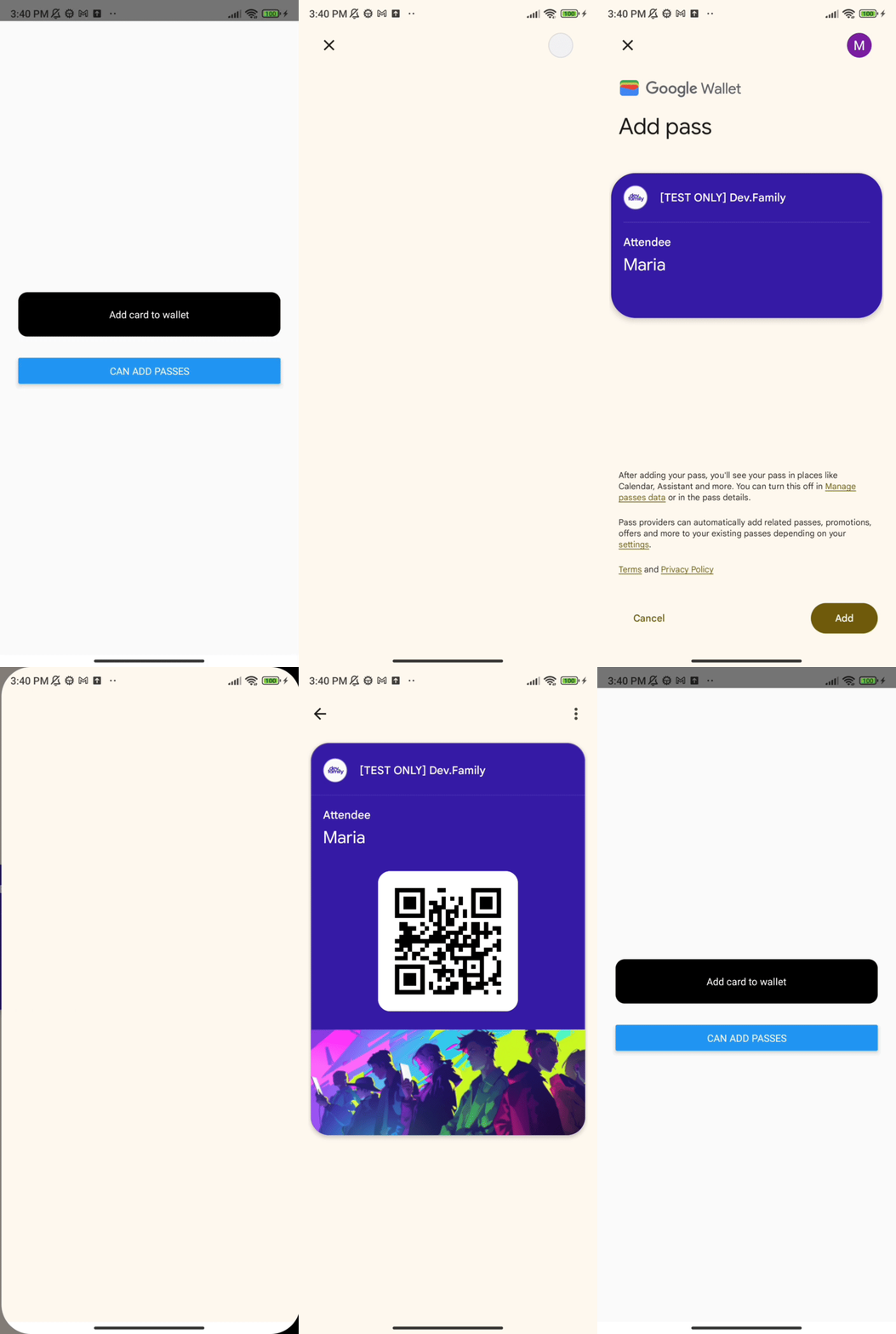
This library provides integration with both Apple Wallet on iOS and Google Wallet on Android. It allows you to add, remove, and check for existing passes on iOS, and add passes to Google Wallet on Android.






|  |
|  |
| :-------------------------------------------------------------------------------------------------------------------------------: | :--------------------------------------------------------------------------------------------------------------------------------------------------------: |
| iOS | Android |
|
| :-------------------------------------------------------------------------------------------------------------------------------: | :--------------------------------------------------------------------------------------------------------------------------------------------------------: |
| iOS | Android |
Installation
- react-native-wallet-manager V2 requires the new architecture/TurboModules to be enabled
- iOS 13.0 or later
- for old architecture please use react-native-wallet-manager V1.1.3
native module NativeWalletManager not found, the New Architecture is disabled in the app (the default before React Native 0.76). Enable it and rebuild the app:
- Android: set
newArchEnabled=trueinandroid/gradle.properties - iOS: run
RCT_NEW_ARCH_ENABLED=1 bundle exec pod installin theiosfolder
yarn add react-native-wallet-manageror
npm install react-native-wallet-managerSetup
iOS
To enable the Wallet functionality on iOS, you need to add the Wallet capability in Xcode. Follow these steps:
- Open your project in Xcode (
xcworkspacefile).
- Select your project Target.
- Go to the Signing & Capabilities tab.
- Click on + Capability to add a new capability.
- In the search bar, type Wallet and add it to your project.
ios folder in your project directory and run the following command to install necessary dependencies:
cd ios && pod installAndroid
No extra setup is needed. The library already depends on com.google.android.gms:play-services-pay. The device needs Google Play services and a Google account to save passes.
Usage
For platform-specific instructions on how to create passes:
- iOS: For a detailed guide on creating Apple Wallet pkpasses visit this Medium article.
- Android: You can find a detailed guide on creating passes for Google Wallet at this Google Codelab.
import WalletManager from 'react-native-wallet-manager';API
| Method | Parameters | iOS | Android |
| ---------------------------------------------------------------------------------------------------------------------------------- | -------------------------------------------------- | --- | ------- |
| canAddPasses() | None | ✅ | ✅ |
| addPassToGoogleWallet(jwt: string) | jwt: string | ❌ | ✅ |
| addPassFromUrl(url: string, headers?: Record | url: string, headers?: Record | ✅ | ✅ |
| [addPassesFromUrls(urls: string[], headers?: Record](#addpassesfromurlsurls-string-headers-recordstring-string) | urls: string[], headers?: Record | ✅ | ❌ |
| hasPass(cardIdentifier: string, serialNumber?: string) | cardIdentifier: string, serialNumber?: string | ✅ | ❌ |
| removePass(cardIdentifier: string, serialNumber?: string) | cardIdentifier: string, serialNumber?: string | ✅ | ❌ |
| viewInWallet(cardIdentifier: string, serialNumber?: string) | cardIdentifier: string, serialNumber?: string | ✅ | ❌ |
| showAddPassControllerFromFile(filePath: string) | filePath: string | ✅ | ❌ |
Notes
All methods return a Promise that resolves with the result of the operation or rejects if an error occurs.
On a platform where a method is not supported (❌ in the table), the promise rejects with an Error that has no code.
Only one request can add passes at a time. While addPassFromUrl, addPassesFromUrls, addPassToGoogleWallet or showAddPassControllerFromFile is downloading passes or showing the Wallet sheet, another call to addPassFromUrl, addPassesFromUrls or addPassToGoogleWallet rejects with ADD_PASS_IN_PROGRESS, and showAddPassControllerFromFile resolves with false.
The headers of addPassFromUrl and addPassesFromUrls are sent with every request, to every URL in the list. Pass an Authorization header only for URLs that should receive it. Header values should be strings. A number or boolean value is sent as text, other values such as null are skipped. On iOS, a pass is always downloaded again, the local cache is not used.
Access to passes (iOS)
hasPass, removePass and viewInWallet only see passes whose pass type identifier is allowed by the app's Wallet capability. By default the capability allows all pass types of your team. Passes of other teams are not visible to the app. Adding a pass does not depend on this.
Error codes
Rejected promises carry an error with a code. The WalletErrorCode type covers every code below except the Android-only RESULT_CANCELED, UNKNOWN_ERROR and ERROR.
| Code | Platform | Meaning |
| ---------------------- | ------------ | ------------------------------------------------------------------------- |
| INVALID_URL | iOS, Android | The URL cannot be parsed or has no scheme, or the list of URLs is empty. |
| NETWORK_ERROR | iOS, Android | The request failed. |
| HTTP_ERROR | iOS, Android | The server responded with a status outside 200–299. |
| ADD_PASS_IN_PROGRESS | iOS, Android | Another pass is being added. |
| USER_CANCELLED | iOS | The Apple Wallet sheet was closed without adding the passes. |
| PASS_ALREADY_EXISTS | iOS | The pass, or every pass of a bundle or URL list, is already in Wallet. |
| INVALID_PASS | iOS | The data is not a valid .pkpass or contains no valid pass in a bundle. |
| INVALID_DATA | iOS | The response has no body. |
| NO_VIEW_CONTROLLER | iOS | No view controller is available to show the sheet. |
| CONTROLLER_ERROR | iOS | The Apple Wallet sheet could not be created or shown. |
| RESULT_CANCELED | Android | Google Wallet was closed without saving the pass. |
| NO_ACTIVITY | Android | There is no current activity. |
| API_ERROR | Android | Google Pay API returned an error. |
| GENERAL_ERROR | Android | Saving to Google Wallet failed for another reason. |
| UNKNOWN_ERROR | Android | Google Wallet returned an unexpected result. |
| ERROR | Android | canAddPasses could not check the availability of the Google Wallet API. |
canAddPasses()
Checks if the device can add passes to the wallet. This method is supported on both iOS and Android.
Example
const canAddPasses = async () => {
  try {
    const result = await WalletManager.canAddPasses();
    console.log(result);
  } catch (e) {
    console.log(e);
  }
};
addPassToGoogleWallet(jwt: string)
Adds a pass to Google Wallet. This method is only supported on Android.
Parameters
jwt(string): The JWT token containing the pass information to be added to Google Wallet.
RESULT_CANCELED when Google Wallet is closed without saving.
_Note:_ In the example below, you'll see a placeholder for the JWT. You need to generate a valid Google Wallet JWT for testing purposes.
Example
const addPassToGoogleWallet = async () => {
  try {
    await WalletManager.addPassToGoogleWallet(
      'eyJhbGciOiJSUzI1NiIsInR5cCI6IkpXVCJ9...'
    );
  } catch (e) {
    console.log(e);
  }
};
addPassFromUrl(url: string, headers?: Record)
Adds a pass from a specified URL. This method is supported on both iOS and Android.
- On iOS, it downloads the pass and shows the Apple Wallet sheet to add it. The promise resolves with
trueonce the pass is added. It rejects withUSER_CANCELLEDif the sheet is closed and withPASS_ALREADY_EXISTSif the pass is already in Wallet. - On Android, the response body must be a Google Wallet JWT. It is passed to Google Wallet, and the promise resolves and rejects the same way as in
addPassToGoogleWallet. It resolves with the message string, although the TypeScript type isPromise.
Parameters
url(string): The URL of the pass. On iOS it is a.pkpassfile or a.pkpassesbundle, on Android it returns a JWT.headers(object, optional): HTTP headers sent with the request, for example for authentication.
Pass bundles (iOS)
A .pkpasses bundle with several passes is shown in a single Apple Wallet sheet, which adds all of them at once. For several .pkpass URLs see addPassesFromUrls. Passes that are already in Wallet are left out of the sheet. The promise resolves with true after the passes are added and rejects with USER_CANCELLED if the sheet is closed. It rejects with PASS_ALREADY_EXISTS only when every pass of the bundle is already in Wallet, and with INVALID_PASS when no pass in the bundle can be read.
A bundle is a ZIP archive of .pkpass files, stored or deflated, ZIP64 included. Other files, entries that cannot be read and duplicate passes are skipped. Encrypted archives are not supported.
URLs
INVALID_URL means the URL cannot be parsed or has no scheme. On iOS, characters that are not allowed in a URL, such as spaces, are percent-encoded.
Examples
const addPass = async () => {
  try {
    const result = await WalletManager.addPassFromUrl(
      'https://github.com/dev-family/react-native-wallet-manager/blob/main/example/resources/pass.pkpass?raw=true'
    );
    console.log(result);
  } catch (e) {
    console.log(e);
  }
};
const addPassWithAuth = async () => {
  try {
    const result = await WalletManager.addPassFromUrl(
      'https://example.com/passes/ticket.pkpass',
      { Authorization: 'Bearer <token>' }
    );
    console.log(result);
  } catch (e) {
    console.log(e.code, e.message);
  }
};
addPassesFromUrls(urls: string[], headers?: Record)
Downloads several passes and shows them in a single Apple Wallet sheet, which adds all of them at once. Use it when the passes come as separate .pkpass files, for example one per ticket. This method is supported on iOS only. On Android, several passes are added with one JWT through addPassToGoogleWallet or addPassFromUrl.
Every URL is downloaded in parallel with the same headers and can return a .pkpass file or a .pkpasses bundle. A repeated URL is downloaded once. Duplicate passes and passes that are already in Wallet are left out of the sheet. The promise resolves with true after the passes are added and rejects with USER_CANCELLED if the sheet is closed, with PASS_ALREADY_EXISTS if every pass is already in Wallet and with INVALID_URL if the array is empty or one of the URLs is invalid. If a download fails (NETWORK_ERROR, HTTP_ERROR or INVALID_DATA), the other downloads are cancelled, the promise rejects with the error of the download that failed first and the sheet is not shown. If every download succeeds but one of them contains no valid pass, the promise rejects with INVALID_PASS. An error of a single URL names it by its position in the array, for example URL 2: HTTP 404.
Parameters
urls(string[]): The URLs of the passes.headers(object, optional): HTTP headers sent with every request, for example for authentication.
Example
const addTickets = async (urls) => {
  try {
    const result = await WalletManager.addPassesFromUrls(urls, {
      Authorization: 'Bearer <token>',
    });
    console.log(result);
  } catch (e) {
    if (e.code === 'USER_CANCELLED') {
      return;
    }
    console.log(e.code, e.message);
  }
};
hasPass(cardIdentifier: string, serialNumber?: string)
Checks if a pass with a specific identifier exists in the Apple Wallet. This method is only supported on iOS.
The promise resolves with true if a matching pass is found and false otherwise. See Access to passes.
Parameters
cardIdentifier(string): The pass type identifier,passTypeIdentifierinpass.json.serialNumber(string, optional): The serial number of the pass. This parameter is optional and can be used to further specify the pass.
Example
const hasPass = async () => {
  try {
    const result = await WalletManager.hasPass('pass.family.dev.walletManager');
    console.log(has pass: ${result});
  } catch (e) {
    console.log(e, 'hasPass');
  }
};
removePass(cardIdentifier: string, serialNumber?: string)
Removes a pass with a specific identifier from the Apple Wallet. This method is only supported on iOS.
The promise resolves with true if a matching pass was removed and false if none was found. Only the first matching pass is removed, so pass serialNumber when several passes share the pass type identifier. See Access to passes.
Parameters
cardIdentifier(string): The pass type identifier,passTypeIdentifierinpass.json.serialNumber(string, optional): The serial number of the pass. This parameter is optional and can be used to further specify the pass.
Example
const removePass = async () => {
  try {
    const result = await WalletManager.removePass(
      'pass.family.dev.walletManager'
    );
    console.log(remove pass: ${result});
  } catch (e) {
    console.log(e, 'removePass');
  }
};
viewInWallet(cardIdentifier: string, serialNumber?: string)
Opens a pass with a specific identifier in Apple Wallet. This method is only supported on iOS.
The promise resolves with true if a matching pass is found and false otherwise. See Access to passes.
Parameters
cardIdentifier(string): The pass type identifier,passTypeIdentifierinpass.json.serialNumber(string, optional): The serial number of the pass. This parameter is optional and can be used to further specify the pass.
Example
const viewPass = async () => {
  try {
    const result = await WalletManager.viewInWallet(
      'pass.family.dev.walletManager'
    );
    console.log(result);
  } catch (e) {
    console.log(e, 'error Viewing Pass');
  }
};
showAddPassControllerFromFile(filePath: string)
Displays a view controller to add a pass using the data from the specified file path. This method is only supported on iOS.
The promise resolves with true as soon as the file is read, before the pass is parsed. It resolves with false when the file cannot be read or another pass is being added. It does not report whether the pass was added.
Parameters
filePath(string): The path to a.pkpassfile or a.pkpassesbundle. All passes of a bundle are shown in a single Apple Wallet sheet.
Example
const showAddPassControllerFromFile = async (filePath) => {
  try {
    const result = await WalletManager.showAddPassControllerFromFile(filePath);
    console.log(File was read: ${result});
  } catch (e) {
    console.error('Error displaying pass view controller:', e);
  }
};
Project inspired by react-native-wallet
Contributing
See the contributing guide to learn how to contribute to the repository and the development workflow.
License
MIT