
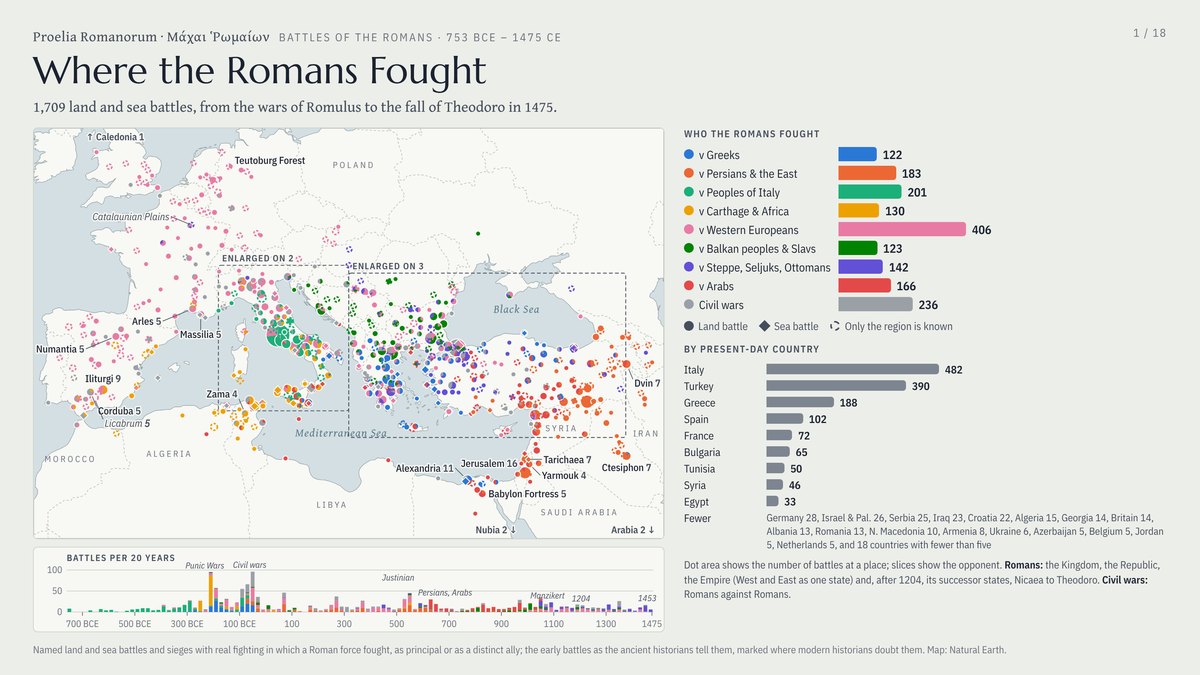
What counts as a battle
A named land or sea battle in which a Roman force fought, as a principal belligerent or as a distinct allied force: one with its own name in the ancient and medieval historians or the standard modern works, or in English Wikipedia's battle lists and campaign boxes. Sieges count when there was real fighting (assaults, sorties, relief battles); a distinctly named battle inside a siege is its own entry. Left out: unnamed skirmishes, massacres without a battle, captures and surrenders without fighting, and legends. When in doubt an entry is kept and marked borderline, with the reason: 649 entries, most of them minor.
Who counts as Roman
The Roman Kingdom, the Republic and the Empire, West and East as one state (the western court to 480, the eastern throughout), and after 1204 every Roman successor state: Nicaea and the empire it restored at Constantinople (1261–1453), Epirus, Thessalonica (1224–46), Trebizond (1204–1461), the Morea (1349–1460) and Theodoro in the Crimea (to 1475). Client kings and allies (Pergamon, Rhodes, the Numidian kings, the Ghassanids, the federates) are not Rome; Romans in foreign service do not make a battle Roman.
Traditional battles
The battles of the kings and the early Republic are included as the ancient historians tell them, and 94 battles known only from a tradition that modern historians doubt are marked traditional, each with the reason. Most are the battles of 753–391 BCE: they rest on Livy, Dionysius of Halicarnassus and Plutarch, who wrote centuries later from the annalists, and Livy himself says that most records of early Rome perished when the Gauls burnt the city (6.1). Others are victories that Livy took from annalists who invented or inflated them (the Scipios in Spain, 215–214 BCE), and a few medieval battles known only from much later chronicles (the early Ottoman traditions of 1284–1303).
Civil wars
Battles with Roman forces on both sides, 236 in all, are mapped and listed, in grey, with the factions (Caesar and the Pompeians, Constantine and Maxentius, John VI Kantakouzenos and the regency), but not scored. Foreign armies in a Roman civil war count as allies. Palmyra under Zenobia is counted as an opponent; the battles of the Gallic emperors are civil wars.
Colours and dots
Each battle takes the colour of its main opponent: Greeks, Persians and the East, peoples of Italy (Latins, Etruscans, Samnites, the Italian allies, the slave revolts), Carthage and Africa (with Numidia, Mauretania and the Moors), Western Europeans, Balkan peoples and Slavs (Illyrians, Thracians, Dacians, Bulgaria, Serbia, the Rus'), steppe peoples, Seljuks and Ottomans, and Arabs (the caliphates and emirates, the Fatimids and Hamdanids); grey for civil wars. Each place is drawn as a small pie: its area grows with the number of battles there, and the slices give the number against each opponent.
Wins, draws and losses
The victor is the side that won on the battlefield: it held the field, routed the enemy, took the city or destroyed the fleet; strategic outcomes and disagreements between the sources are in the notes. In a siege the besieger wins if the place fell and the defender if the siege was raised. A draw is an indecisive battle, or one that both sides claimed with no clear verdict from modern scholarship.
The Roman armies
For every battle the research recorded who fought on the Roman side: the contingents as the sources give them (legions and allies, themes and tagmata, federates and mercenaries), their main languages, and an estimate of the share of Greek speakers, with its basis and a confidence. Where the sources say nothing, the estimate rests on where that army was recruited in that period, and the record says so: 1,061 of the 1,709 estimates are of low confidence.
Research
Twenty-one research batches by period, each following the same written rules and citing its sources battle by battle; then twelve coverage and fact-check passes against the Wikipedia lists and war articles, which added 123 battles, corrected 129 fields and removed 7 entries (listed under Left out); then checks of names, of possible doubles and of every position against the present-day country. Positions: 586 known, 812 approximate, 311 only within their region.
The images
The 18 images were made for X in the house style of the series, 3200 × 1800 pixels: the overview map with the number of battles per 20 years, Italy with Rome and Latium, the Balkans, Anatolia and the East with Constantinople, the win-draw-loss tables, and the list in fourteen parts.