

ConnectOnion
The agent CLI harness. CLI is all you need.
One command line, co, gives your AI agent the accounts and tools it works with:
Gmail and Outlook, a logged-in browser, your files, chat apps and other agents.
co rem enables decentralized context flow: connect the context in your
work, keep it on your machine, and carry it into the next task.
Identity & memory


Mail, calendar & notes


Chat apps


Browser & files


Issues & feedback


Coding agents


Models


Agents & servers


Every command · co commands lists them all.
co rem — decentralized context flow
Your context, connected and ready for the next task. co rem connects context from your mail and coding sessions in local, linked Markdown pages. People, projects, skills and decisions stay connected to their sources, so you and your agents can follow the evidence and reuse that context.
The context lives on your machine, where your tools and agents can read it. Memory keeps it available over time; the goal is to keep context flowing through your work.
Explore co rem → · Try the sample reader · Setup and source controls

*The 1.9.0a20 reader with invented example data. The linked sample is a frozen notebook you can explore without connecting an account.*
- Connect scattered context. Bring mail and coding sessions into linked
- Follow the evidence. Trace facts, decisions and changes back to their
- Keep context in your hands. Local Markdown pages can be read by you and
Try co rem · 1.9.0 preview
co rem is in the opt-in preview. Start with the setup guide for account setup, source choices and model costs. Daily scheduling currently requires macOS. Then run:
pip install --upgrade 'connectonion==1.9.0a22'
co rem init                # build your map and first pages
co rem open                # read the local notebook
co rem start               # approve a daily schedule (macOS)
Pages stay in ~/.co/rem. Selected source content is sent to the configured
model during investigation; see source controls and costs.
For access from another device, co rem open --live opens your online
co ai Host at https://chat.openonion.ai//rem, for the Host owner only.
Install and start
pip install connectonion   # Python 3.10+
co init                    # your identity and ~/.co/keys.env
co auth microsoft          # or: co auth google
co outlook                 # or: co gmail
co commands                # everything else; add --help to any
The Quick start guide covers Google, the browser, chat apps and project settings.
Your tools, one command line
Use Gmail, Outlook, your browser, files and chat apps from the same co
command. Your agent discovers each tool through --help when it needs it.
How the CLI works
CLI is all you need
An agent's work lives in many places: your inbox, your calendar, a chat
thread, a web page behind a login, a file on the NAS, an issue tracker, its own
notes, another agent. **ConnectOnion strings all of that context together with
one command line, co.** The agent reads a thread with one command, looks
something up with the next, and writes the answer with a third. Every step is
a line in its shell, and the output of one is the input of the next.
Why a command line, and not MCP or a plugin per tool
- Every agent already has one. Claude Code, Codex, Cursor and any agent you
- It costs no context until it is used. Tool schemas sit in an agent's
co lists the groups, co gmail --help explains one, and only the page
the agent opens enters its context.
- The help page is the prompt. Each
--helpsays what the command does,
co audit).
- Every answer names the next step. A list ends with how to open the first
Next: co auth microsoft, a typo ends with
the command you meant. The agent recovers without asking you.
- It composes. Commands pipe into each other and into scripts, and the
$ co                       # every command group
$ co linear --help         # what it does, what it changes, an example
$ co linear issues -n 3
3 open issues
CON-3  Todo  No priority  -  2026-10-01  Import your data
CON-1  Todo  No priority  -  2026-10-01  Get familiar with Linear
CON-4  Todo  No priority  -  2026-10-01  Set up your teams
Next: co linear issue CON-3
MCP becomes a command too
MCP servers are useful; the protocol is not the problem, the interface is.
co mcp (coming next, #2048)
puts any MCP server behind the same command line: co mcp tools
lists its tools, co mcp help renders a tool as a help page,
and co mcp call runs it. The agent finds MCP tools the way it finds
everything else, through --help, and none of them sit in its prompt.
Credentials stay on your machine, in ~/.co/keys.env or encrypted with
co env set … --secret. Writes that matter preview until --yes, and in
co ai a risky tool call waits for your approval.
See the CLI in action
Watch the 43-second film — real runs from co 1.8.10.
See search, Linear, Slack, Canny and audit examples
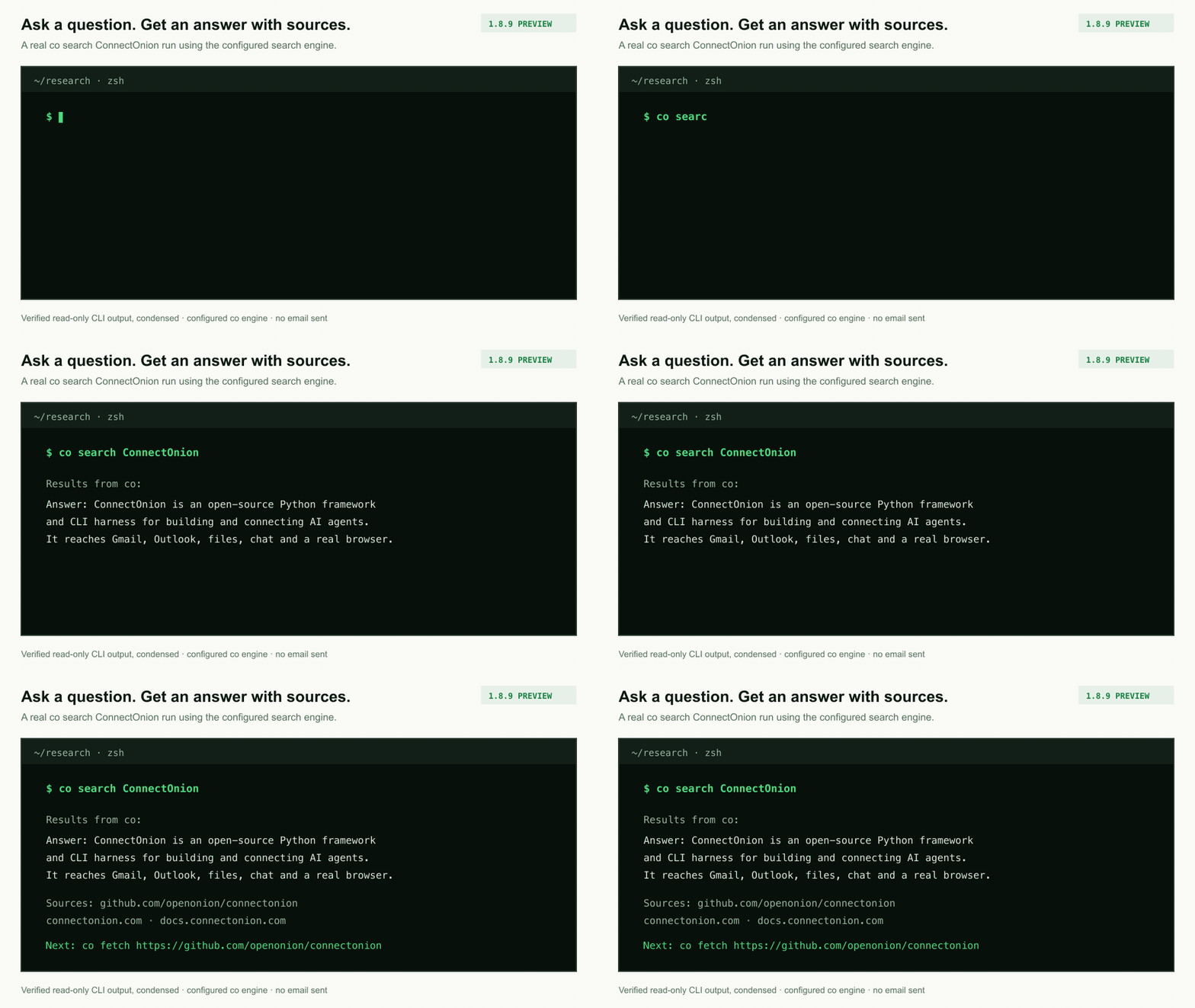
co search ConnectOnion answers from the web and cites its sources. The default
engine uses your own search key, then ConnectOnion credits;
--engine ddg is free.

List your Linear issues, then create one. The create shows a preview and changes nothing until --yes.

Search Slack, then read the whole thread. Each message carries the id that co slack send --reply-to takes.

Your most-voted Canny requests, and a status change you preview before voters hear about it.

co audit scores a CLI's help pages the way an agent reads them. CI runs it on every co page, and it works on any other CLI too.
Use it from Claude Code, Codex or Cursor
Nothing to install into them: ask your coding agent to "use co to check my
Outlook inbox" and it reads co commands and co outlook --help before it
acts. co skills link also links ConnectOnion's skills into Claude Code and
Codex (co skills).
ConnectOnion is also a Python framework for building your own agents on the same harness; see the documentation.
Project
Stable 1.8.10 is what pip install connectonion installs; 1.9.0 previews
carry new features first (release channels,
release notes).
Questions go to Discussions
or the Discord linked above, bugs to Issues.
Contributing · Code of Conduct ·
Security (report vulnerabilities privately) ·
Apache-2.0.