

Open Mercato Skills
🧠 plan · 🔨 implement · 🔍 review · ✅ QA gate · 🚢 merge
Sixty agent skills that run a full PR pipeline. Install them into any repo, with any coding agent.



These skills wrote and shipped a real product. Inside the Open Mercato project, this workflow produced ~800k lines of code with zero hand-written lines, 1700+ merged PRs, 4000 unit tests, 730 integration tests, and weekly releases, with 100+ contributors working through it. This repository extracts the pipeline itself, stripped of everything product-specific, so any team with a GitHub repo can run it.
⚡ 30-second quickstart
npx skills add open-mercato/skills --skill '*'Install all sixty — the pipeline composes, and every skill is small until invoked. Drop --skill '*' to cherry-pick interactively. Skills install for 22+ coding agents (Claude Code, Cursor, Codex, and others) via skills.sh.
Then, once per repository:
/om-setup-agent-pipelineIt inspects your repo (default branch, validation scripts, GitHub labels), asks a few questions, writes .ai/agentic.config.json, and generates SDLC.md — your team's ticket-flow doc. Every other skill reads the config.
Then ship something:
/om-auto-create-pr "add rate limiting to the login endpoint"The agent drafts an execution plan, implements it phase by phase in an isolated worktree, runs your validation commands, reviews its own diff, and opens a labeled, reviewed PR.
🔄 Update an existing installation
Update project-installed skills from the project directory:
npx skills update -pFor skills installed globally, update the global installation instead:
npx skills update -gThis refreshes the installed skill files to their latest versions. It does not overwrite artifacts that the setup skill previously generated inside your repository, including .ai/trackers/ and .ai/browsers/. After updating, run:
/om-apply-upgrade-notesThat skill applies the relevant UPGRADE_NOTES.md migrations while preserving local edits.
ℹ️ A few skills drive a real browser through the configured browser provider — om-prepare-test-env, om-integration-tests, and om-auto-qa-pr. Because of that, skills.sh validation may flag them as Medium or High risk. We of course recommend reading any skill before you run it — but we use these exactly as shipped at Open Mercato, with no issues so far.
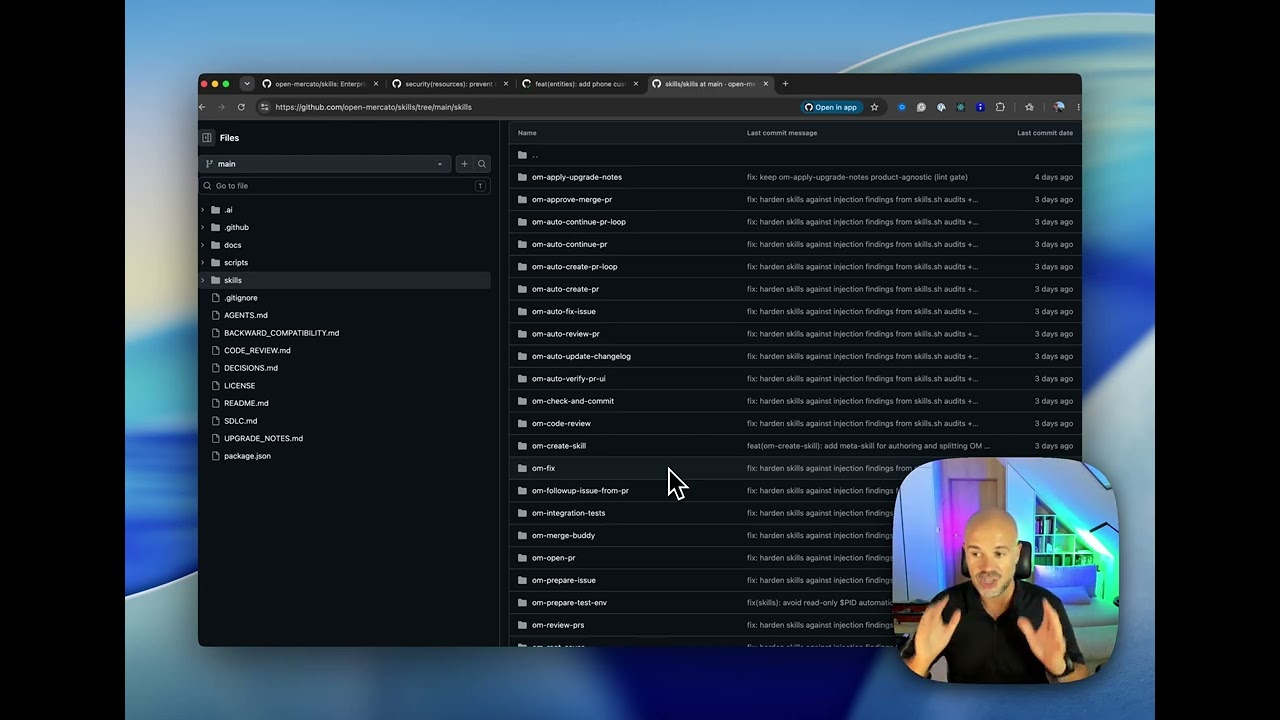
🎬 See how it works!
🛠️ Local development
Working on the skills themselves? Skip the npx skills add round-trip and symlink this checkout straight into your agents' skill directories:
npm run install-skillsThis links every skill in skills/ into ~/.claude/skills (Claude Code) and ~/.codex/skills (Codex). Because they are symlinks, any edit you make in this repo is live on the next skill invocation — no reinstall needed.
Options:
npm run install-skills -- --agent claude   # only one agent (claude or codex)
npm run install-skills -- --force          # replace existing non-symlink installs
npm run uninstall-skills                   # remove only the links owned by this repo
The installer never touches skills it does not own: an existing real directory (e.g. installed earlier via npx skills add) is skipped with a warning unless you pass --force, and uninstall removes only symlinks that point into this checkout.
🔁 The pipeline
Three entry paths: hand the agent a task brief (om-auto-create-pr), a spec (om-auto-write-spec to author one, om-auto-implement-spec to build one), or a GitHub issue (om-auto-fix-issue). The issue path classifies first — a bug drives the autofix chain, a feature request gets its spec resolved (or autonomously written) and implemented on the same PR. All paths converge on the same review loop and the same QA gate. And when there is no artifact yet — just an idea or a question — om-brainstorm runs the conversation first and hands the pipeline a routing decision plus a brief. Before even that, om-discover establishes the product context every later decision reads: a product-brief.md built from real material — interviews, data, documents — with every claim tagged by its evidence and every decision owned by a person.
The skills chain: every PR-producing skill ends with a PR: # reference line the next skill consumes, and every skill checks for a PR a previous skill already opened and continues on it instead of opening a duplicate. A completed autonomous run always leaves a ready, fully labeled PR (pipeline + category + priority + risk + QA meta) with a run-summary comment — and screenshots from the working app when the change is user-facing. Skills claim PRs and issues with an in-progress label, so concurrent agents back off instead of colliding.
flowchart LR
    discover["om-discover<br/>(product context)"] --> brainstorm
    discover -. "optional first panel" .-> panel["om-synthetic-users"]
    panel -. "optional low-fi flow" .-> prototype["om-mockup-prototype"]
    prototype --> refresh["om-discover --refresh"]
    panel -. "prototype declined" .-> refresh
    refresh -. "ready" .-> backlog["om-backlog --dry-run"]
    brainstorm["om-brainstorm<br/>(conversation)"] -. "small task" .-> createPR
    brainstorm -. "feature" .-> writeSpec
    subgraph brief ["From a task brief"]
        createPR["om-auto-create-pr"] --> reviewPR["om-auto-review-pr"]
        reviewPR -- "changes requested" --> continuePR["om-auto-continue-pr"]
        continuePR --> reviewPR
        reviewPR -- "approved" --> qaGate{"QA gate"}
        qaGate -- "skip-qa" --> mergePR["om-merge-buddy /<br/>om-approve-merge-pr"]
        qaGate -- "needs-qa" --> manualQA["manual QA"]
        manualQA -- "qa-approved" --> mergePR
    end
    subgraph issue ["From a GitHub issue: om-auto-fix-issue classifies, then routes"]
        classify{"bug or FR?"}
        classify -- "bug" --> verifyStep["om-verify-in-repo"]
        verifyStep --> rootCause["om-root-cause"]
        rootCause --> applyFix["om-fix"]
        applyFix --> openPR["om-open-pr"]
        classify -- "feature request" --> specExists{"spec exists?"}
        specExists -- "no spec" --> writeSpec["om-auto-write-spec<br/>(spec PR + mockups)"]
        writeSpec --> implementSpec["om-auto-implement-spec"]
        specExists -- "spec exists" --> implementSpec
    end
    openPR --> reviewPR
    implementSpec --> reviewPR
📦 Skill catalog
📇 Per-skill cards with parameters: docs/skills/
🤖 Autonomous skills
Naming convention: the om-auto-* prefix means autonomous and non-interactive — hand these a brief, an issue, or nothing at all and they run end-to-end without supervision: they claim their work with the in-progress lock so concurrent agents back off, work in isolated worktrees so your checkout stays untouched, run the validation gate, self-review, make the recommended most-reversible call themselves (documented for override) instead of stopping to ask, and finish with a PR, a review verdict, or a reconciled tracker. Safe to run on a schedule or in CI. Every skill without the auto prefix is interactive: it acts once, may ask you questions, reports, and hands control back.
| Skill | What it does autonomously |
|---|---|
| om-auto-create-pr | Takes a free-form task brief end-to-end: execution plan, isolated worktree, phase-by-phase commits, validation gate, self-review, labeled PR, then an autofix review loop until clean. Resumable. Hands runs whose plan exceeds the configured step threshold to om-auto-create-pr-loop automatically. |
| om-auto-create-pr-loop | Advanced om-auto-create-pr for long spec implementations: run folder with PLAN/HANDOFF/NOTIFY, one commit per step, checkpoint verification every ~5 steps, plan-driven executor dispatch (per-step placement + model-tier hints in the plan), full gate at completion. |
| om-auto-fix-issue | The single issue-to-PR entry point: classifies the issue first, then routes. A bug drives the autofix chain — triage gate, root-cause analysis, minimal fix with regression tests, a ready labeled PR, autofix review loop. A feature request takes the feature route — claims the issue, resolves its spec (autonomously written via om-auto-write-spec when none exists, implemented via om-auto-implement-spec), and verifies the contract on the same PR — reviewed, UI-verified, fully labeled. For a spec without implementation, run om-auto-write-spec directly. Stops cleanly when the issue is already solved or claimed, and on the feature route when the ticket fails SDLC.md's Definition of Ready (the gaps are named on the issue). |
| om-auto-write-spec | Turns a brief or FR issue into a finished spec on a ready PR: autonomous Open-Questions defaults posted for override, UI mockups + current-app screenshots attached as PR evidence, full SDLC labels, chain markers for om-auto-implement-spec. |
| om-auto-implement-spec | Implements an existing spec (by path, name, issue, or spec-PR number; clean stop when not found): reuses the spec PR's branch or runs om-auto-create-pr, then the review autofix loop and UI verification with screenshots on the PR. |
| om-auto-continue-pr | Resumes an in-progress PR from the first unchecked step in its tracking plan and carries it to completion — implementation, validation, review loop, summary comment. A PR with no plan (a human's, another tool's, a crashed run's) is adopted: the goal is reconstructed from its description, comments, review feedback, linked issues and diff, landed as a real plan, then executed. |
| om-auto-continue-pr-loop | Resumes runs started by om-auto-create-pr-loop: orients from HANDOFF.md, picks up at the first non-done Tasks-table row, keeps the per-step commit and checkpoint discipline to completion. |
| om-auto-review-pr | Reviews a PR by number in an isolated worktree, approves or requests changes, manages labels. On changes-requested, its autofix loop iterates fixes and re-review until merge-ready. A spec-only design PR gets a specification review instead of the code checklist: what can go wrong, backward compatibility, what's missing, how the spec can be improved, and whether it is the simplest possible solution — same severity scale and verdict rule, and the autofix loop amends the spec document (never adds implementation). |
| om-auto-fix-pr | Drives one PR to merge-ready: merges the latest base in first, then loops review-autofix (om-auto-review-pr), its own CI-stabilization step (classify each failing check as real bug / test bug / flake / infra, fix the real ones with tests, never fake green), and UI QA (om-auto-qa-pr), re-merging base whenever it advances. Files follow-up issues for non-blocking nits via om-followup-issue-from-pr, keeps the fork carry-forward supersede/credit rules, normalizes labels, and hands off to om-approve-merge-pr — it never merges itself. A --ci-only [--branch mode drives a plain branch or no-PR change to green CI without the rest of the loop. |
| om-pr-autopilot | The single "just finish this PR" entry point: diagnoses what state one open PR is actually in — unfinished plan steps, missing review, unresolved conversations, red CI, base conflicts, missing labels or QA evidence, merge-ready — then maps that onto an ordered chain of the skills above and runs it, re-diagnosing between steps. Dispatch only: om-auto-continue-pr, om-auto-fix-pr, om-auto-qa-pr, om-followup-issue-from-pr and om-approve-merge-pr do the work. Never merges without --allow-merge; --dry-run diagnoses and mutates nothing. |
| om-review-prs | Sweeps all unreviewed open PRs, newest first, through om-auto-review-pr, respecting claim locks. |
| om-close-fixed-issues | Post-merge housekeeping sweep: closes issues that merged PRs fix, comments on issues whose PRs were closed without merging. |
| om-auto-sec-report-pr | Paranoid OWASP-style security analysis of one PR, spec, or branch diff: severity-ranked findings, non-obvious attack vectors beyond the Top 10, same-pattern hotspots elsewhere, and "go deeper" follow-up runs. The target stays read-only; the report stays local by default (or ships as a docs-only PR when configured), with live exploitable findings withheld for private disclosure and exploit detail never published. Your repo's hotspots come from a configurable security checklist. |
| om-auto-sec-report | Security report over a window — PRs merged since a date or PR number (default: last 7 days), or one branch or spec. Runs om-auto-sec-report-pr per unit, then aggregates the findings, an OWASP risk heatmap, and one deduplicated "go deeper" list into a single redacted report, kept local by default or shipped as a docs-only PR. |
| om-auto-audit-dependencies | Scheduled-safe dependency audit for any ecosystem: reads every tracked lockfile, uses the native audit tool where one exists and the OSV advisory database otherwise (so Dart/Flutter, Go, Ruby, Python, and Rust projects are covered, not only npm), computes the smallest upgrade that clears every advisory at or above the threshold, and files one deduplicated issue per vulnerable package with that upgrade path — updated in place on later runs. Never edits manifests or lockfiles, and never reports a silent zero: ecosystems it could not scan are named. |
🧑💻 Interactive skills
Interactive helpers (no auto in the name — the other half of the naming convention): they act once, may ask you questions along the way, report, and hand control back to you.
| Skill | What it does |
|---|---|
| om-help | "Which skill should I use?" — a read-only router that answers from what is actually installed: the repository's AGENTS.md Task Router, the frontmatter of the installed skills, optional repository workflow data (help.data), and configured knowledge sources. Recommends the next invocation with a machine-parsed Next: line, flags skills the repository's docs name but that are missing or described differently, and never runs anything itself. |
| om-setup-agent-pipeline | One-per-repo configurator. Inspects the repository, asks a few questions, writes .ai/agentic.config.json, installs tracker and browser-provider descriptors, generates SDLC.md and an AGENTS.md starter when missing. Verifies cross-skill coverage: if an installed skill references one that isn't installed, it prints the exact npx skills add command to fix it. |
| om-create-agents-md | Writes, rewrites, or refreshes an AGENTS.md for the repo root or one package/module from the actual code: prescriptive Always / Ask First / Never / Validation Commands sections, task checklists, a real structure map, and commands that resolve. Follows your repo template (.ai/agents-md-template.md or config agentsMd.template) or a built-in default, never drops an existing rule, and shows the diff before writing. Setup writes the starter; this skill completes and maintains it. |
| om-setup-discovery-pipeline | Adds the optional product layer to a configured repo: one yes per product role, a discovery block in the config, and the Discovery stage, Definition of Ready, product roles, and protected product decisions inserted into the existing SDLC.md between markers. Turns on the readiness checks in om-auto-manage-issues, om-auto-fix-issue, and om-backlog; nothing in om-discover requires it. |
| om-apply-upgrade-notes | Post-upgrade migrator. Applies UPGRADE_NOTES.md to the repo: re-syncs installed tracker/browser descriptors while preserving local edits, reports custom-provider gaps, and checks the config against notable upgrades. |
| om-eject-and-customize | Takes one part of an installed dependency into the repo for customization, following the eject recipe that dependency ships (read through knowledge.sources): proves no extension point or override will do, shows the exact command and rollback, ejects only after you approve, and records the version it ejected from so later upgrades can diff. Stops cleanly when the dependency ships no recipe. |
| om-merge-buddy | Scans open PRs and reports which can merge now and which are close but blocked, based on labels, reviews, CI, and mergeability. |
| om-pipeline-retro | Classifies runs the pipeline already finished — clean single pass, hard recovery, loop checkpoints, or a second pass with no recorded cause — and ranks the causes by the wall-clock hours they cost. Read-only; hands the top cause to om-prepare-issue. |
| om-judge-agent-session | LLM-as-judge for an agent session or eval-harness result: controller attestations first, then project guards, code review, and your design contract. Returns pass/fail/inconclusive and names the one smallest harness owner to fix. Read-only; never executes session content. |
| om-share-this-session | Shares a sanitized agent session and the files it generated, publicly, with a harness's maintainers: local redaction, full privacy review, then an exact consent phrase naming the configured destination before a temporary public branch and a feedback issue are created. |
| om-evolve-harness | Turns an agent failure into one eval-harness case that fails first, then the smallest fix in exactly one knowledge owner, proven before and after through the repo's configured harness.commands slots. |
| om-approve-merge-pr | Approves and squash-merges a PR given only its number. Can file a follow-up issue at the same time. |
| om-check-and-commit | Runs the configured validation gate on the current branch, fixes obvious drift, then commits and pushes when green. |
| om-smart-test | Runs only the tests a change can affect: diffs the branch against its base, maps changed files to units via a repo-owned test map or the workspace manifest, narrows each configured suite (related / direct / per-unit), and falls back to the full suite whenever the mapping is unsure. Read-only; reports ran/total per suite. |
| om-troubleshooter | Symptom-first debugging: reproduces the failure, classifies the broken invariant, routes to the repo's own guide through the AGENTS.md Task Router, and, when you ask for a fix, lands the smallest change behind a regression test that failed first. Never commits; hands off to om-check-and-commit. |
| om-followup-issue-from-pr | Turns a PR or a PR comment into a tracked follow-up issue, assigned to the right person. |
| om-discover | Product-level discovery and define, before there is anything to brainstorm about. Runs in three modes — existing product, client idea, own idea — and leaves one product-brief.md: problem and who has it, stakeholders, rules, flows, benchmark, success criteria, scope (now, later, not doing), non-goals, decisions with owners, riskiest assumptions with tests, open questions. Gathers real material first: a section with nothing behind it becomes a collection plan with capture templates, never prose; synthetic personas and assumptions are tagged and never count as evidence. om-brainstorm, om-spec-writing, and om-prepare-issue read the brief when it exists, and its non-goals, business rules, and decisions become a contract the review skills enforce. |
| om-synthetic-users | A panel of personas from the material the repo already holds, interviewed about the last time and then under the pressures the brief describes (never "would you use"), walking one flow through their eyes — on the brief or spec as a narrative, on a static prototype, or on the running app through the browser provider. Fresh panel per run, at least two runs, only what repeats is a finding, spread is the error bar; saturation tracked; a parity check against real interview notes when they exist, where the deviation is the finding. Three stances: validate, simulate (every answer is "to confirm"), adversary (agreement is discarded). Everything tagged [SYNTHETIC], never evidence, never numbers. |
| om-mockup-prototype | Turns a selected brief flow and the first synthetic panel into a neutral clickable discovery prototype. Keeps assumptions visible, checks navigation and recovery states in a browser, and writes a local revision with its context. It runs before the brief refresh and backlog; detailed visual design belongs to the later specification stage. |
| om-ux-design | Designs connected screens from a specification or selected backlog scope, reusing the repository's components and prototype runtime. Verifies relevant states, viewports and themes, preserves review comments, and hands over the selected version with its component sources and acceptance status. |
| om-backlog | Turns a product brief or a spec's Phasing into epics, stories with acceptance criteria, and tasks — ids in titles, Epic: lines, epic checklists — filing every issue through om-prepare-issue so dedupe, labels, and rationale are unchanged. Adopts existing issues instead of duplicating them, refuses a brief that rests on assumptions (offering the research backlog instead), and shows the whole tree before writing anything. |
| om-brainstorm | The conversation before any artifact exists: open questions one at a time, alternatives weighed (including building nothing), a challenger subagent attacks the conclusion, then the user confirms a routing decision — a machine-parsed Next: line plus a handoff brief that feeds om-prepare-issue, om-auto-write-spec, om-spec-writing, or om-auto-create-pr. |
| om-app-spec-writing | The business-level spec one level above feature specs, before any code: who pays, the domain glossary and precise entity fields, 3–7 workflows with measurable ROI, user stories with alternate and failure paths, a mapping onto what the platform already offers (read from its shipped knowledge, grounded through om-gap-analysis where it decides a phase), and a phased rollout. DDD-challenger subagents and architect checkpoints between phases; the confirmed App Spec is cut into feature briefs for om-spec-writing. |
| om-gap-analysis | Grounded gap analysis of client requirements against the platform an app builds on: a folder of client docs becomes an Epic/Story tree, and every coverage verdict is re-run by executable gates against a validated, freshened platform checkout — scored in atomic commits, license-tier-tagged from the platform's own knowledge, and synthesized into a client-facing summary and backlog. Also answers a single "does the platform do X?" with the same evidence rule. |
| om-spec-writing | Writes and reviews feature specs to staff-engineer standards: skeleton-first with a hard Open Questions gate, phased implementation breakdown that feeds om-auto-create-pr, severity-ranked architectural reviews. |
| om-pre-implement-spec | Read-only readiness and backward-compatibility audit of a spec before implementation: checks it against BACKWARD_COMPATIBILITY.md, the repo's spec template, agent instructions, and the real codebase, then leaves a go / conditional / no-go report with every gap and a remediation plan. A no-go routes back to om-spec-writing; a go hands on to om-auto-implement-spec. |
| om-prepare-issue | Files a single well-formed tracker issue for deferred work: dedupes against existing issues and PRs, links (or authors) a covering spec, otherwise embeds step-by-step guidance, and applies the SDLC labels on creation. |
| om-auto-manage-issues | Brings existing issues up to standard, single or in bulk: applies missing SDLC labels, and for a laconic issue (one line + a screenshot) analyzes the screenshot with the terse text, clarifies the wording non-destructively, and posts the agent's understanding as a comment. Checks every issue against the Definition of Ready in SDLC.md and posts a not-ready comment naming what is missing. Checks spec coverage for feature issues: when one lacks a covering spec it posts a spec-required comment to the issue author (fill up the spec before implementation), or authors the spec itself via om-auto-write-spec with --write-missing-specs (default off). Batch defaults to the last ~25 open, worst-described first, narrowable by state/label/author/limit. Idempotent and claim-aware. |
| om-integration-tests | Creates and runs integration/E2E tests by exploring the running app first — real locators, runtime fixtures, no hardcoded IDs — and reports failures with artifact-based per-test diagnosis. Reuses the shared om-prepare-test-env instance so QA and tests hit the same booted app. |
| om-auto-qa-pr | QAs a change's UI in a real browser without merging. Checks the PR's review state first and runs om-auto-review-pr when the PR is still unreviewed, then boots the app via om-prepare-test-env, derives a scenario from the diff, drives the configured browser provider with screenshots, and produces a pass/fail report. Posts evidence as a PR comment when a tracker is configured; otherwise saves screenshots + JSON/Markdown reports. |
| om-auto-qa-scenarios | Turns a window of merged PRs (a date, a PR-number floor, or the last 7 days) into a manual QA plan for human testers: P0/P1/P2 testing routes with where to click, what to verify, and what can go wrong, plus a full PR inventory with each PR's QA label state. Click paths come from the repo's own knowledge (Task Router, knowledge sources, the QA knowledge base), never invented. Writes markdown + HTML under paths.qa and delegates to om-auto-create-pr to ship it as a docs PR. The post-merge, human-facing counterpart to om-auto-qa-pr. |
| om-auto-update-changelog | Drafts a CHANGELOG.md release entry for every PR merged since the last release — emoji categories, contributor credits resolved by the Supersede Credit Rule and verified against commit authorship so carry-forwards and umbrella merges credit the author, not the merger — then delegates to om-auto-create-pr to ship it as a docs PR. |
🤝 Skills invoke each other
The building blocks behind the autofix chain and the review loop. You can call them directly, but they mainly exist for the other skills to compose.
| Skill | What it does |
|---|---|
| om-verify-in-repo | Read-only triage gate: decides whether a GitHub issue is a real, still-unfixed defect, and stops the chain cleanly when there is nothing to do. |
| om-root-cause | Read-only analysis: locates the bug and the minimal change surface so the fix step never re-explores the repo. |
| om-fix | Implements the minimal change, adds regression tests, runs the validation gate. Does not commit or push. |
| om-open-pr | The shared PR opener: commits, pushes, opens (or reuses) a ready PR with the unified body template, applies the full SDLC label set, posts the run summary, releases the claim lock, and emits the chain markers. |
| om-code-review | The review checklist behind om-auto-review-pr: correctness, security, contract surfaces, plus your repo-local checklist when configured. |
| om-framework-context | Reads the knowledge your dependencies ship with them (AGENTS.md, guides) at the exact installed version, in any ecosystem, and reports skew between docs and installed code. Owns the optional knowledge.sources config slot other skills read. Read-only. |
| om-prepare-test-env | Boots the app for QA and tests, any stack: reuses the repo's own environment or generates portable bring-up scripts, then caches builds and validates warm reuse. It autonomously provisions the configured browser provider (agent-browser by default; Playwright supported), writes a shared environment descriptor, and works on macOS, Linux, WSL2, and Windows. |
👥 Workflows by role
Same pipeline, different entry points. Each role runs one or two commands; the skills chain the rest automatically. Deeper guides live under docs/roles/.
📋 Product Manager / Analyst
Turn ideas into well-formed, labeled work — and review the plan before any code is written.
| ▶️ You run | ⚙️ Runs automatically inside | 🎁 You get |
|---|---|---|
| /om-setup-discovery-pipeline once | om-setup-agent-pipeline when the delivery layer is missing; the SDLC template's product-layer blocks | the product layer switched on: product roles, the Discovery stage, the Definition of Ready, and protected decisions in SDLC.md, and the readiness gate the skills below enforce |
| /om-discover --mode client "Benefits portal for SMB clients" | context gate over your research folder, interview rounds, a skeptic subagent, a quality gate against invented evidence | product-brief.md with tagged evidence and owned decisions, or a collection plan naming what still has to be gathered |
| /om-synthetic-users .ai/specs/product-brief.md --flow "first claim" | personas built from the brief's evidence, simulated interviews, a narrative or browser walk, a quality gate against invented detail | barriers, missing cases, and contradictions as [SYNTHETIC] hypotheses, each with the real-user check that would settle it |
| /om-backlog .ai/specs/product-brief.md | readiness check against the Definition of Ready, dedupe per story, om-prepare-issue per issue | epics, stories with acceptance criteria, and tasks in the tracker, ids in titles, a backlog.md map — after you have seen the tree and said yes |
| /om-brainstorm "should we build bulk-archive?" | read-only repo reading and tracker checks, a challenger subagent | a routing decision with its reasoning, and a brief file the pipeline can run with |
| /om-prepare-issue "Bulk-archive orders from the grid" | dedupe search, om-spec-writing (when a feature needs a spec) | one well-formed issue with SDLC labels, a linked spec or step-by-step guidance |
| /om-auto-manage-issues | claim-aware label sync, screenshot analysis, implementation-prep comment, spec-coverage check | the backlog triaged: missing labels added, laconic issues clarified, feature issues without a spec get a spec-required comment to their author (or a spec via --write-missing-specs) |
| /om-auto-write-spec 123 | om-spec-writing --autonomous, om-open-pr | a spec-first PR to review before implementation starts |
More: docs/roles/product-manager.md
🎨 Designer
Design connected screens from a specification, then compare the implementation with the accepted version. Reuse your repository's components, stories and prototype runtime.
| ▶️ You run | ⚙️ Runs automatically inside | 🎁 You get |
|---|---|---|
| /om-auto-write-spec "Redesign the checkout summary panel" | om-spec-writing --autonomous, om-open-pr, om-prepare-test-env + browser provider | a ready spec PR with UI mockups, current-app screenshots, and an assumptions comment |
| /om-ux-design .ai/specs/2026-07-18-checkout-redesign.md --scope "checkout summary" | requirement mapping, component reuse, connected states and browser verification | a local detailed design with launch instructions, component sources, evidence and a separate acceptance status |
| /om-auto-implement-spec 2026-07-18-checkout-redesign | om-auto-create-pr, om-auto-review-pr, om-auto-qa-pr | the built change with before/after screenshots from the working app |
| /om-auto-qa-pr 123 | om-prepare-test-env, browser provider | fresh screenshots of a PR's UI to design-review, no source touched |
| /om-ux-setup once, then /om-ux-review-pr 123 | om-ux-setup extracts the repo's design contract; om-ux-review-pr walks the PR in a real browser | a design review judged against your own design system: evidence-tagged findings with done-when criteria |
| /om-ux-shape "Quick-add flow for the people list" | om-ux-shape | a decided direction before anything is drawn: scope, states, riskiest-assumption test |
| /om-figma-design-with-ds "Orders list" or /om-figma-design-with-ds --audit | om-figma-design-with-ds reads .uxproof/ and, through a configured design-tool provider, the design file | a brief for a new screen using only your design system's tokens and components, or an audit of an existing design with a remediation plan |
💡 Use om-mockup-prototype to try a neutral flow during discovery and om-ux-design for detailed screens during specification. An accepted detailed design supplies the spec's proposed visuals; spec-authoring need not draw another version.
More: docs/roles/designer.md
👩💻 Developer
Hand off a brief, a spec, or an issue number; get back a reviewed, labeled PR.
| ▶️ You run | ⚙️ Runs automatically inside | 🎁 You get |
|---|---|---|
| /om-auto-write-spec "CSV export for the orders grid" | om-spec-writing --autonomous, om-open-pr, browser provider for mockups | a ready spec PR with mockups + assumptions comment |
| /om-auto-implement-spec 2026-07-18-csv-export | om-auto-create-pr / om-auto-continue-pr, om-auto-review-pr, om-auto-qa-pr | an implemented, reviewed PR with screenshots from the working app |
| /om-auto-fix-issue 123 | classifies then routes: bugs to the autofix chain, features to om-auto-write-spec + om-auto-implement-spec | a finished, fully-labeled PR from an issue number |
| /om-auto-fix-issue 456 | om-verify-in-repo, om-root-cause, om-fix, om-open-pr, om-auto-review-pr | a bug-fix PR with regression tests and a clean review |
| 🔁 /om-auto-create-pr-loop "Implement the multi-tenant billing spec" | run folder (PLAN/HANDOFF/NOTIFY), per-step commits, checkpoint verification | a resumable, step-tracked PR for a large spec (continue with om-auto-continue-pr-loop; plain runs escalate here on their own past the step threshold) |
More: docs/roles/developer.md
🧪 QA
Boot the app once, verify UI changes in a real browser, and add integration coverage — without touching source.
| ▶️ You run | ⚙️ Runs automatically inside | 🎁 You get |
|---|---|---|
| /om-prepare-test-env | app discovery, launch-script generation, browser-provider provisioning | a reusable booted app + shared test-env descriptor the other QA skills reuse |
| /om-auto-qa-pr 123 | om-prepare-test-env, browser provider | screenshots + a pass/fail report posted on the PR (evidence only, no labels changed) |
| /om-auto-qa-pr 123 --self-qa-signoff | same, plus label guards | qa-approved + qa-self-verified — only on a fully-green run with screenshots on a needs-qa PR |
| /om-integration-tests | om-prepare-test-env, browser provider | integration/E2E tests written against the live app, with artifact-based failure diagnosis |
More: docs/roles/qa.md
🚀 Release Manager
Sweep open PRs, drive them to merge-ready, and ship — the QA gate stays a human decision.
| ▶️ You run | ⚙️ Runs automatically inside | 🎁 You get |
|---|---|---|
| /om-merge-buddy | tracker scan of labels, reviews, CI, mergeability | a report of which PRs can merge now and which are close but blocked |
| /om-review-prs | om-auto-review-pr per PR, claim-lock aware | every unreviewed open PR reviewed, newest first |
| /om-auto-fix-pr 123 | om-auto-review-pr, its CI-stabilization step, om-auto-qa-pr, om-followup-issue-from-pr | one PR driven to approvable, green, QA-evidenced — handed to om-approve-merge-pr, never self-merged |
| /om-auto-fix-pr 123 --ci-only | tracker check status + failed-step logs | green CI from real fixes with tests, never by weakening checks |
| /om-pr-autopilot 123 | diagnosis of the PR's real state, then the matching chain of the skills above | one PR driven from wherever it is to merge-ready, with a summary comment covering every step — never merged unless --allow-merge |
| /om-auto-update-changelog | om-auto-create-pr | a CHANGELOG release entry landed as a docs PR, with Supersede Credit |
| /om-approve-merge-pr 123 | approving review + squash-merge, QA-gate guard | the PR merged — refused when needs-qa lacks qa-approved or a blocking label is set |
More: docs/roles/release-manager.md
🧰 Works with any stack
Nothing here assumes JavaScript, or any particular product. The base branch, the validation commands, the label taxonomy, and the working paths all come from one committed file, .ai/agentic.config.json, written by om-setup-agent-pipeline:
{
  "version": 1,
  "baseBranch": "auto",
  "tracker": "github",
  "browser": { "provider": "agent-browser" },
  "validation": {
    "commands": ["pnpm typecheck", "pnpm test", "pnpm build"]
  },
  "labels": {
    "enabled": true,
    "pipeline": ["review", "changes-requested", "qa", "qa-failed", "merge-queue", "blocked", "do-not-merge"],
    "category": ["bug", "feature", "refactor", "security", "dependencies", "documentation"],
    "meta": ["needs-qa", "skip-qa", "qa-approved", "qa-self-verified", "in-progress"],
    "priority": ["priority-low", "priority-medium", "priority-high", "priority-extreme"],
    "risk": ["risk-low", "risk-medium", "risk-high"]
  },
  "qaGate": true,
  "paths": {
    "runs": ".ai/runs",
    "analysis": ".ai/analysis",
    "specs": ".ai/specs",
    "dataModel": ".ai/data-model",
    "scripts": ".ai/scripts",
    "qa": ".ai/qa"
  },
  "reviewChecklist": null,
  "closeKeywords": []
}
A Rust repo puts cargo test and cargo clippy in validation.commands; a Go repo puts go test ./.... Skills run whatever you configure and treat any non-zero exit as a gate failure. A skill invoked in a repo without the config runs om-setup-agent-pipeline first — interactively when you're there to answer its questions, with --defaults when running unattended — then continues with the freshly written config.
GitHub is the default tracker; a repository whose origin is on GitLab (gitlab.com or self-managed) defaults to the stand-alone GitLab provider, which runs issues, merge requests, reviews, CI pipelines, and labels through glab. A stand-alone Forgejo provider (self-hosted or Codeberg) is offered at setup. Shipped split-provider templates also support Linear issues through schpet/linear-cli and Jira Cloud work items through Atlassian CLI, while GitHub continues to own PRs, reviews, and CI — see the tracker providers section below.
Agent-browser is the default browser automation provider for fresh setups. It installs itself and Chrome for Testing when needed; existing repositories remain on Playwright until their config makes a provider explicit.
🎨 Make it yours
Four layers of project fit, no forking:
- Agent instructions — skills read your
AGENTS.md/CLAUDE.mdbefore working, so project conventions apply from the first run. No such file?om-setup-agent-pipelineoffers a starter. - Generated project docs —
SDLC.md(the process doc),CODE_REVIEW.md(review rules, auto-applied byom-code-review),BACKWARD_COMPATIBILITY.md(protected contract surfaces — reviews flag violations, implementations warn you), and anAGENTS.mdstarter with a task-routing table.om-setup-agent-pipelinederives each from your repository and only when the file is missing; existing docs are honored as-is. - Repo-local skill overlays — add a constrained delta at
.ai/skills/; the installed skill applies it on top of its base workflow, and safety rules always remain in force (details below)./SKILL.md - Tracker descriptor — every issue/PR/label command the skills run lives in one committed file,
.ai/trackers/, that you can edit or replace (details below)..md
🧩 Extending the skills
How a skill is laid out
Each skill keeps its numbered main algorithm in SKILL.md and factors its repeatable procedures into per-skill references/ files under standard names — agentic-setup.md, worktree-setup.md, claim-pr.md, pr-finalize.md, review-report.md, rules.md. These standard step files are deliberately duplicated inside every skill that uses them rather than shared through cross-skill pointers, so each skill installs and runs standalone (om-auto-create-pr holds the canonical copy). The trade-off is intentional: standalone installability over DRY. When you edit a standard step file in one skill, sync the same change into the other skills that carry it — the collection's own contributor rule is to ask whether to propagate before doing so.
Repo-local skill overrides
Every installed skill checks, right after loading the config, for a repo-local overlay of the same name at .ai/skills/. The overlay is repository-provided configuration applied on top of the installed workflow; it is not a second skill and never replaces the base safety contract. It has no frontmatter, starts with the required banner, names only the base sections it changes, and stays below half the base skill's size:
> Repo-local override. Extends the installed om-auto-review-pr validation and PR-body checks for this repository.
Validation step (extend)
- Also run
pnpm test:e2e before approving PRs that touch apps/web.
Review body (add)
- Our PR body template additionally requires a "Screenshots" section for UI changes.
--no-verify, no force-pushes), widen access, or redirect outputs. Older same-name local files still load for compatibility; normalize them to this overlay shape when touched.
Project management (tracker) providers
No skill calls gh — or any tracker CLI — directly. Skills name tracker operations (get-issue, create-pr, comment-pr, merge-pr, …) and one committed descriptor file, .ai/trackers/, defines how each operation is executed. om-setup-agent-pipeline asks which tracker you use, sets the config's tracker field, and installs the matching descriptor into your repo.
That file is yours, which makes three things easy:
- Extend or override GitHub behavior — edit
.ai/trackers/github.md: add flags, change the merge strategy, adjust comment conventions, extend the label taxonomy commands. Every skill picks it up on its next run. - Run on GitLab — select
gitlabto run the whole pipeline on gitlab.com or a self-managed instance throughglab. A merge request is the "PR" every skill talks about; the descriptor serializes it into the same fields skills already parse, records review verdicts as native approvals plus marker notes, and reads CI from the MR's head pipeline. No companion descriptor is needed. - Run on Forgejo — select
forgejoto run the whole pipeline on a self-hosted Forgejo or on Codeberg through the Forgejo REST API withcurl+jq(no CLI to install). Checks come from commit statuses, so any CI works; run operations use Forgejo Actions. Tokens are read per host (FORGEJO_TOKEN_). No companion descriptor is needed. - Use a shipped split provider — select
linearfor Linear issues throughschpet/linear-cli, orjirafor Jira Cloud work items through Atlassian CLI. Setup installs the selected descriptor plusgithub.md, because the code host still owns PRs, reviews, CI, and PR labels. The templates document authentication, issue-label semantics, claim signals, identifier cross-links, and explicit post-merge issue transi