
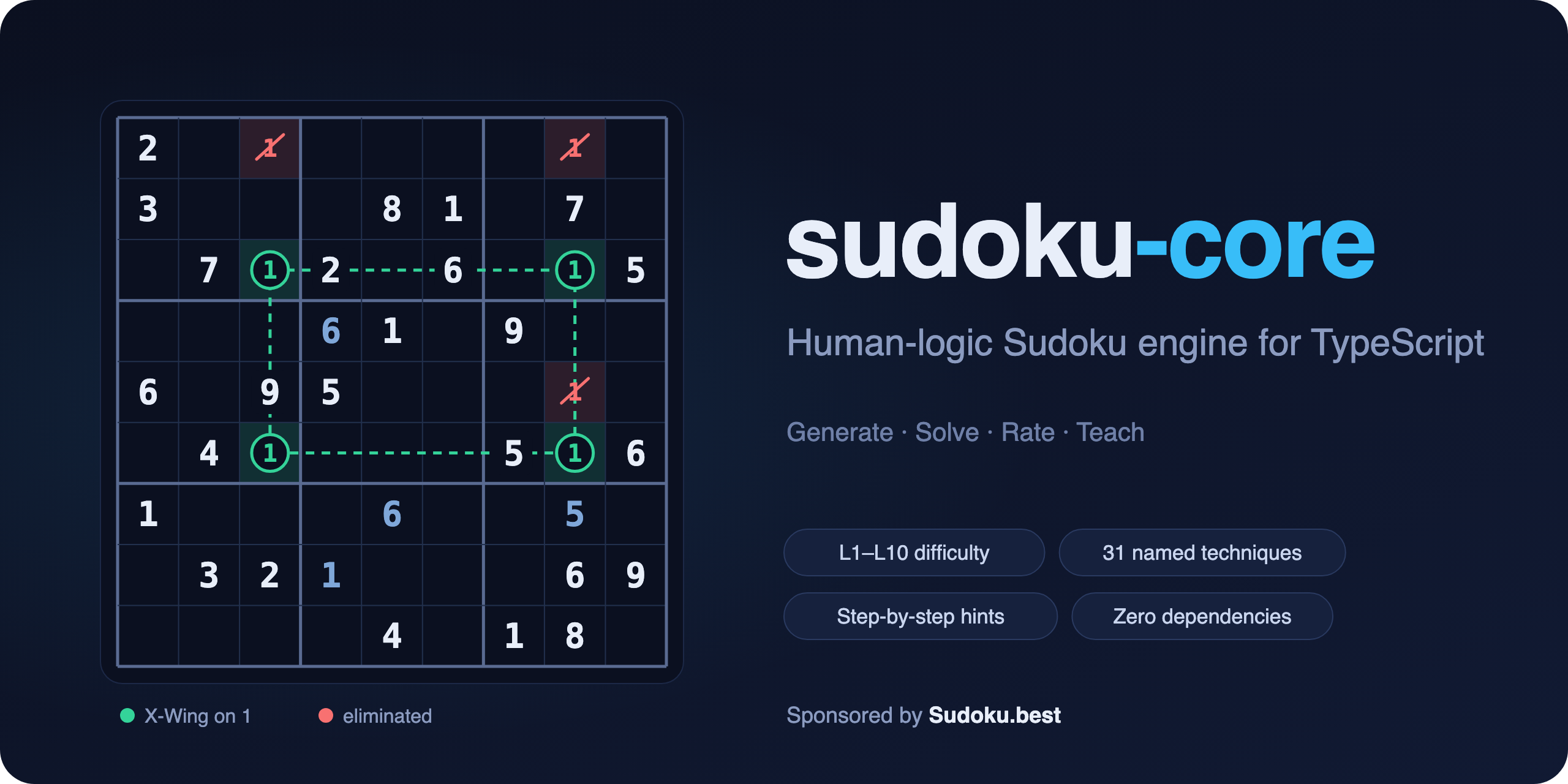
A human-logic Sudoku engine for TypeScript.
Generate unique puzzles across ten difficulty levels, solve them step by step with 31 named techniques, rate them, and explain every move.






Sponsored by Sudoku.best
Why sudoku-core
- Solves like a person. Every step is a named technique (Hidden Single, X-Wing, Y-Wing, AIC, …), never brute-force guessing. You get the steps, not just the answer.
- Honest difficulty. Puzzles are rated
L1–L10by the hardest technique they actually require, so "L7" means the same thing every time. - Unique puzzles, on demand.
generate("L5")returns a puzzle with exactly one solution. Pass aseedfor reproducible daily challenges. - Built for teaching.
teachHintreturns the cells to highlight, the candidates to strike out and a plain-English explanation, and it can check a player's pencil marks. - Small and portable. Zero dependencies, about 13 kB minified and brotli-compressed, ESM and CommonJS builds with bundled type definitions. Runs in Node 20+, browsers, web workers and edge runtimes.
Install
npm install sudoku-coreQuick start
import { generate, solve, hint, analyze } from "sudoku-core";
const puzzle = generate("L4", { seed: 2 }); // seeded = same puzzle every time
analyze(puzzle).difficulty; // "L4"
hint(puzzle).steps; // the next move, with the technique that justifies it
solve(puzzle).board; // the full solution
CommonJS works too: const { generate } = require("sudoku-core").
The board
A board is an array of 81 cells in row-major order: index row * 9 + column, with rows and columns counted from 0. Each cell is a digit 1–9 or null when empty.
const board = [
  6,
  9,
  null,
  4,
  2,
  null,
  null,
  null,
  1,
  // … 72 more cells
];
API
generate(difficulty, options?)
Returns a new puzzle with exactly one solution that human-logic techniques can solve.
generate("L1"); // gentle: open singles only
generate("L8", { seed: 20261020 }); // deterministic, e.g. a daily puzzle
generate("L6", { timeoutMs: 5_000 }); // cap the search time
| Option | Default | Meaning |
| ------------- | ------- | ---------------------------------------------------------------------------------------------------------------------- |
| seed | random | Same seed and level always give the same puzzle. |
| timeoutMs | 16000 | Wall-clock budget. With a seed there is no limit by default, so the same seed gives the same puzzle on every device. |
| maxAttempts | 500 | Fresh grids to dig before giving up. |
The puzzle is always rated exactly the requested level. generate throws only if it cannot find one within the budget, which is rare with the defaults.
solve(board)
Solves the whole board and returns every step, plus the analysis.
const result = solve(puzzle);
result.solved; // true
result.board; // [6, 9, 3, 4, 2, 7, 8, 5, 1, …]
result.steps.length; // 55
result.steps[0];
// {
//   strategy: "Single Candidate Strategy",
//   type: "value",
//   updates: [{ index: 20, filledValue: 4 }],
//   patternCells: [20],
//   regionCells: [18, 19, 20, …]
// }
Each step has a strategy (the technique title), a type ("value" places digits, "elimination" removes candidates) and the updates it makes. patternCells, patternDigits and regionCells say what to highlight in a UI.
hint(board)
Advances the board to its next placement. steps lists any eliminations needed first, then the placement itself.
const { board: next, steps } = hint(puzzle);
steps[steps.length - 1].strategy; // "Single Candidate Strategy"
analyze(board)
Rates a board without returning the solution.
analyze(puzzle);
// {
//   hasSolution: true,
//   hasUniqueSolution: true,
//   difficulty: "L4",
//   hardestTechnique: "Pointing Elimination Strategy",
//   hardestRank: 2.6,
//   score: 362.9,
//   tedium: 1.02,
//   usedStrategies: [
//     { title: "Open Singles Strategy", freq: 19 },
//     { title: "Single Candidate Strategy", freq: 34 },
//     { title: "Visual Elimination Strategy", freq: 1 },
//     { title: "Pointing Elimination Strategy", freq: 1 }
//   ]
// }
score is the summed effort of every step, and tedium is steps per placement (higher means more grinding).
teachHint(board, notes?, mode?)
A UI-ready hint: what to highlight, what to strike out, and why.
import {
  teachHint,
  applyTeachStep,
  candidatesFromBoard,
  TEACH_MODE,
} from "sudoku-core";
const tip = teachHint(puzzle);
// {
//   label: "Hidden Single (Row)",
//   digit: 4,
//   focusCell: 20,
//   explanation: "The candidate 4 has been ruled out from all other cells …",
//   regionCells: […], relatedCells: […], digitCells: […], elimMarks: [],
//   step: { … }   // pass to applyTeachStep to play it
// }
- Pass the player's pencil marks as
notes(an array of 81 digit lists). In the defaultTEACH_MODE.OPENit first points out impossible marks ("Impossible Candidate") and missing ones ("Missing Candidate") before teaching the next technique. TEACH_MODE.CONTINUEtreats the lists you pass as the working candidates, for stepping through a walkthrough withapplyTeachStep(board, candidates, tip.step).candidatesFromBoard(board)returns the legal candidates for every cell.teachHintreturnsnullwhen the board is complete or no technique applies.
Uniqueness helpers
import {
  isUniqueSolution,
  hasAnySolution,
  getUniqueSolution,
} from "sudoku-core";
isUniqueSolution(board); // exactly one solution?
hasAnySolution(board); // at least one?
getUniqueSolution(board); // the solved grid, or null if there are zero or several
These use a fast backtracking search and work on any board, including ones human logic can't finish.
Errors
solve and hint never throw. When something is wrong they return solved: false with a machine-readable errorCode (plus a human-readable error):
| errorCode | Meaning |
| -------------------- | -------------------------------------------------------------------------------------- |
| INVALID_BOARD | Not 81 cells, a value outside 1–9, or the same digit twice in a row, column or box. |
| NO_SOLUTION | The givens are consistent, but no solution exists. |
| NEEDS_GUESSING | A solution exists, but the techniques get stuck (for example "Everest"-class puzzles). |
| MULTIPLE_SOLUTIONS | Solved (solved: true), but the puzzle has more than one solution. |
import { solve, SOLVE_ERROR } from "sudoku-core";
const result = solve(board);
if (result.errorCode === SOLVE_ERROR.NEEDS_GUESSING) {
  // fall back to getUniqueSolution(board)
}
Constants and types
Compare against exported constants rather than string literals:
| Export | Contents |
| -------------------------------------------- | --------------------------------------------------------------- |
| DIFFICULTIES | ["L1", …, "L10"] |
| STRATEGY | Every technique title, e.g. STRATEGY.X_WING |
| TACTIC_ID | Stable technique ids, e.g. TACTIC_ID.X_WING === "x-wing" |
| STEP_TYPE | VALUE, ELIMINATION, ADD |
| SOLVE_ERROR | The error codes above |
| TACTICS | The ordered technique registry (id, title, rank, score) |
| TEACH_MODE, TEACH_STRATEGY, HOUSE_KIND | Values used by teachHint |
import { solve, STRATEGY } from "sudoku-core";
const usesXWing = solve(board).steps?.some(
  (s) => s.strategy === STRATEGY.X_WING,
);
All public types (Board, Difficulty, SolvingStep, SolvingResult, AnalyzeData, TeachingHint, …) are exported. Run npm run docs in a clone for the full TypeDoc reference.
Difficulty levels and techniques
A puzzle's level is set by the hardest technique it needs. A long grind of easy steps can push it up by one level.
| Level | Techniques it introduces | | ----- | ------------------------------------------------------------------------------------------------------- | | L1 | Open Singles (the last empty cell in a row, column or box) | | L2 | Hidden Single | | L3 | Naked Single | | L4 | Pointing (locked candidates) | | L5 | Naked Pair | | L6 | Hidden Pair, Hidden Triple / Quad, Naked Triple, Naked Quad, X-Wing, Swordfish | | L7 | Skyscraper, Two-String Kite, Crane | | L8 | Y-Wing, W-Wing, XYZ-Wing, WXYZ-Wing, Simple Colouring, Empty Rectangle, Unique Rectangle, Finned X-Wing | | L9 | Jellyfish, Finned Swordfish, Finned Jellyfish, BUG+1, X-Chain, XY-Chain | | L10 | 3D Medusa, Alternating Inference Chains (AIC), Nishio forcing chains |
The titles in SolvingStep.strategy are kept stable across versions. Two keep their v3 names: Hidden Single is "Single Candidate Strategy" and Naked Single is "Visual Elimination Strategy". See STRATEGY for every title.
Migrating from v3
v4 replaces the engine. The function names and return shapes stay the same, with these changes:
- Difficulty values are now
"L1"–"L10"instead of"easy" | "medium" | "hard" | "expert" | "master". v3 used only techniques up to Hidden Pair, so its puzzles fall withinL1–L6. Use the table above to pick new levels. AnalyzeDataaddshardestTechnique,hardestRankandtedium.usedStrategiesentries are nevernull.Update.filledValueis optional: elimination updates carry onlyeliminatedCandidate.- New:
seedforgenerate,errorCodeon results,teachHintand the uniqueness helpers, and 25 more techniques. - Technique titles and the
errormessage strings are unchanged.
Contributing
Bug reports, technique requests and pull requests are welcome. See CONTRIBUTING.md for setup, the project layout and how to add a technique. Please follow the Code of Conduct, and report security issues privately as described in SECURITY.md.
Sponsor
sudoku-core is sponsored by Sudoku.best.
Acknowledgements
Inspired by sudokuJS by Jonas Ohlsson Aden.