

Introducing Kimi K3.1 Pro
We're introducing Kimi K3.1 Pro, the first model in our new K3.1 series and our most capable 3T-class open-weight model to date, with a 1-million-token context window. It delivers substantial improvements across coding, 3D creation, financial research, and other agentic capabilities.
We are also releasing Kimi K3.1 Pro Highspeed, which delivers 2-3× the speed of K3.1 Pro for more responsive interactions.
Kimi K3.1 Pro and Kimi K3.1 Pro Highspeed are available today on Kimi.ai, Kimi Work, Kimi Code, and the Kimi API. The full model weights will be released by Nov 4.
Advancing the Frontier of Open Intelligence
Kimi K3.1 Pro is a post-trained version of Kimi K3, with substantially larger post-training compute. To enable large-scale joint RL across hundreds of downstream domains, we optimized every layer of the stack — the RL framework, long-context inference, training efficiency, sandbox infrastructure, rollout scheduling, and a shared platform for environment quality checks — so that each increment of RL compute delivers stable, predictable returns. As a result, K3.1 Pro achieves consistent gains in every domain.
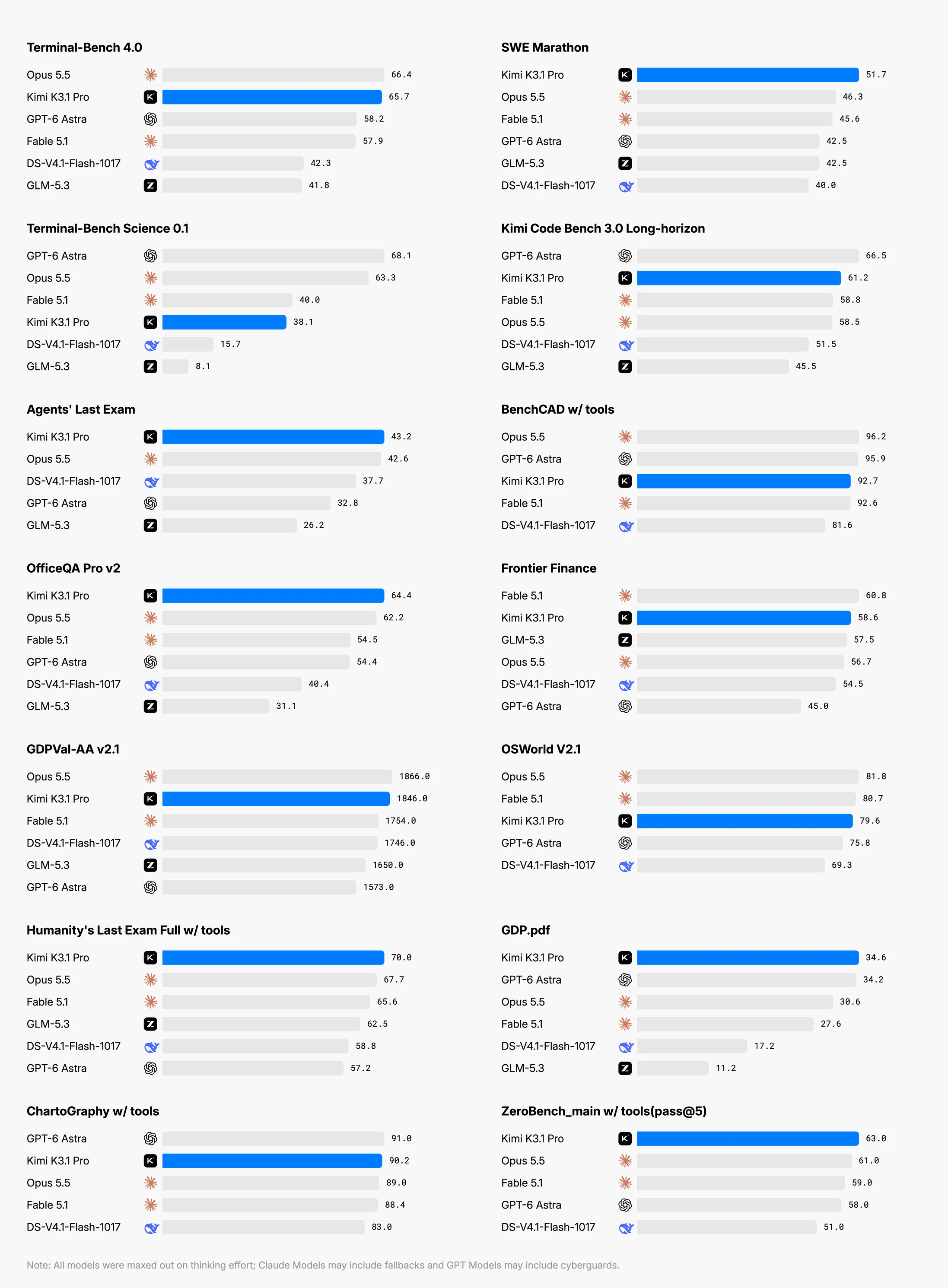
Across coding, agentic, and knowledge benchmarks, K3.1 Pro matches or approaches the strongest proprietary models. On Terminal-Bench 4.0, which evaluates coding agents on realistic, resource-constrained terminal tasks using strict task-specific tests, K3.1 Pro scores 65.7%, ahead of GPT-6 Astra (58.2%) and narrowly behind Claude Opus 5.5 (66.4%). And on Kimi Code Bench 3.0 Long-horizon, our internal benchmark that tests coding agents' multi-step execution, tool use, and end-to-end problem solving across diverse engineering domains, K3.1 Pro scores 61.2%, above K3's 55.95%.
Coding
K3.1 Pro covers the full range of coding work, from quick fixes in real codebases to full-project builds. It also brings a more considered visual style to games and web experiences, and knows how to build them with the right tools.
K3.1 Pro works effectively across game engines such as Unity, Unreal Engine, and Godot, combining them with web search and 3D generation to create complete experiences. Its front-end pages, interactive Three.js scenes, and 3D assets show stronger composition, typography, animation, and polish. The examples below were created end to end by K3.1 Pro:
K3.1 Pro's long-horizon coding capabilities are also strengthened through large-scale reinforcement learning. In one internal test, it built a human walking dynamics simulator with integrated training and evaluation pipelines on top of human-atlas, an open-source anatomical model of the human body comprising 296 skeletal components, including cartilage, and 402 muscle components. Across 167 missions and 420 independent reviews, it analyzed experimental results, diagnosed problems, and iteratively refined the walking controller, enabling the simulated human to go from collapsing within seconds to walking continuously with alternating strides for 11.2 seconds. When reward shaping failed to improve arm motion, K3.1 Pro did not simply keep adjusting the reward: it ran open-loop probes of the simulator's dynamics, identified and corrected 36 errors in shoulder-muscle moment-arm calculations, and then retrained the controller.
3D Modeling and Design
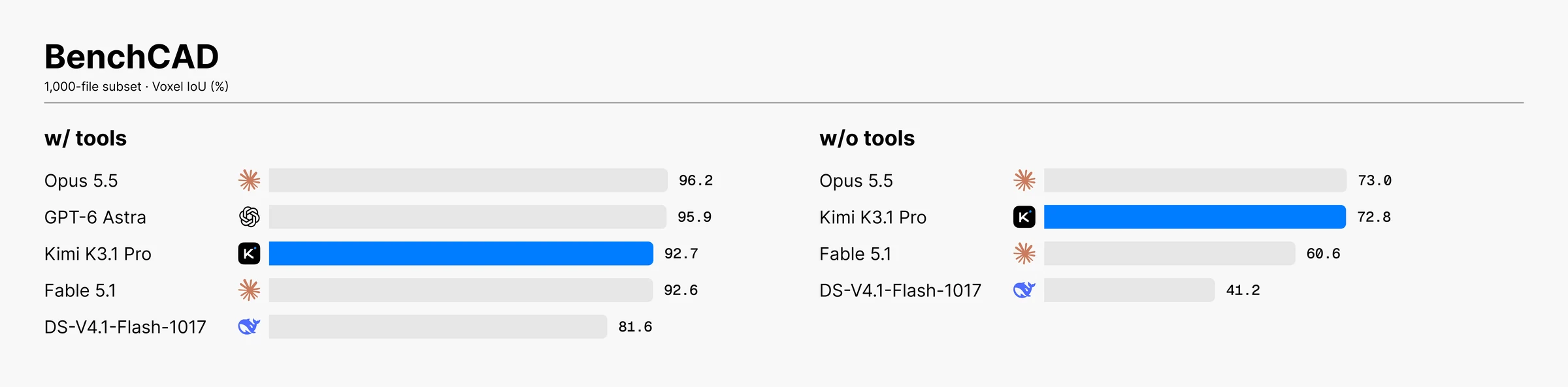
K3.1 Pro is strong at 3D creation and spatial reasoning. On BenchCAD, which tests 3D reconstruction from multi-view renderings through CAD code generation, K3.1 Pro scores 92.7% with tools, approaching the performance of Claude Opus 5.5 (96.2%) and GPT-6 Astra (95.9%). From a text brief, sketch, or reference image, it can infer shape, proportions, and spatial relationships to create usable 3D models. It also has a stronger grasp of existing asset libraries and model collections.
K3.1 Pro particularly excels at parametric modeling, from mechanical parts and architectural models to configurable products and custom furniture. Without MCP connectors, it can write and run scripts for tools like Blender and CAD software to build and refine assets, edit components, and adjust geometry, materials, and scene layout.
Below are examples of 3D assets K3.1 Pro created for brand films, games, and interactive web experiences:
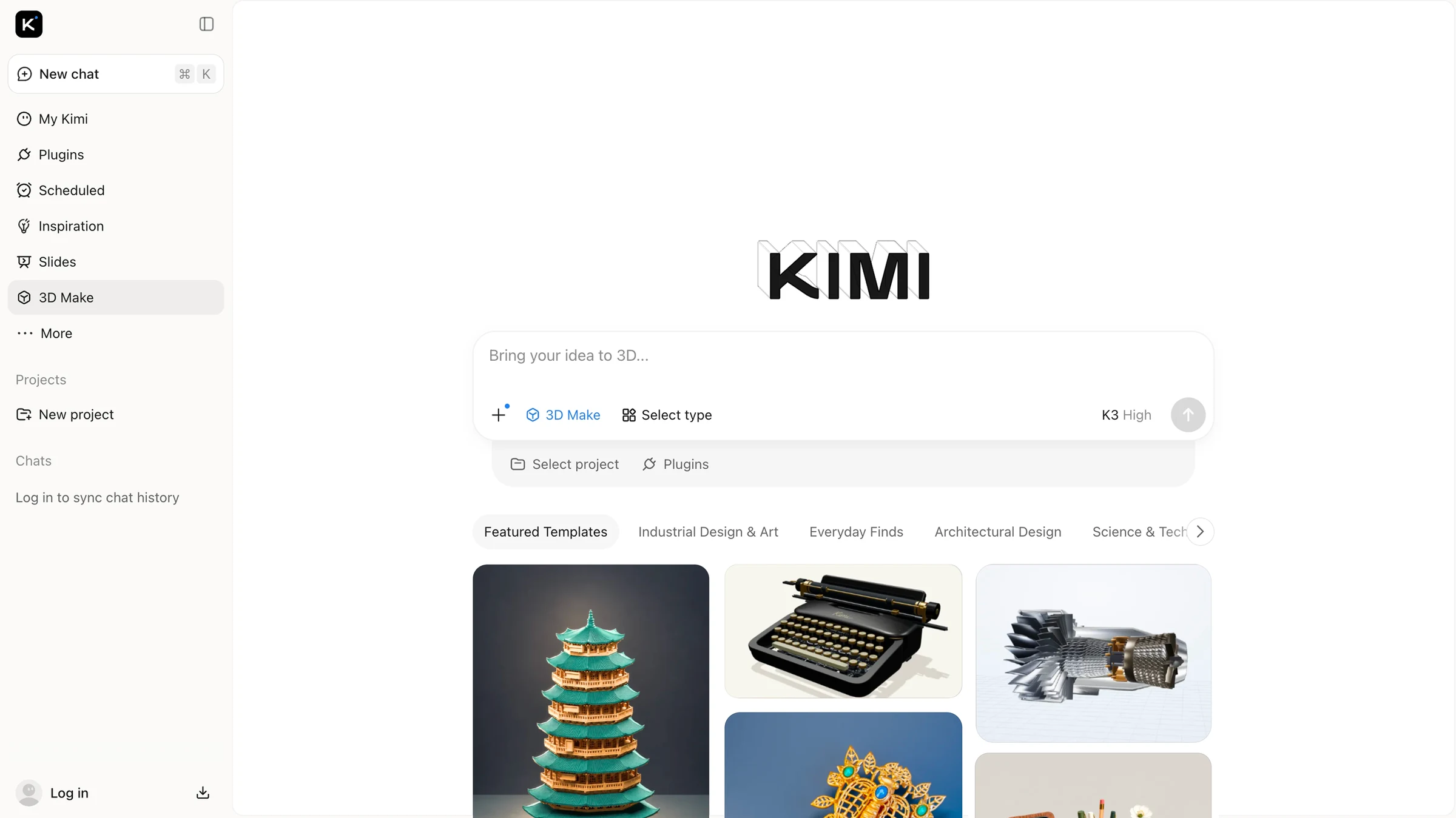
3D Make is now live on kimi.ai and the Kimi app — preview and edit your 3D models online, download them ready for 3D printing, or export them as videos or Live Photos to share anywhere.
Finance
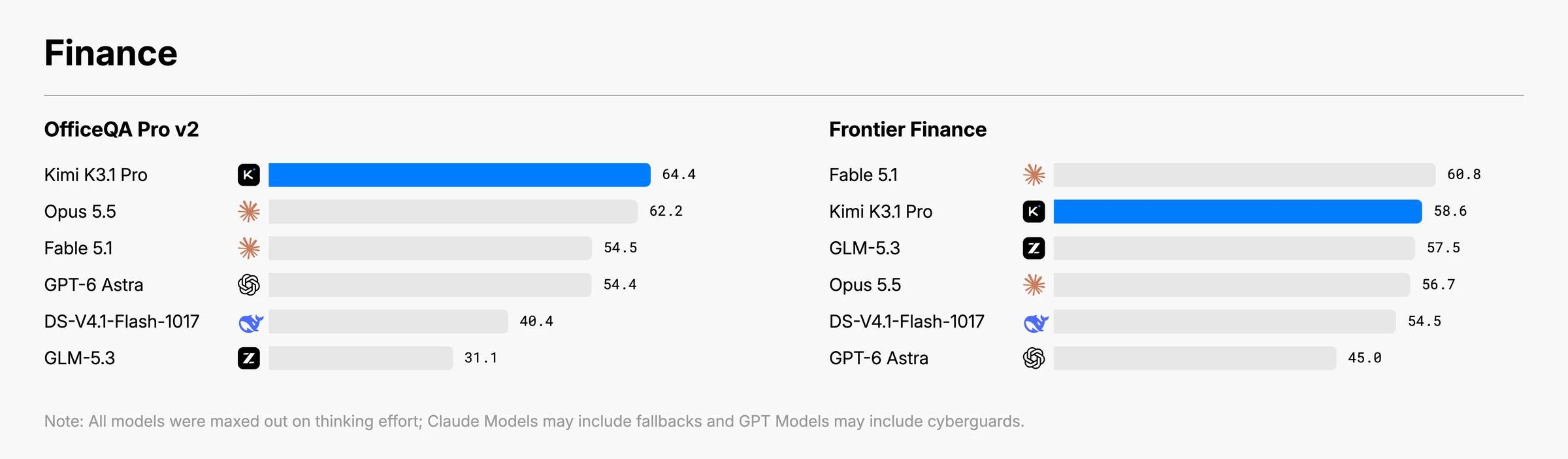
With stronger reasoning and agentic capability, K3.1 Pro is capable of end-to-end delivery of complete financial workflows. K3.1 Pro achieves state-of-the-art results on OfficeQA Pro v2 (64.4), which tests complex fiscal data analysis over real financial documents through retrieval, cross-document verification, and multi-step numerical reasoning. K3.1 Pro also improves over K3 on Frontier Finance, which measures support for complete investment workflows from screening to profitability analysis.
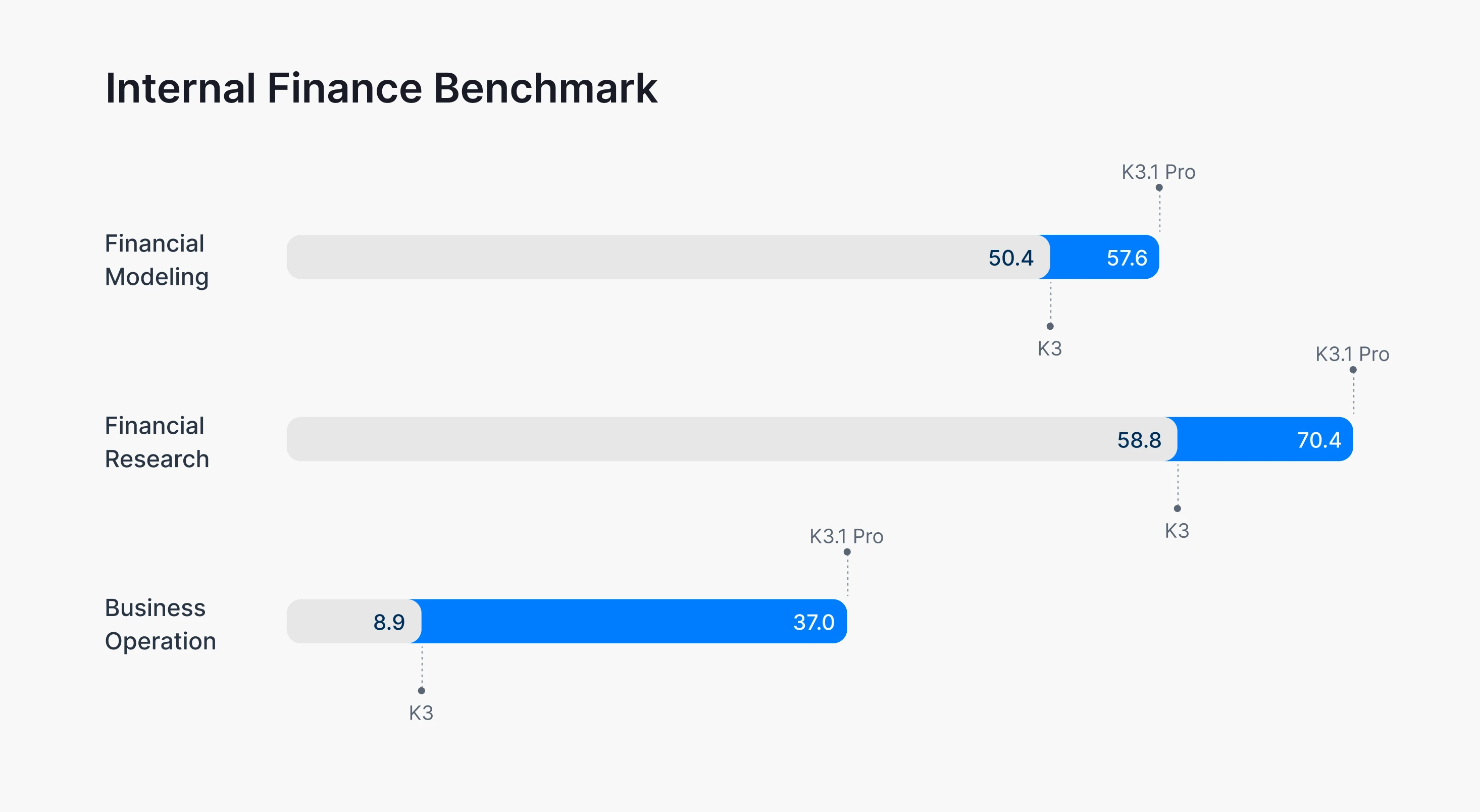
K3.1 Pro also improves significantly across all our internal finance benchmarks:
- Financial Modeling evaluates formula linkage, financial logic, and final workbook quality in real-world modeling tasks. K3.1 Pro improves on K3 by 7.2 points.
- Financial Research evaluates whether models can produce auditable research under evidence and cutoff constraints. K3.1 Pro improves on K3 by 11.6 points.
- Business Operation evaluates long-horizon management and decision-making in a simulated business environment. K3.1 Pro achieves about 4.2× K3's performance.
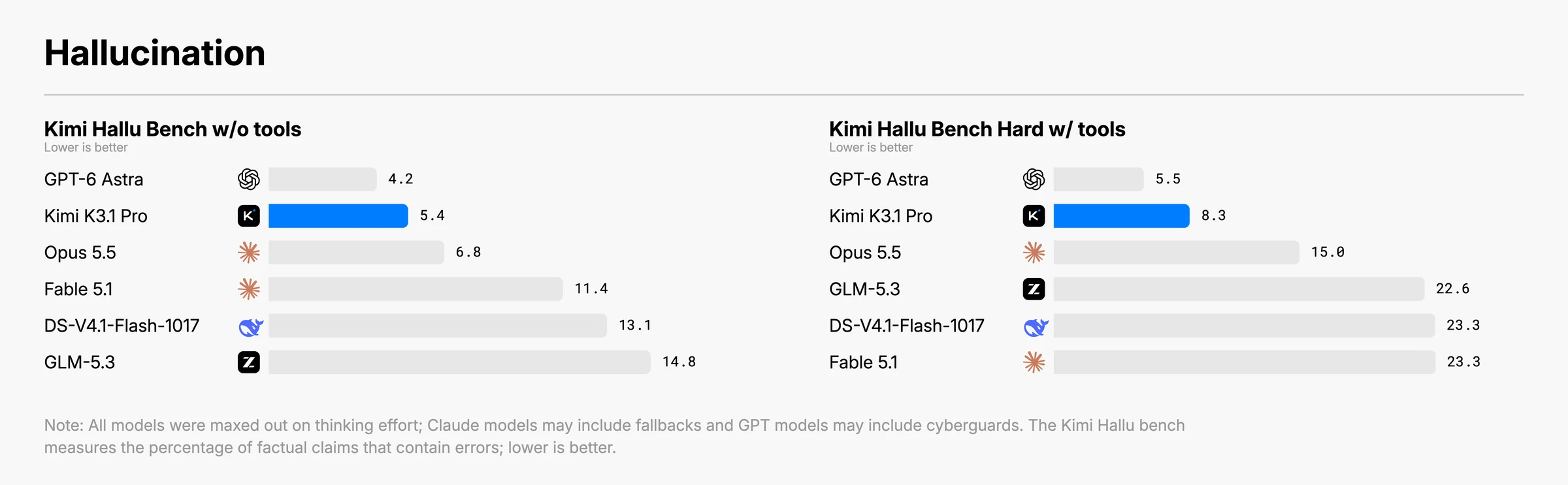
Financial analysis and investment research demand a high degree of factual accuracy. To address this, we made targeted improvements to K3.1 Pro's factual accuracy on real-world tasks and challenging prompts. On Kimi Hallu Bench Hard bench, an internal benchmark designed to stress-test factual accuracy, its claim-level hallucination rate fell from 23.4% for K3 to 8.3%, while the share of responses containing at least one factual error was just 42.4% of its predecessor's rate. (The evaluation is a stress test for factual accuracy, with examples deliberately crafted to probe situations where models are prone to errors. The reported rates do not represent overall error rates in daily use.)
The cases below show how K3.1 Pro handles financial modeling, investment analysis, and source-grounded research in practice:
Cybersecurity
As K3.1 Pro became more capable, we spent a correspondingly larger share of our effort understanding where cyber capability comes from, and how much of it we can control. We therefore analyzed and evaluated K3.1 Pro's vulnerability research capabilities, and applied targeted controls during training to reduce potential misuse risk while preserving general usefulness.
Identifying and removing cyber-related data. During development, we observed vulnerability research performance improving steadily as post-training scaled. Tracing the source of this trend, we found that cyber-related content was embedded within the general mid-training corpus, and cyber-related tasks were present in the RL environment mix — a natural byproduct of training on broad data. In preliminary experiments on internal models, we found that without data removal at either the mid-training or the RL stage, downstream cyber capability would increase substantially. These findings gave us a concrete lever for control. For the open-weight release of K3.1 Pro, we identified and removed cyber-related data from both training stages, while retaining the general-purpose coding tasks needed for model usefulness. We will continue to apply appropriate controls at every training stage, of which cyber-related data identification and restriction is one example.
Evaluation and results. After data cleaning, we evaluated K3.1 Pro on xdev-bench-hard, our in-house benchmark of expert-curated, source-code-based vulnerability discovery and exploitation tasks, calibrated to provide meaningful differentiation at our current capability level. Most tasks faithfully reproduce recently disclosed vulnerabilities in software such as the Linux kernel, Node.js, JavaScriptCore, Exim, and VirGL, with mitigations enabled. Each task provides the vulnerable source code, a short bug hint, and the corresponding binary; the agent must develop an exploit, achieve arbitrary code execution in a separate sandbox, and retrieve a secret string for automated verification. We report pass@3 over a random subset of runs, with no hard timeouts or output token limits.
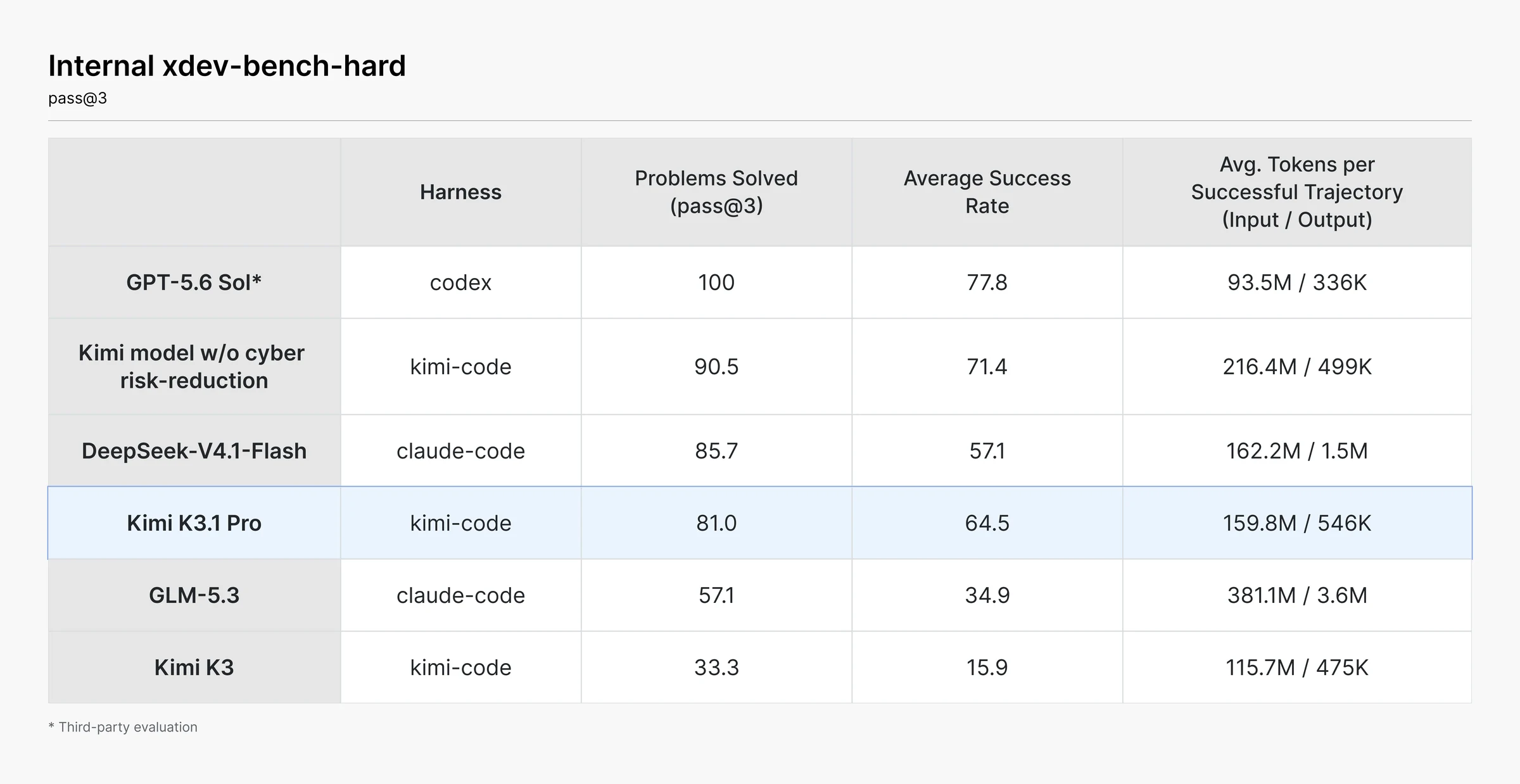
On xdev-bench-hard, the checkpoint without these risk-reduction measures — no cyber-related data removal at mid-training and no cyber-related RL environment filtering — solves 90.5% of problems at pass@3; the final K3.1 Pro reaches 81.0%. The comparison shows that data removal meaningfully reduces cyber capability relative to what the same training pipeline would otherwise produce. At the same time, K3.1 Pro improves substantially over its predecessor, indicating that stronger general coding and long-horizon debugging capabilities generalize to cyber tasks even after targeted data removal. K3.1 Pro's cyber capability remains behind that of frontier proprietary models that have been publicly available for at least three months. We will keep evolving our internal benchmarks so that evaluation stays informative as model capabilities continue to advance.
Open-weight principles. These evaluations frame our open-weight release decision. First, we aim not to release open weights that would extend the absolute frontier of cyber capability. K3.1 Pro's offensive cyber capability is, by design, below what our pipeline can produce, and remains behind that of frontier proprietary models. Second, we intend to progressively raise the cyber capability available in open weights. We believe making K3.1 Pro available in a non-discriminatory way benefits people who need dual-use capabilities for defensive purposes. When a capable model is open and runs on infrastructure its users control, many more teams gain the means to audit the code they maintain — including legacy systems that rarely receive dedicated security reviews. We believe that letting this capability diffuse gradually — rather than concentrating it in a few proprietary systems — ultimately makes all software more secure.
Availability
Kimi K3.1 Pro rolls out today across the Kimi product family: on Kimi.ai and the Kimi mobile apps, Kimi Work and Kimi Code, and through the Kimi API.
Full model weights will be released by Nov 4, 2026.
Kimi Enterprise administrators can enable K3.1 Pro for their organization; access is off by default at launch.
Details for each channel:
- Kimi Agents: Download or update to the latest Kimi app from your mobile app store, available on iOS, Android, and HarmonyOS, or visit kimi.ai.
- Work with Kimi K3.1 Pro: Download the latest Kimi Work desktop app, version 3.1.0 or later, available for Windows and Apple silicon Macs.
- Code with Kimi K3.1 Pro: Run Kimi Code and select Kimi K3.1 Pro using the
/modelcommand. - Build with the Kimi API: Visit the Kimi API Platform and select kimi-k3.1-pro / kimi-k3.1-pro-highspeed. Zero Data Retention is available for API customers.
- Bring Kimi to your organization: Kimi Business provides enterprise-grade data privacy and member management, with complete separation between personal and organization accounts. Visit the pricing page and select “Get Kimi Business” to subscribe for your team.
Benchmarks
Footnotes
Unless otherwise specified, all Kimi K3.1 Pro results reported below are obtained with the reasoning effort set to 'max', temperature = 1.0, and top-p = 0.95.
Coding benchmarks
- Terminal-Bench 4.0. Kimi K3.1 Pro is evaluated with the Claude-Code harness. The DeepSeek-V4.1-Flash-1017 is taken from the release blog (https://huggingface.co/deepseek-ai/DeepSeek-V4.1-Flash-1017). All remaining scores are taken as the maximum value reported in either their blog posts or the official Terminal-Bench 4.0 leaderboard (https://www.tbench.ai/).
- Terminal-Bench Science 0.1. Kimi K3.1 Pro is evaluated with the Claude-Code harness. Our internal evaluation of DeepSeek-V4.1-Flash-1017 yields a score of 9.3; However, an older version, DeepSeek-V4.1-Flash, scores 15.7 on the official Terminal-Bench Science, so we report 15.7 here; all remaining scores are from the official Terminal-Bench Science leaderboard (https://www.terminal-bench-science.ai/).
- DeepSWE v1.1. Kimi K3.1 Pro is evaluated with the Claude-Code harness. All scores are taken from each model's respective technical report. GPT-6 Astra(https://openai.com/index/gpt-6-astra/). Claude Opus 5.5 and Claude Fable 5.1(https://www.anthropic.com/claude-opus-5-5-system-card and https://www.anthropic.com/claude-fable-5-1-mythos-5-1-system-card); DeepSeek-V4.1-Flash-1017 (https://api-docs.deepseek.com/news/news261017/); GLM-5.3 (https://z.ai/blog/glm-5.3).
- SWE-Marathon v1.1. Kimi K3.1 Pro is evaluated with the Claude-Code harness. DeepSeek-V4.1-Flash-1017 is evaluated with the ClaudeCode harness. All other scores are taken from the official SWE-Marathon leaderboard (https://www.swe-marathon.org/).
- PostTrainBench. Kimi K3.1 Pro and DeepSeek-V4.1-Flash-1017 were evaluated internally on v1.2 using the Claude-Code harness and H20 GPUs instead of H100 GPUs. For stable evaluation, all judge models used DeepSeek-V4.1-Flash-1017 at maximum effort, which best matched the official GPT-5.6-Terra (xhigh) judge in testing. Other scores are from the official leaderboard (https://posttrainbench.com/).
- ProgramBench (binary score). We report binary scores rather than raw ProgramBench scores: a task receives a score of 1 if its ProgramBench score is ≥95%, and 0 otherwise. Kimi K3.1 Pro is evaluated with the Claude-Code harness. The DeepSeek-V4.1-Flash-1017 and GLM-5.3 scores are taken from the release blog (https://huggingface.co/deepseek-ai/DeepSeek-V4.1-Flash-1017); all remaining scores are from the Vals ProgramBench leaderboard (https://www.vals.ai/benchmarks/programbench).
- Internal Coding Bench: Kimi Code Bench 2.0 and Kimi Code Bench 3.0 Long-horizon. Kimi K3.1 Pro is evaluated with Claude-Code harnesses; All other models are evaluated at their max-effort setting. Note that proprietary model testing may involve some fallback behavior.
- BenchCAD. Open models are evaluated by us on 1,000-case subsets randomly sampled from the full 17,900-case Vision2Code dataset, at maximum reasoning effort. With-tools results use the Claude Code harness; without-tools results use single-shot generation with the official BenchCAD prompts and scoring pipeline. Scores for Claude Fable 5.1 and Claude Opus 5.5 are taken from the Claude Opus 5.5 System Card; GPT‑6 Astra’s with-tools score is taken from its official report. GPT‑6 Astra has not reported a without-tools score and is marked “—”.
Agentic benchmarks
- BioMysteryBench dataset is drawn from the official v11 release, with Kimi K3 as the judge model. We evaluate Kimi K3.1 Pro with Kimi Code, GLM-5.3 and DeepSeek-V4.1-Flash-1017 with Claude Code, and GPT-6 Astra with Codex. Scores for the Claude models are taken directly from their official system cards.
- Our Agents’ Last Exam dataset is drawn from the official v1.1 release, comprising 122 tasks, including 86 CLI tasks, with environment images aligned with the official Hugging Face release. We additionally assign a score of zero to runs that bypass the task’s stated requirements, such as retrieving answers online instead of performing the required analysis in Wireshark. DeepSeek and Kimi are evaluated using Claude Code and Kimi Code, respectively. All other results are taken from the official benchmark website.
- OfficeQA Pro, OfficeQA Pro v2. GPT-6 Astra is evaluated with Codex, while all other models are evaluated with Claude Code. Each task provides the agent with the entire PDF corpus, with all PDFs rendered as images and no machine-readable text available. We observed instances in the trajectories of certain external models where they retrieved reference answers online; Consequently, we assigned a score of zero to these tasks.
- Frontier Finance is evaluated with the official finance agent v2 harness.
- HANDBOOK.md is evaluated using the official harness built on OpenHands, with evaluation tasks drawn from the benchmark’s early open-source v1 release.
- Harvey Legal Agent is evaluated on a public dataset of 1,251 tasks using Artificial Analysis’s Stirrup harness, with performance reported as the all-pass rate (i.e., the percentage of tasks that pass all rubric criteria).
- OSWorld V2.1 is evaluated with the Kimi Agent harness in the official OSWorld v2 repo, while GPT-6 Astra's score is taken from Muse Wonder's technical report.
- DECK-Arena evaluates presentation generation on real-world queries, while Design Bench covers graphic design via direct and reference-image few-shot prompting; Both run models across python-pptx, pptxjs, and Kimi's in-house DSL in a harness with integrated search and image generation, using an automated grader calibrated on 10,000+ human judgments.
- MCP Atlas. All models are evaluated on the 500-task public subset with a 100-turn limit, using Gemini 3.1 Pro as the judge.
- BrowseComp. We adopt the context-compaction strategy used in the Claude model cards, triggered at 200K tokens. We allow a maximum of 500 steps; if this limit is reached before a task is completed, we force the agent to provide an answer, which is then judged. All BrowseComp runs are conducted with temperature=1.0 and top-p=1.0.
- GDPval-AA v2.1, AA-Briefcase v1.1 and AutomationBench-AA scores are cited from https://artificialanalysis.ai/, Apex Agents scores are cited from https://www.mercor.com/apex/apex-agents-leaderboard/
- GDP.pdf w/ python, ZeroBench w/ python and ChartoGraphy w/ python are averaged over five runs. Other multimodal benchmarks (w/ python) are averaged over four runs. For GDP.pdf w/ python: Each original PDF file is sent to the sandbox, where the model can use IPython tool to process it. Final responses are graded against each rubric criterion using Gemini-3.5-Flash (medium reasoning effort) and the official judging prompt. We report the task-macro mean rubric pass rate: for each task, we average the fraction of rubric criteria passed over five independent runs, then average these task-level scores equally across all tasks.
Reasoning & Knowledge & Multimodal benchmarks
- GDP.pdf. Each PDF is provided as page images resized to a longest edge of 1,152 pixels, interleaved with Docling-extracted text in page order. Responses are graded against each rubric criterion using Gemini-3.5-Flash Medium and the official judging prompt. We report the strict pass rate among fully scored responses.
- HLE and HLE-Diamond evaluate general knowledge and reasoning capabilities. We report accuracy on the full evaluation sets, with 2,500 questions for HLE and 1,000 questions for HLE-Diamond. For models marked with an asterisk (*), accuracy is reported on the text-only subset of questions.
- GDP.pdf, ZeroBench and ChartoGraphy are averaged over five runs. Other multimodal benchmarks are averaged over four runs. GDP.pdf scores of GLM-5.3 Max and DeepSeek-V4.1-Flash-1017 Max is cited from https://artificialanalysis.ai/.
- MMMU-Pro is evaluated following the official protocol, preserving the original input order and prepending images to the text input.
- Kimi Hallucination Benchmark evaluates factual accuracy on an internal set of challenging, de-identified prompts drawn from practical work tasks. We report the claim-level hallucination rate assessed by fact-checking agents.
Cybersecurity benchmarks
- ExploitBench. Kimi K3.1 Pro is evaluated with the official ExploitBench harness under the 300-turn budget. We report the pass@5 max capability score: for each environment, the best run across 5 seeds, scored by the number of capability flags reached out of 16, where achieving arbitrary code execution counts as achieving all 16 capabilities. The GPT-6 Astra score is taken from https://openai.com/index/gpt-6-astra/; the Claude Opus 5.5 and Claude Mythos 5.1 scores are taken from https://www.anthropic.com/claude-opus-5-5-system-card; the GLM-5.3 score is taken from https://z.ai/blog/glm-5.3.
- ExploitGym. Kimi K3.1 Pro is evaluated with the KimiCode harness under a 6-hour wall-clock budget per task. The GPT-6 Astra score is taken from https://openai.com/index/gpt-6-astra/; the Claude Opus 5.5 and Claude Mythos 5.1 scores are taken from https://www.anthropic.com/claude-opus-5-5-system-card at the 6-hour budget; the GLM-5.3 score is taken from https://z.ai/blog/glm-5.3.
- xdev-Bench-hard: Kimi K3.1 Pro is evaluated with the KimiCode harness. GLM-5.3 and DeepSeek-V4.1-Flash-1017 are evaluated with the Claude Code harness.