
PDF Document Layout Analysis
A Docker-powered microservice for intelligent PDF document layout analysis, OCR, and content extraction




Built with ❤️ by HURIDOCS
⭐ Star us on GitHub • 🐳 Pull from Docker Hub • 🤗 View on Hugging Face
📣 Feedback & Use Cases
Are you using this tool in your workflow? We’d love to learn more about your experience. Sharing your use case helps us improve the service for everyone.
🚀 Overview
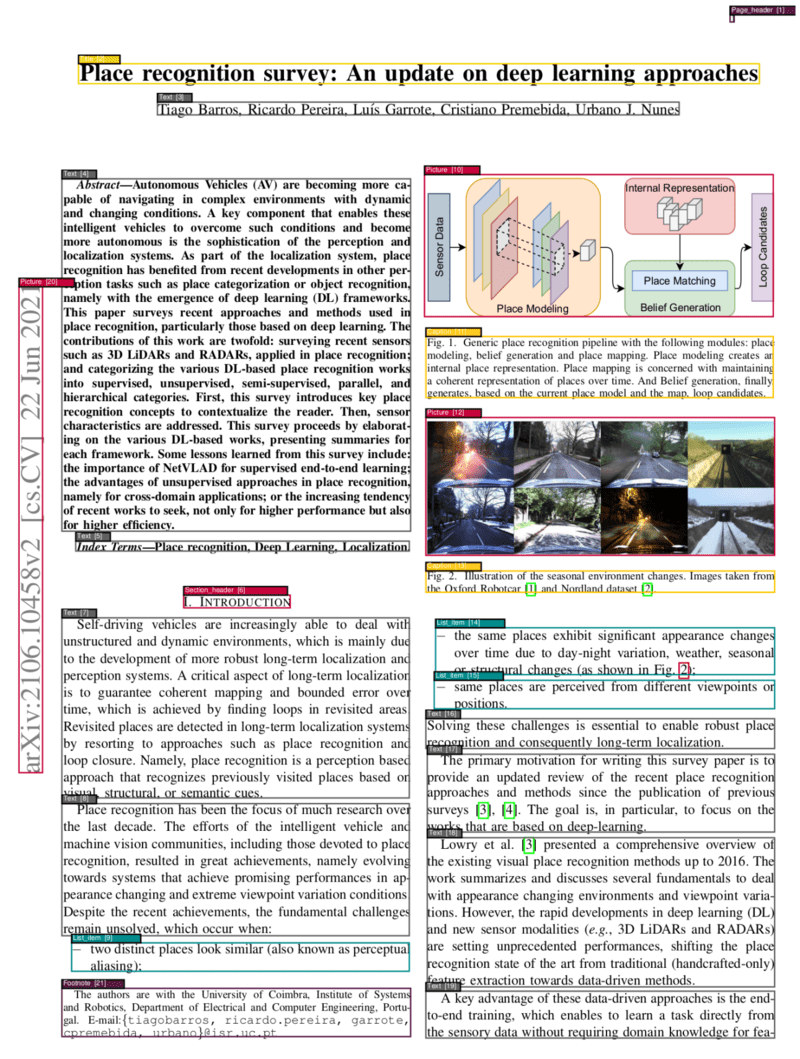
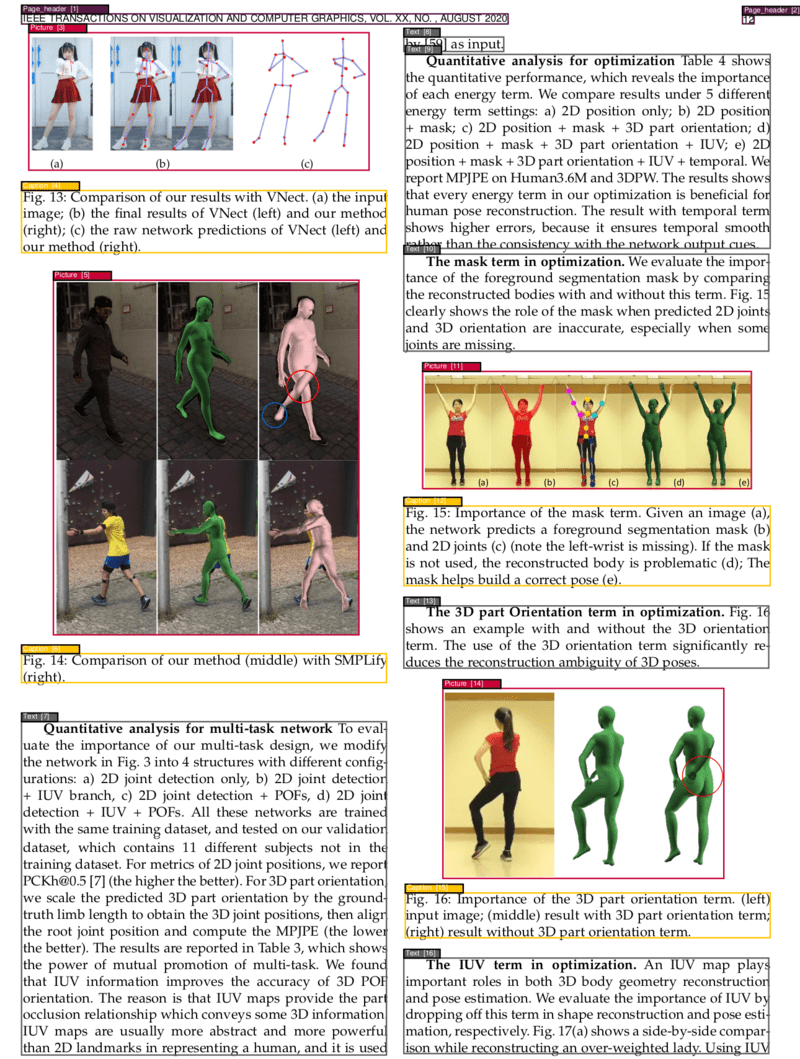
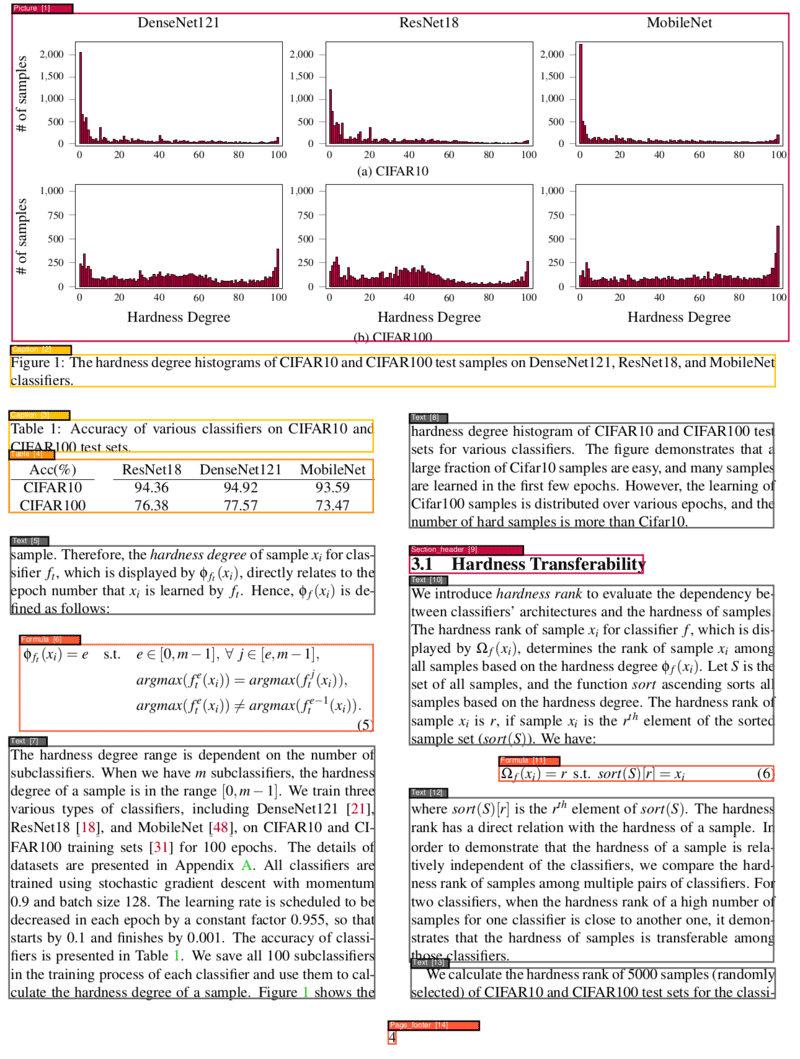
This project provides a powerful and flexible PDF analysis microservice built with Clean Architecture principles. The service enables OCR, segmentation, and classification of different parts of PDF pages, identifying elements such as texts, titles, pictures, tables, formulas, and more. Additionally, it determines the correct reading order of these identified elements and can convert PDFs to various formats including Markdown and HTML with automatic translation support powered by Ollama.
The service offers both a user-friendly Gradio web interface for interactive use and a comprehensive REST API for programmatic access and integration.
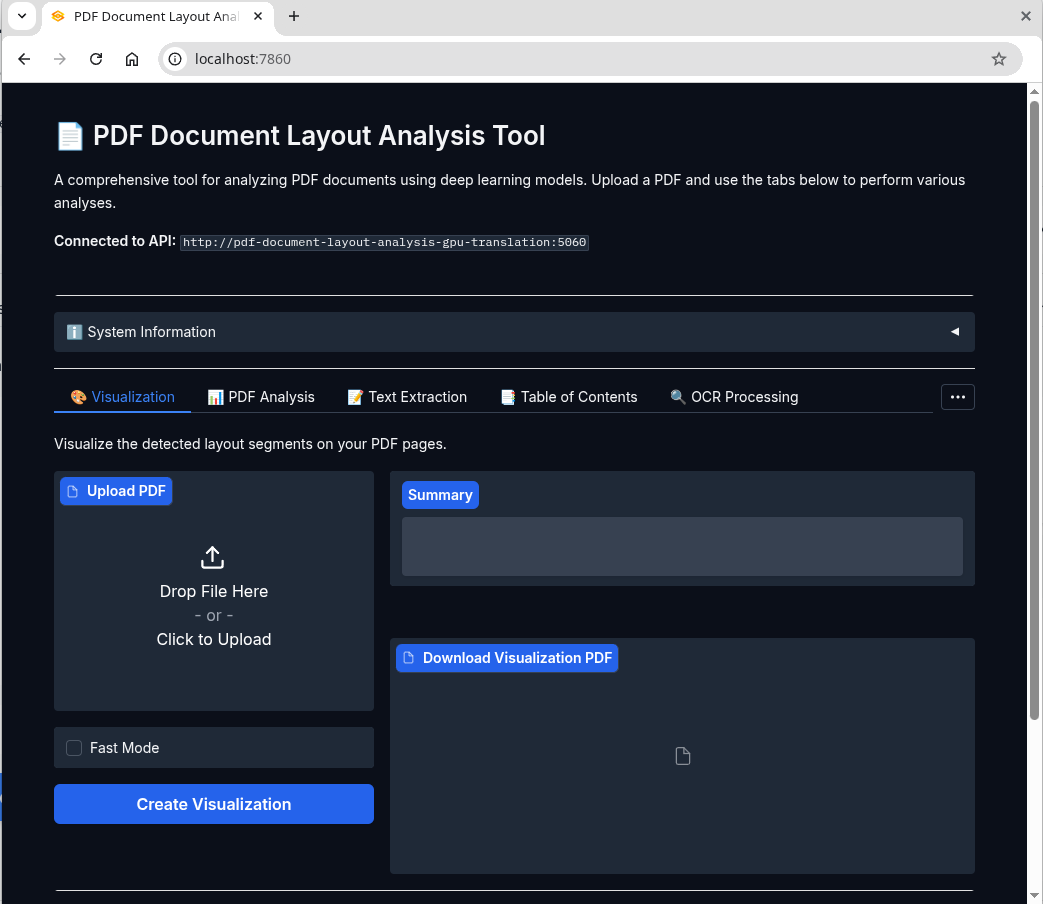
Gradio Web Interface - Easy-to-use UI for PDF analysis, conversion, and translation
🚀 Quick Start
1. Start the Service
make start # or just start (https://github.com/casey/just)The service provides two interfaces:
- 🎨 Web UI (Gradio):
http://localhost:7860- User-friendly interface for all features - 🔌 REST API:
http://localhost:5060- Programmatic access for integrations
make helpCheck service status:
curl http://localhost:5060/info2. Using the Web UI
Simply open your browser and navigate to http://localhost:7860 to access the intuitive web interface. The UI provides:
- 📄 PDF Analysis - Upload and analyze PDFs with visual results
- 🔄 Format Conversion - Convert to Markdown or HTML
- 🌍 Translation - Translate documents to multiple languages
- 👁️ Visualization - View segmentation overlays on your PDFs
- 🔍 OCR Processing - Apply OCR to scanned documents
- 📑 TOC Extraction - Extract table of contents
3. Using the REST API
Analyze a PDF document (VGT model - high accuracy):
curl -X POST -F 'file=@/path/to/your/document.pdf' http://localhost:5060Fast analysis (LightGBM models - faster processing):
curl -X POST -F 'file=@/path/to/your/document.pdf' -F "fast=true" http://localhost:50604. Stop the Service
make stop💡 Tip: The Web UI athttp://localhost:7860is the easiest way to get started. For automation and integration, use the REST API athttp://localhost:5060.
✨ Key Features
- 🎨 User-Friendly Web UI - Intuitive Gradio interface for easy PDF processing
- 🔍 Advanced PDF Layout Analysis - Segment and classify PDF content with high accuracy
- 🖼️ Visual & Fast Models - Choose between VGT (Vision Grid Transformer) for accuracy or LightGBM for speed
- 📝 Multi-format Output - Export to JSON, Markdown, HTML, and visualize PDF segmentations
- 🌍 Automatic Translation - Translate documents to multiple languages using Ollama models
- 🌐 OCR Support - 150+ language support with Tesseract OCR
- 📊 Table & Formula Extraction - Extract tables as HTML and formulas as LaTeX
- 🏗️ Clean Architecture - Modular, testable, and maintainable codebase
- 🐳 Docker-Ready - Easy deployment with GPU support
- ⚡ RESTful API - Comprehensive API with 10+ endpoints
📸 Example Results
|
|
|
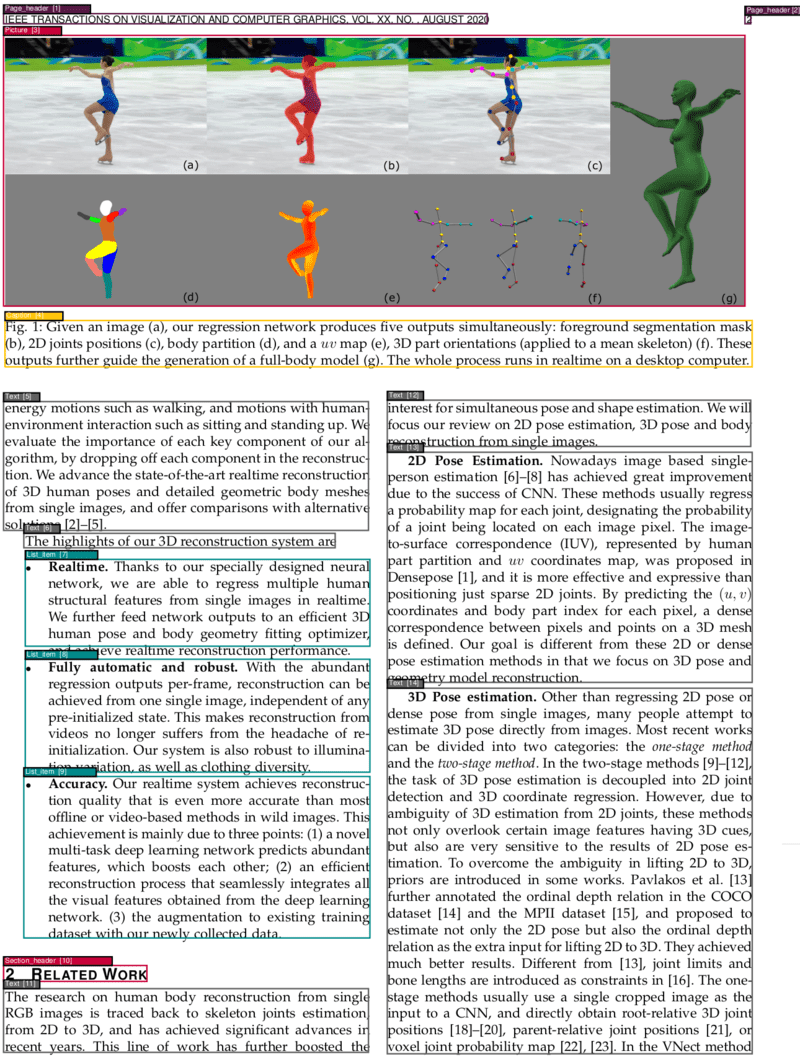
|
🔗 Project Links
- GitHub: pdf-document-layout-analysis
- HuggingFace: pdf-document-layout-analysis
- DockerHub: pdf-document-layout-analysis
📋 Table of Contents
- 🚀 Overview
- 🚀 Quick Start
- ✨ Key Features
- ⚙️ Dependencies
- 📋 Requirements
- 📚 API Reference
- 💡 Usage Examples
⚙️ Dependencies
Required
- Docker Desktop 4.25.0+ - Installation Guide
- Python 3.10+ (for local development)
Optional
- NVIDIA Container Toolkit - Installation Guide (for GPU support)
📋 Requirements
System Requirements
- RAM: 2 GB minimum
- GPU Memory: 5 GB (optional, will fallback to CPU if unavailable)
- Disk Space: 10 GB for models and dependencies
- CPU: Multi-core recommended for better performance
Docker Requirements
- Docker Engine 20.10+
- Docker Compose 2.0+
🖥️ ARM64 / NVIDIA Grace-Blackwell (e.g. DGX Spark)
The GPU stack is picked by select_gpu_stack.sh based on
compute capability, and its legacy/nextgen profiles already build and run
on aarch64 hosts — their CUDA base images ship arm64 manifests, and nextgen's
compute-capability check (>= 10.0) already matches Blackwell GPUs like the
GB10, running via PTX JIT.
For native aarch64 hardware such as the DGX Spark (Grace CPU + GB10 GPU,
sm_121), this adds an explicit grace profile that targets CUDA 13 and
compiles native SASS for the GPU instead of relying on nextgen's PTX JIT
fallback:
GPU_STACK_PROFILE=grace just start_detached_gpuwhich resolves to:
| Build arg | Value |
| ------------------------ | ----------------------------------------------- |
| BUILDER_IMAGE | nvidia/cuda:13.0.3-cudnn-devel-ubuntu24.04 |
| TORCH_INDEX_URL | https://download.pytorch.org/whl/cu130 |
| TORCH_CUDA_ARCH_LIST | 12.0;12.1 |
Verified on: DGX Spark, aarch64, NVIDIA GB10 (compute capability 12.1),
driver 580 / CUDA 13.0. No pin relaxation was needed — cu130 ships
manylinux_2_28_aarch64 wheels for the exact torch/torchvision versions
this project already pins, and 13.0.3-cudnn-devel-ubuntu24.04 is the newest
cudnn-devel-ubuntu24.04 tag with an arm64 manifest at the time of writing.
| Note | Detail |
| --- | --- |
| Native vs. PTX JIT | nextgen (cu128, 12.0+PTX) also runs on the GB10 via PTX JIT; grace compiles native sm_120/sm_121 SASS to match the host's CUDA 13 driver, avoiding first-call JIT compilation. |
| GPU device-name log line | Upstream's get_model_configuration device-name log line was not observed to fire on this hardware; GPU use is still confirmed via nvidia-smi and the "Is PyTorch using GPU: True" log line. |
| detectron2 build | Compiles from source at the pinned commit against the grace arch list; no changes were needed beyond the existing TORCH_CUDA_ARCH_LIST build arg. |
| Build time | Docker's layer cache makes rebuilds after the first near-instant; the first build compiles detectron2 and downloads several GB of wheels/models, same as any other profile. |
📚 API Reference
The service provides a comprehensive RESTful API with the following endpoints:
Core Analysis Endpoints
| Endpoint | Method | Description | Parameters |
| ---------------------- | ------ | --------------------------------------- | --------------------------------------- |
| / | POST | Analyze PDF layout and extract segments | file, fast, parse_tables_and_math |
| /save_xml/{filename} | POST | Analyze PDF and save XML output | file, xml_file_name, fast |
| /get_xml/{filename} | GET | Retrieve saved XML analysis | xml_file_name |
Content Extraction Endpoints
| Endpoint | Method | Description | Parameters |
| ------------------------------ | ------ | ------------------------------ | ----------------------- |
| /text | POST | Extract text by content types | file, fast, types |
| /toc | POST | Extract table of contents | file, fast |
| /toc_legacy_uwazi_compatible | POST | Extract TOC (Uwazi compatible) | file |
Format Conversion Endpoints
| Endpoint | Method | Description | Parameters |
| ------------ | ------ | ----------------------------------------------------------- | -------------------------------------------------------------------------------------------- |
| /markdown | POST | Convert PDF to Markdown (includes segmentation data in zip) | file, fast, extract_toc, dpi, output_file, target_languages, translation_model, segment_boxes |
| /html | POST | Convert PDF to HTML (includes segmentation data in zip) | file, fast, extract_toc, dpi, output_file, target_languages, translation_model, segment_boxes |
| /visualize | POST | Visualize segmentation results on the PDF | file, fast |
OCR & Utility Endpoints
| Endpoint | Method | Description | Parameters |
| -------- | ------ | ---------------------------- | -------------------------------------------- |
| /ocr | POST | Apply OCR to PDF | file, language, rotate_pages, deskew |
| /info | GET | Get service information | - |
| / | GET | Health check and system info | - |
| /error | GET | Test error handling | - |
Common Parameters
file: PDF file to process (multipart/form-data)fast: Use LightGBM models instead of VGT (boolean, default: false)parse_tables_and_math: Apply OCR to table regions (boolean, default: false) and convert formulas to LaTeXlanguage: OCR language code (string, default: "en")types: Comma-separated content types to extract (string, default: "all")extract_toc: Include table of contents at the beginning of the output (boolean, default: false)dpi: Image resolution for conversion (integer, default: 120)target_languages: Comma-separated list of target languages for translation (e.g. "Turkish, Spanish, French")translation_model: Ollama model to use for translation (string, default: "gpt-oss")segment_boxes: JSON-encoded list of segment boxes from a prior analysis of the same document (e.g. the response ofPOST /). When provided,/markdownand/htmlskip re-running layout analysis and convert using these segments directly — the same pattern/toc_from_xmlalready uses for its ownsegment_boxesparameter
💡 Usage Examples
Basic PDF Analysis
Standard analysis with VGT model:
curl -X POST \
  -F '[email protected]' \
  http://localhost:5060
Fast analysis with LightGBM models:
curl -X POST \
  -F '[email protected]' \
  -F 'fast=true' \
  http://localhost:5060
Analysis with table and math parsing:
curl -X POST \
  -F '[email protected]' \
  -F 'parse_tables_and_math=true' \
  http://localhost:5060
Text Extraction
Extract all text:
curl -X POST \
  -F '[email protected]' \
  -F 'types=all' \
  http://localhost:5060/text
Extract specific content types:
curl -X POST \
  -F '[email protected]' \
  -F 'types=title,text,table' \
  http://localhost:5060/text
Format Conversion
Convert to Markdown:
curl -X POST http://localhost:5060/markdown \
  -F '[email protected]' \
  -F 'extract_toc=true' \
  -F 'output_file=document.md' \
  --output 'document.zip'
Convert to HTML:
curl -X POST http://localhost:5060/html \
  -F '[email protected]' \
  -F 'extract_toc=true' \
  -F 'output_file=document.md' \
  --output 'document.zip'
Convert to Markdown reusing segments from a prior analysis (skips re-analysis):
# 1. Analyze once and keep the segments
curl -X POST http://localhost:5060 -F '[email protected]' > segments.json
2. Reuse them for both /markdown and /html without re-running analysis
curl -X POST http://localhost:5060/markdown \
  -F '[email protected]' \
  -F "segment_boxes=$(cat segments.json)" \
  --output 'document.zip'
Convert to Markdown with Translation:
curl -X POST http://localhost:5060/markdown \
  -F '[email protected]' \
  -F 'output_file=document.md' \
  -F 'target_languages=Turkish, Spanish' \
  -F 'translation_model=gpt-oss' \
  --output 'document.zip'
Convert to HTML with Translation:
curl -X POST http://localhost:5060/html \
  -F '[email protected]' \
  -F 'output_file=document.md' \
  -F 'target_languages=French, Russian' \
  -F 'translation_model=huihui_ai/hunyuan-mt-abliterated' \
  --output 'document.zip'
📋 Segmentation Data & Translations: Format conversion endpoints automatically include detailed segmentation data in the zip output. The resulting zip file contains:
> - Original file: The converted document in the requested format
- Segmentation data: {filename}_segmentation.json file with information about each detected document segment:
- Coordinates:left,top,width,height
- Page information:page_number,page_width,page_height
- Content:textcontent and segmenttype(e.g., "Title", "Text", "Table", "Picture")
- Translated files (iftarget_languagesspecified):{filename}_{language}.{extension}for each target language
- Images (if present): {filename}_pictures/ directory containing extracted images
Translation Features
The /markdown and /html endpoints support automatic translation of the converted content into multiple languages using Ollama models.
Translation Requirements:
- The specified translation model must be available in Ollama
- An
output_filemust be specified (translations are only included in zip responses)
- Any Ollama-compatible model (e.g.,
gpt-oss,llama2,mistral, etc.) - Models are automatically downloaded if not present locally
- The service checks if the specified model is available in Ollama
- If not available, it attempts to download the model using
ollama pull - For each target language, the content is translated while preserving:
- Translated files are named:
{filename}_{language}.{extension}
gpt-oss were satisfactory, which is why we set it as the default model. If you need something smaller you can also try huihui_ai/hunyuan-mt-abliterated, we saw it gives decent results especially if the text does not have much styling._
Example Translation Output:
document.zip
├── document.md                   # Source text with markdown/html styling
├── document_Spanish.md           # Spanish translation
├── document_French.md            # French translation
├── document_Turkish.md           # Turkish translation
├── document_segmentation.json    # Segmentation information
└── document_pictures/       # (if images present)
    ├── document_1_1.png
    └── document_1_2.png
OCR Processing
OCR in English:
curl -X POST \
  -F 'file=@scanned_document.pdf' \
  -F 'language=en' \
  http://localhost:5060/ocr \
  --output ocr_processed.pdf
OCR in other languages:
# French
curl -X POST \
  -F 'file=@document_french.pdf' \
  -F 'language=fr' \
  http://localhost:5060/ocr \
  --output ocr_french.pdf
Spanish
curl -X POST \
  -F 'file=@document_spanish.pdf' \
  -F 'language=es' \
  http://localhost:5060/ocr \
  --output ocr_spanish.pdf
OCR with rotation fix for sideways scanned documents
curl -X POST \
  -F 'file=@scanned_document.pdf' \
  -F 'language=en' \
  -F 'rotate_pages=true' \
  http://localhost:5060/ocr \
  --output ocr_processed.pdf
OCR with deskew for crooked scans
curl -X POST \
  -F 'file=@scanned_document.pdf' \
  -F 'language=en' \
  -F 'deskew=true' \
  http://localhost:5060/ocr \
  --output ocr_processed.pdf
Visualization
Generate visualization PDF:
curl -X POST \
  -F '[email protected]' \
  http://localhost:5060/visualize \
  --output visualization.pdf
Table of Contents Extraction
Extract structured TOC:
curl -X POST \
  -F '[email protected]' \
  http://localhost:5060/toc
XML Storage and Retrieval
Analyze and save XML:
curl -X POST \
  -F '[email protected]' \
  http://localhost:5060/save_xml/my_analysis
Retrieve saved XML:
curl http://localhost:5060/get_xml/my_analysis.xmlService Information
Get service info and supported languages:
curl http://localhost:5060/infoHealth check:
curl http://localhost:5060/Response Format
Most endpoints return JSON with segment information:
[
  {
    "left": 72.0,
    "top": 84.0,
    "width": 451.2,
    "height": 23.04,
    "page_number": 1,
    "page_width": 595.32,
    "page_height": 841.92,
    "text": "Document Title",
    "type": "Title"
  },
  {
    "left": 72.0,
    "top": 120.0,
    "width": 451.2,
    "height": 200.0,
    "page_number": 1,
    "page_width": 595.32,
    "page_height": 841.92,
    "text": "This is the main text content...",
    "type": "Text"
  }
]
Supported Content Types
Caption- Image and table captionsFootnote- Footnote textFormula- Mathematical formulasList item- List items and bullet pointsPage footer- Footer contentPage header- Header contentPicture- Images and figuresSection header- Section headingsTable- Table contentText- Regular text paragraphsTitle- Document and section titles
🏗️ Architecture
This project follows Clean Architecture principles, ensuring separation of concerns, testability, and maintainability. The codebase is organized into distinct layers:
Directory Structure
src/
├── domain/                 # Enterprise Business Rules
│   ├── PdfImages.py       # PDF image handling domain logic
│   ├── PdfSegment.py      # PDF segment entity
│   ├── Prediction.py      # ML prediction entity
│   └── SegmentBox.py      # Core segment box entity
├── use_cases/             # Application Business Rules
│   ├── pdf_analysis/      # PDF analysis use case
│   ├── text_extraction/   # Text extraction use case
│   ├── toc_extraction/    # Table of contents extraction
│   ├── visualization/     # PDF visualization use case
│   ├── ocr/              # OCR processing use case
│   ├── markdown_conversion/ # Markdown conversion use case (with translation)
│   └── html_conversion/   # HTML conversion use case (with translation)
├── adapters/              # Interface Adapters
│   ├── infrastructure/    # External service adapters
│   ├── ml/               # Machine learning model adapters
│   ├── storage/          # File storage adapters
│   └── web/              # Web framework adapters
├── ports/                 # Interface definitions
│   ├── services/         # Service interfaces
│   └── repositories/     # Repository interfaces
└── drivers/              # Frameworks & Drivers
    └── web/              # FastAPI application setup
Layer Responsibilities
- Domain Layer: Contains core business entities and rules independent of external concerns
- Use Cases Layer: Orchestrates domain entities to fulfill specific application requirements
- Adapters Layer: Implements interfaces defined by inner layers and adapts external frameworks
- Drivers Layer: Contains frameworks, databases, and external agency configurations
Key Benefits
- 🔄 Dependency Inversion: High-level modules don't depend on low-level modules
- 🧪 Testability: Easy to unit test business logic in isolation
- 🔧 Maintainability: Changes to external frameworks don't affect business rules
- 📈 Scalability: Easy to add new features without modifying existing code
🤖 Models
The service offers two complementary model approaches, each optimized for different use cases:
1. Vision Grid Transformer (VGT) - High Accuracy Model
Overview: A state-of-the-art visual model developed by Alibaba Research Group that "sees" the entire page layout.
Key Features:
- 🎯 High Accuracy: Best-in-class performance on document layout analysis
- 👁️ Visual Understanding: Analyzes the entire page context including spatial relationships
- 📊 Trained on DocLayNet: Uses the comprehensive DocLayNet dataset
- 🔬 Research-Backed: Based on Advanced Literate Machinery
- GPU: 5GB+ VRAM (recommended)
- CPU: Falls back automatically if GPU unavailable
- Processing Speed: ~1.75 seconds/page (GPU [GTX 1070]) or ~13.5 seconds/page (CPU [i7-8700])
2. LightGBM Models - Fast & Efficient
Overview: Lightweight ensemble of two specialized models using XML-based features from Poppler.
Key Features:
- ⚡ High Speed: ~0.42 seconds per page on CPU (i7-8700)
- 💾 Low Resource Usage: CPU-only, minimal memory footprint
- 🔄 Dual Model Approach:
- 📄 XML-Based: Uses Poppler's PDF-to-XML conversion for feature extraction
- Slightly lower accuracy compared to VGT
- No visual context understanding
- Excellent for batch processing and resource-constrained environments
OCR Integration
Both models integrate seamlessly with OCR capabilities:
- Engine: Tesseract OCR
- Processing: ocrmypdf
- Languages: 150+ supported languages
- Output: Searchable PDFs with preserved layout
Model Selection Guide
| Use Case | Recommended Model | Reason | | -------------------------- | ----------------- | ----------------------------------- | | High accuracy requirements | VGT | Superior visual understanding | | Batch processing | LightGBM | Faster processing, lower resources | | GPU available | VGT | Leverages GPU acceleration | | CPU-only environment | LightGBM | Optimized for CPU processing | | Real-time applications | LightGBM | Consistent fast response times | | Research/analysis | VGT | Best accuracy for detailed analysis |
📊 Data
Training Dataset
Both model types are trained on the comprehensive DocLayNet dataset, a large-scale document layout analysis dataset containing over 80,000 document pages.
Document Categories
The models can identify and classify 11 distinct content types:
| ID | Category | Description | | --- | ------------------ | ----------------------------------- | | 1 | Caption | Image and table captions | | 2 | Footnote | Footnote references and text | | 3 | Formula | Mathematical equations and formulas | | 4 | List item | Bulleted and numbered list items | | 5 | Page footer | Footer content and page numbers | | 6 | Page header | Header content and titles | | 7 | Picture | Images, figures, and graphics | | 8 | Section header | Section and subsection headings | | 9 | Table | Tabular data and structures | | 10 | Text | Regular paragraph text | | 11 | Title | Document and chapter titles |
Dataset Characteristics
- Domain Coverage: Academic papers, technical documents, reports
- Language: Primarily English with multilingual support
- Quality: High-quality annotations with bounding boxes and labels
- Diversity: Various document layouts, fonts, and formatting styles
🔧 Development
Local Development Setup
- Clone the repository:
git clone https://github.com/huridocs/pdf-document-layout-analysis.git
cd pdf-document-layout-analysis- Create virtual environment:
make install_venv- Activate environment:
source .venv/bin/activate- Install dependencies:
make installCode Quality
Format code:
make formatterCheck formatting:
make check_formatTesting
Run tests:
make testIntegration tests:
# End-to-end tests require a running service on http://localhost:5060
python -m pytest src/tests/test_end_to_end.py
Docker Development
Build and start:
# Standard start (includes translation features)
make start
Start without translation support
make start_no_translation
Start in detached mode (API only, no UI)
make start_detached
Start in detached mode with GPU (API only, no UI)
make start_detached_gpu
Force CPU mode with translation
make start_no_gpu
Clean up Docker resources:
# Stop all services
make stop
Remove containers
make remove_docker_containers
Remove images
make remove_docker_images
Project Structure
pdf-document-layout-analysis/
├── src/                    # Source code
│   ├── domain/            # Business entities
│   ├── use_cases/         # Application logic
│   ├── adapters/          # External integrations
│   ├── ports/             # Interface definitions
│   ├── drivers/           # Framework configurations
│   ├── app.py             # FastAPI application
│   └── gradio_app.py      # Gradio web interface
├── test_pdfs/             # Test PDF files
├── models/                # ML model storage
├── docker-compose.yml     # Docker configuration
├── Dockerfile             # FastAPI container definition
├── Dockerfile.gradio      # Gradio container definition
├── justfile              # Development commands (just)
├── pyproject.toml        # Python project configuration
└── requirements.txt      # Python dependencies
Environment Variables
Key configuration options:
# OCR configuration
OCR_SOURCE=/tmp/ocr_source
Model paths (auto-configured)
MODELS_PATH=./models
Service configuration
HOST=0.0.0.0
PORT=5060
Translation configuration (when using translation features)
OLLAMA_HOST=http://ollama:11434  # Ollama service endpoint
Adding New Features
- Domain Logic: Add entities in
src/domain/ - Use Cases: Implement business logic in
src/use_cases/ - Adapters: Create integrations in
src/adapters/ - Ports: Define interfaces in
src/ports/ - Controllers: Add endpoints in
src/adapters/web/
Debugging
View logs:
docker compose logs -fAccess container:
docker exec -it pdf-document-layout-analysis /bin/bashFree up disk space:
make free_up_spaceOrder of Output Elements
The service returns SegmentBox elements in a carefully determined reading order:
Reading Order Algorithm
- Poppler Integration: Uses Poppler PDF-to-XML conversion to establish initial token reading order
- Segment Averaging: Calculates average reading order for multi-token segments
- Type-Based Sorting: Prioritizes content types:
Non-Text Elements
For segments without text (e.g., images):
- Processed after text-based sorting
- Positioned based on nearest text segment proximity
- Uses spatial distance as the primary criterion
Advanced Table and Formula Extraction
Default Behavior
- Formulas: Automatically extracted as LaTeX format in the
textproperty - Tables: Basic text extraction included by default
Enhanced Table Extraction
Parse tables and extract them in HTML format by setting parse_tables_and_math=true:
curl -X POST -F '[email protected]' -F 'parse_tables_and_math=true' http://localhost:5060Extraction Engines
- Formulas: LaTeX-OCR
- Tables: RapidTable
📈 Benchmarks
Performance
VGT model performance on PubLayNet dataset:
| Metric | Overall | Text | Title | List | Table | Figure | | ------------ | --------- | ----- | ----- | ----- | ----- | ------ | | F1 Score | 0.962 | 0.950 | 0.939 | 0.968 | 0.981 | 0.971 |
📊 Comparison: View comprehensive model comparisons at Papers With Code
Speed
Performance benchmarks on 15-page academic documents:
| Model | Hardware | Speed (sec/page) | Use Case | | ------------ | -------------------- | ---------------- | --------------- | | LightGBM | CPU (i7-8700 3.2GHz) | 0.42 | Fast processing | | VGT | GPU (GTX 1070) | 1.75 | High accuracy | | VGT | CPU (i7-8700 3.2GHz) | 13.5 | CPU fallback |
Performance Recommendations
- GPU Available: Use VGT for best accuracy-speed balance
- CPU Only: Use LightGBM for optimal performance
- Batch Processing: LightGBM for consistent throughput
- High Accuracy: VGT with GPU for best results
🌐 Installation of More Languages for OCR
The service uses Tesseract OCR with support for 150+ languages. The Docker image includes only common languages to minimize image size.
Installing Additional Languages
1. Access the Container
docker exec -it --user root pdf-document-layout-analysis /bin/bash2. Install Language Packs
# Install specific language
apt-get update
apt-get install tesseract-ocr-[LANGCODE]
3. Common Language Examples
# Korean
apt-get install tesseract-ocr-kor
German
apt-get install tesseract-ocr-deu
French
apt-get install tesseract-ocr-fra
Spanish
apt-get install tesseract-ocr-spa
Chinese Simplified
apt-get install tesseract-ocr-chi-sim
Arabic
apt-get install tesseract-ocr-ara
Japanese
apt-get install tesseract-ocr-jpn
4. Verify Installation
curl http://localhost:5060/infoLanguage Code Reference
Find Tesseract language codes in the ISO to Tesseract mapping.
Supported Languages
Common language codes:
eng- Englishfra- Frenchdeu- Germanspa- Spanishita- Italianpor- Portugueserus- Russianchi-sim- Chinese Simplifiedchi-tra- Chinese Traditionaljpn- Japanesekor- Koreanara- Arabichin- Hindi
Usage with Multiple Languages
# OCR with specific language
curl -X POST \
  -F '[email protected]' \
  -F 'language=fr' \
  http://localhost:5060/ocr \
  --output french_ocr.pdf
🔗 Related Services
Explore our ecosystem of PDF processing services built on this foundation:
PDF Table of Contents Extractor
🔍 Purpose: Intelligent extraction of structured table of contents from PDF documents
Key Features:
- Leverages layout analysis for accurate TOC identification
- Hierarchical structure recognition
- Multiple output formats supported
- Integration-ready API
PDF Text Extraction
📝 Purpose: Advanced text extraction with layout awareness
Key Features:
- Content-type aware extraction
- Preserves document structure
- Reading order optimization
- Clean text output with metadata
Integration Benefits
These services work seamlessly together:
- Shared Analysis: Reuse layout analysis results across services
- Consistent Output: Standardized JSON format for easy integration
- Scalable Architecture: Deploy services independently or together
- Docker Ready: All services containerized for easy deployment
🤝 Contributing
We welcome contributions to improve the PDF Document Layout Analysis service!
How to Contribute
- Fork the Repository
git clone https://github.com/your-username/pdf-document-layout-analysis.git- Create a Feature Branch
git checkout -b feature/your-feature-name- Set Up Development Environment
make install_venv
make install- Make Your Changes
- Run Tests and Quality Checks
make test
make check_format- Submit a Pull Request
Contribution Guidelines
Code Standards
- Python: Follow PEP 8 with 125-character line length
- Architecture: Maintain Clean Architecture boundaries
- Testing: Include unit tests for new functionality
- Documentation: Update README and docstrings
Areas for Contribution
- 🐛 Bug Fixes: Report and fix issues
- ✨ New Features: Add new endpoints or functionality
- 📚 Documentation: Improve guides and examples
- 🧪 Testing: Expand test coverage
- 🚀 Performance: Optimize processing speed
- 🌐 Internationalization: Add language support
Development Workflow
- Issue First: Create or comment on relevant issues
- Small PRs: Keep pull requests focused and manageable
- Clean Commits: Use descriptive commit messages
- Documentation: Update relevant documentation
- Testing: Ensure all tests pass
Getting Help
- 📚 Documentation: Check this README and inline docs
- 💬 Issues: Search existing issues or create new ones
- 🔍 Code: Explore the codebase structure
- 📧 Contact: Reach out to maintainers for guidance
License
This project is licensed under the terms specified in the LICENSE file.