
Repo2RLEnv
Turn any repository into verifiable RL environments for coding agents.







Documentation · Quickstart · Tasksmith · Pipelines · Datasets · What's new
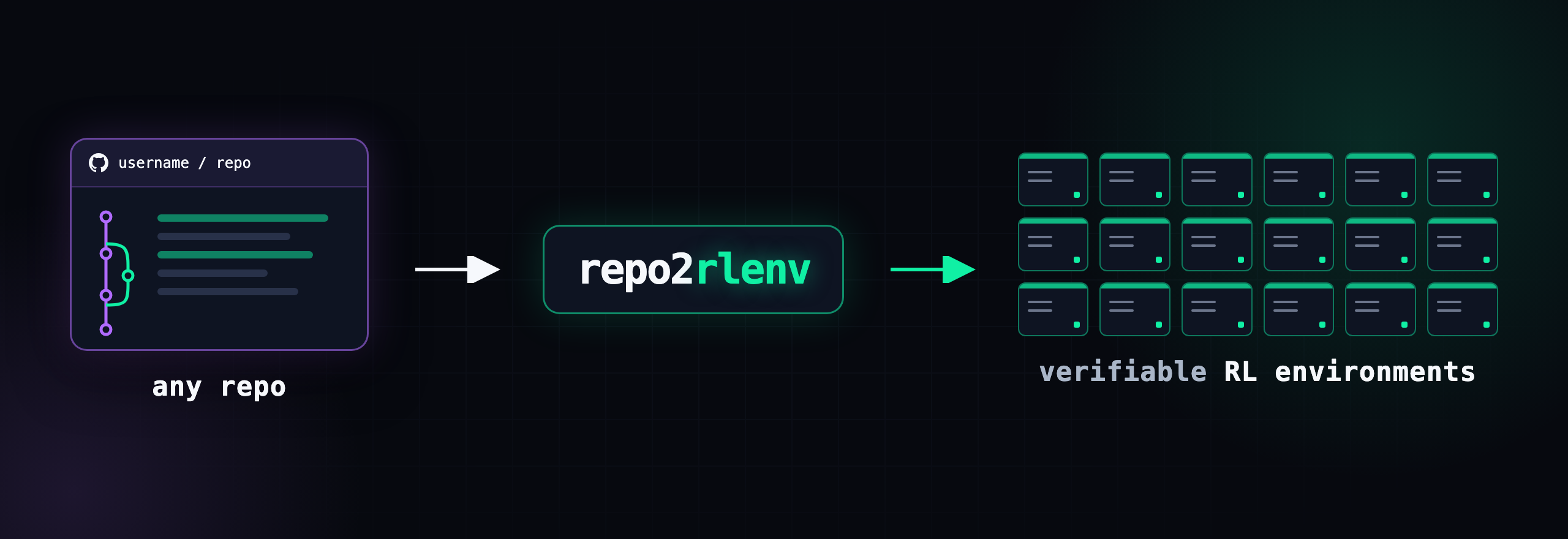
Coding agents get better by doing: attempting a real task, and being told by a program, not a person, whether they succeeded. Reinforcement learning needs thousands of those tasks, each with a working environment, an instruction that doesn't give the answer away, and a verifier you can trust. Building them by hand takes hours apiece.
Repo2RLEnv builds them from material that already exists: merged pull requests, commit history, security advisories, a library's own functions, terminal recordings and problem families. Each one becomes a standard Harbor task you can train on, evaluate with any agent, and share on the Hugging Face Hub.
23 generators · 21 published datasets · 1,930 tasks on the Hub · runs with any Harbor agent
What's new
| When | What | |---|---| | Nov 4, 2026 · v0.9.5 | Verifier hardening and stable dependency updates: stricter test grading, ungraded PR-diff evaluations when the judge is unavailable, Harbor 0.25 support and tested inference SDK updates. Release notes → | | Oct 23, 2026 · v0.9.4 | Task quality review and runtime fixes, with evidence-backed reviews, Harbor 0.24 compatibility, Windows process cleanup and dependency security updates. Release notes → | | Sep 29, 2026 | 📚 A new documentation site, with guides for every pipeline, a full CLI reference, and live explainer films that follow your light or dark theme. Read the docs → | | Sep 29, 2026 · v0.9.3 | 🧮 FrontierSmith turns closed-ended programming problems into optimization tasks with continuous, deterministic rewards. There's no known optimum, so a better solution earns more. Release notes → | | Sep 25, 2026 · v0.9.2 | 🧱 CodeMidas rebuilds removed features from their behavioral contract, with execution-grounded tests and independent rollout review. | | Sep 15, 2026 · v0.9.0 | 🤖 Tasksmith and 15 research recipes (SWE-smith, R2E-Gym, SWE-gen, SETA, SCALER and more) on one shared execution and review layer. |
Older releases are in the version history.
Quickstart
For the current LiteLLM/filelock dependency conflict, use the documented security override or a locked checkout when installing.
Generate your first environments in about five minutes. This first pipeline needs no Docker and no LLM key, just Python 3.12+ and the GitHub CLI.
pip install 'repo2rlenv[harbor]'
gh auth login
Turn three recent merged PRs from pallets/click into Harbor tasks
repo2rlenv generate --repo pallets/click --pipeline pr_diff \
  --pipeline-opt limit=3 --out ./tasks
Check the task structure and oracle assets
repo2rlenv validate ./tasks --oracle
Running tasks needs Docker. PR-diff grading also needs a correctness judge: set
ANTHROPIC_API_KEY and pass it to the verifier. Start with the reference solution,
then point a real agent at the tasks:
harbor run -p ./tasks -a oracle --env docker \
  --ve ANTHROPIC_API_KEY="$ANTHROPIC_API_KEY"
harbor run -p ./tasks -a claude-code -m anthropic/claude-sonnet-4-6 \
  --ae ANTHROPIC_API_KEY="$ANTHROPIC_API_KEY" \
  --ve ANTHROPIC_API_KEY="$ANTHROPIC_API_KEY" --env docker
Without an available judge, PR-diff results are ungraded: the verifier
writes no reward file, Harbor reports the trial as VERIFIER_FAILED, and RL
consumers drop it. A completed judge answer with no valid score is a graded 0; a reported output limit stays ungraded.
The quickstart guide walks through every step and what each file in a task is for.
Tasksmith: an agent that builds environments
Mining pipelines keep only the pull requests that pass their filters. Tasksmith adapts to each one instead. Point it at a merged pull request and an agent:
- investigates the change and the repository around it,
- bootstraps the repository's environment on a remote worker,
- designs the instruction and a private verifier,
- constructs the Harbor task, with the merged code as the reference solution,
- reviews and repairs its own work until the controls pass.
What you can build
Every generator produces a Harbor task. They differ in what they start from and how the agent's work is scored. Browse all 23 →
| Kind of task | Generators | How it's scored |
|---|---|---|
| Repository repair: fix real code in a real repository | Tasksmith, pr_runtime, commit_runtime, cve_patches, swe_smith, swe_next, r2e_gym | The repository's own tests: failing ones must pass, passing ones must stay green |
| Implementation and reconstruction: write or restore functionality | code_instruct, equivalence_tests, r2e, swe_flow, swe_gen, codemidas | Hidden or differential tests |
| Patch similarity: reproduce a real change | pr_diff | Diff similarity plus a required correctness judge; unavailable judgments are ungraded. No test suite needed |
| Terminal tasks: reach a state in a shell | seta_seed2synth, seta_evol, dataarc, tmax, endless_terminals, terminalworld, cli_gym | State checks in the container |
| Reasoning and optimization: no repository at all | scaler, frontiersmith | Exact answers (−1/+1), or a continuous score in [0, 1] |
The six native pipelines run on your machine. Tasksmith and the research recipes run their target code on Modal or Daytona workers, inside a budget you set.
Watch how they work
Each native pipeline has a one-minute explainer film in the docs.
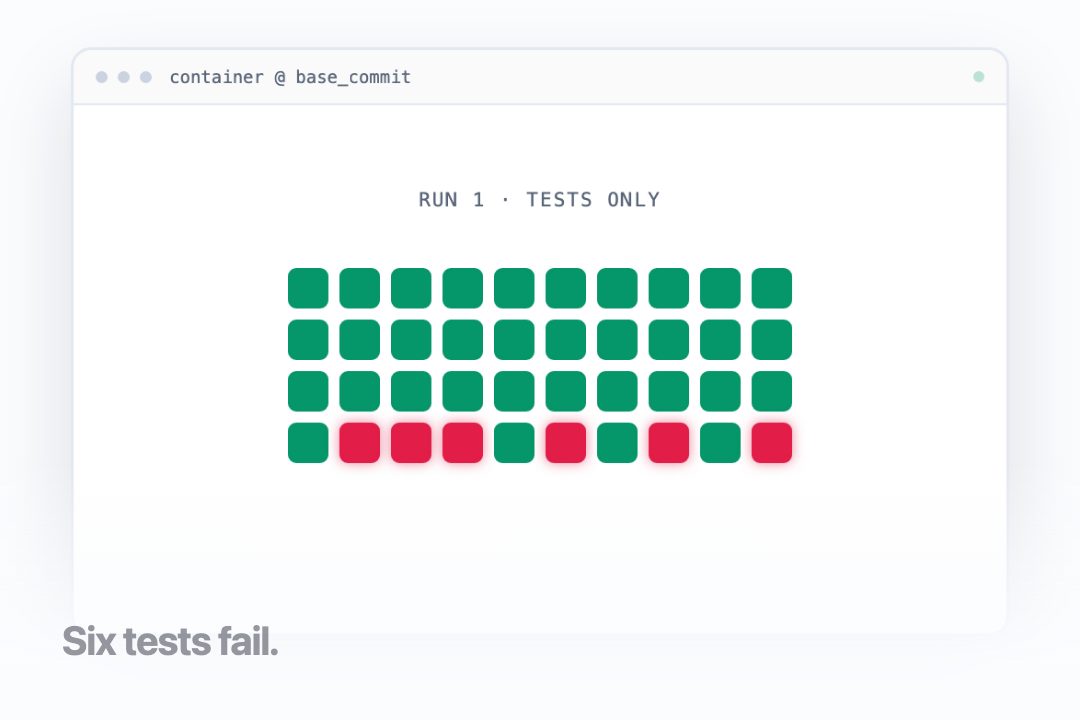 pr_runtime: the two runs |
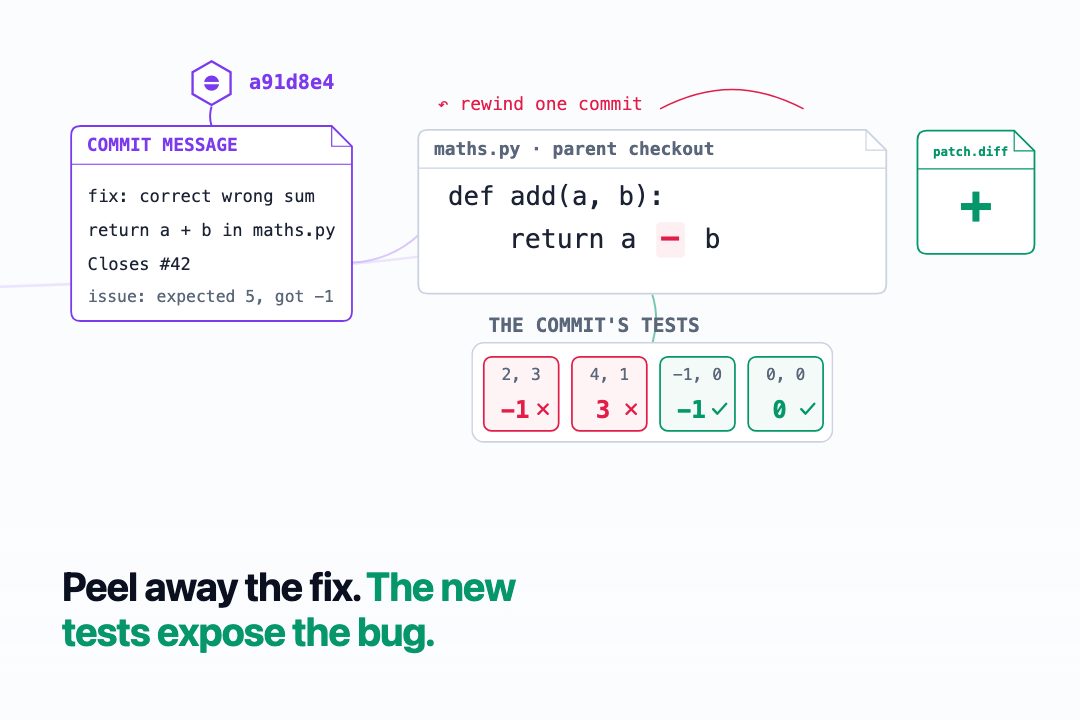 commit_runtime: the history walk |
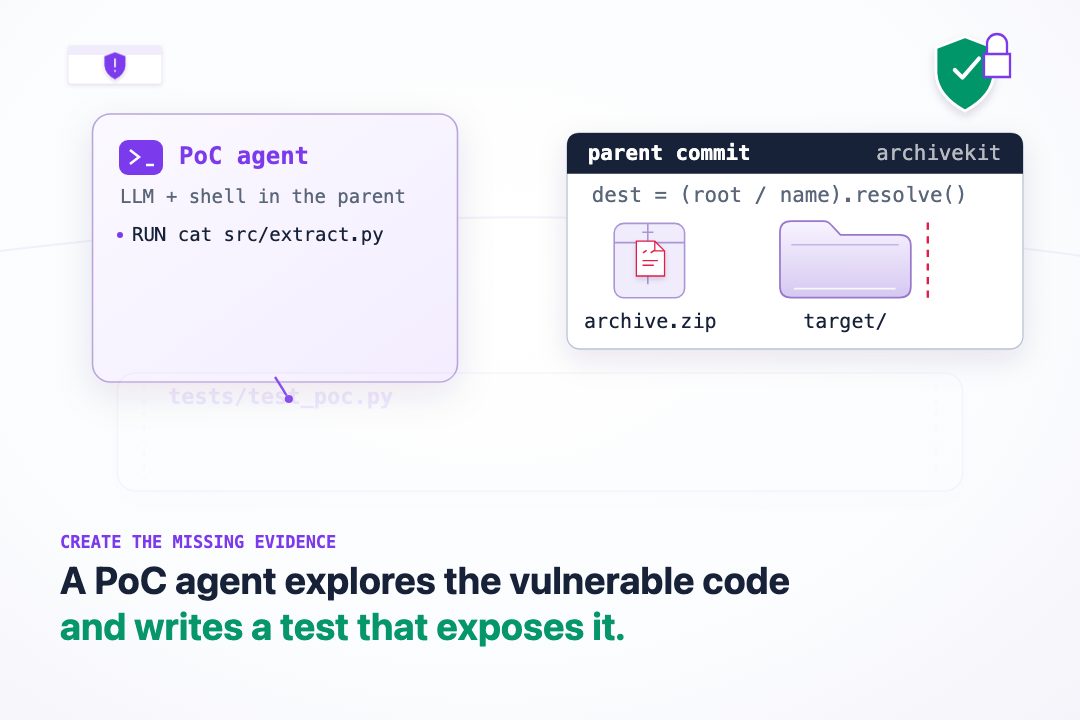 cve_patches: the advisory |
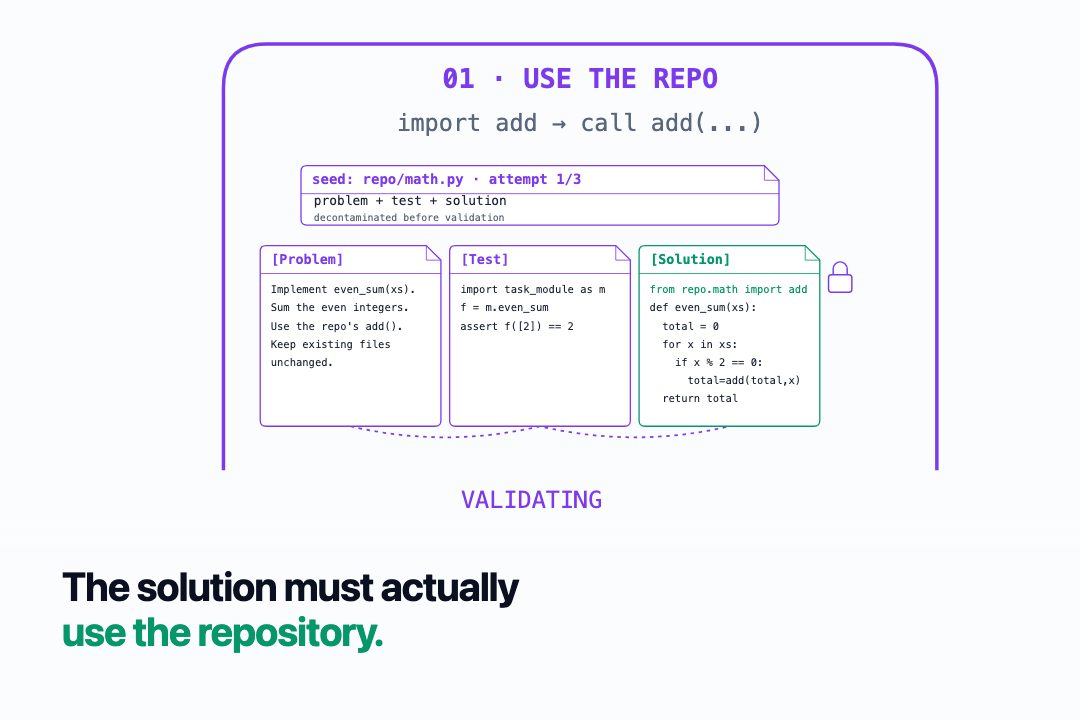 code_instruct: the gauntlet |
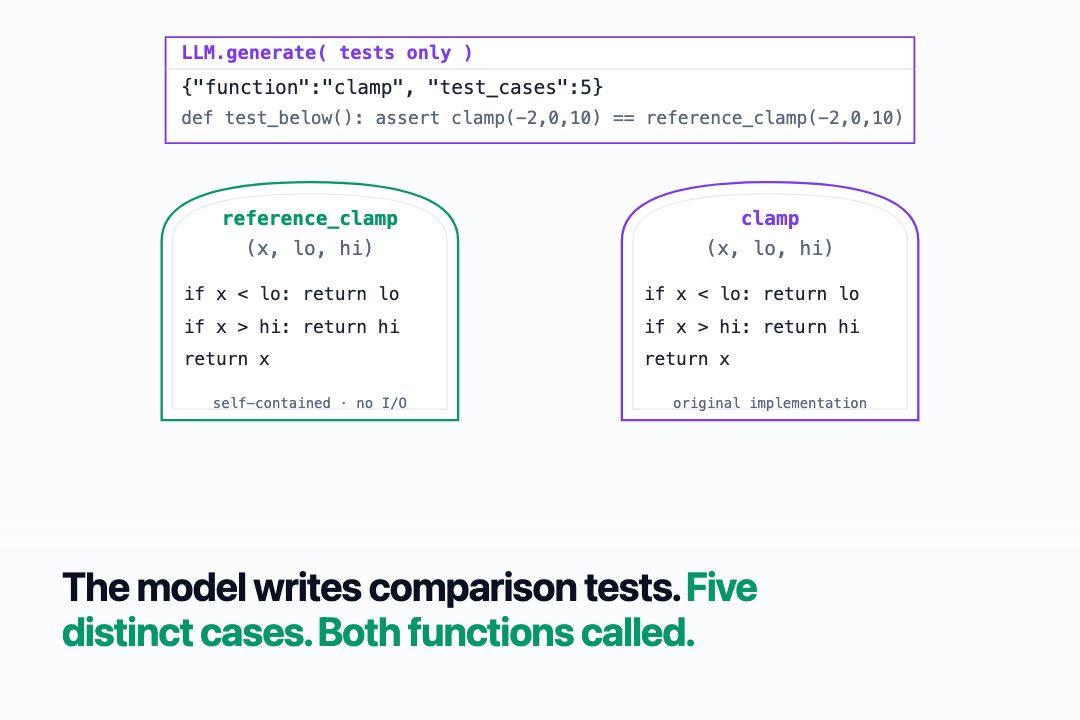 equivalence_tests: the mirror |
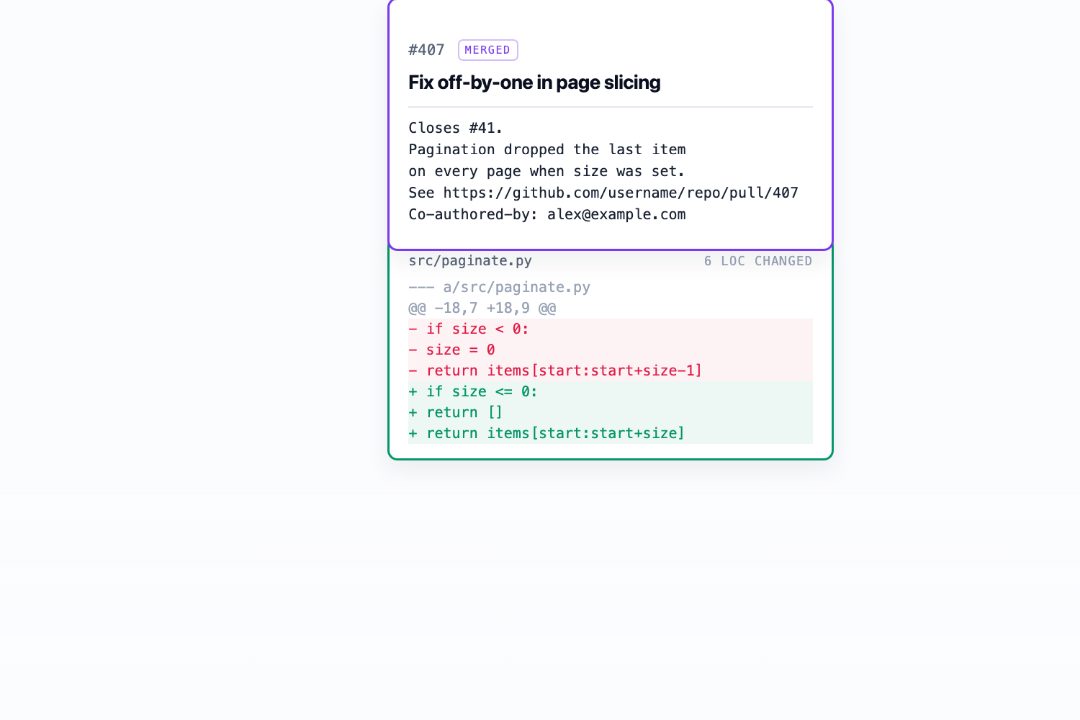 pr_diff: the split |
How it works
flowchart LR
    S["Repository, PR, commit,<br/>advisory or seed"] --> G["Generator"]
    G --> T["Harbor task"]
    T --> C{"Controls:<br/>oracle scores 1,<br/>no-op scores 0"}
    C -->|fails| R["Review and repair"]
    R --> T
    C -->|passes| L["Labeled task"]
    L --> H["Hugging Face Hub"]
    H --> A["Train or evaluate<br/>any Harbor agent"]
A task is a directory. The agent sees the instruction and the starting environment; the verifier and reference solution stay private until grading.
org__service-412/
├── instruction.md     what the agent is asked to do
├── task.toml          resources, provenance and evaluation label
├── environment/       the starting container
├── tests/             the private verifier, which writes the reward
└── solution/          the reference solution (the oracle)
A generated task is a starting point, not a guarantee. Controls, the review and repair loop and evaluation labels record how far each one has been checked. How it works →
Datasets
Start from ours: 21 datasets and 1,930 tasks in the Repo2RLEnv collection, each with its generation evidence and per-task evaluation labels. Browse them in the Harbor Visualizer, or pull one and run it:
repo2rlenv pull FineEnvs/repo2rlenv-pr-runtime ./pr-runtime
harbor run -p ./pr-runtime -a oracle --env docker
Publishing your own is one command: repo2rlenv push ./tasks . The
release inventory and
yield and cost pages report
what each dataset contains and what it cost to generate.
Install
pip install repo2rlenv                               # native pipelines and the CLI
pip install 'repo2rlenv[harbor]'                     # + Harbor, to run and review tasks
pip install 'repo2rlenv[tasksmith,daytona,harbor]'   # + Tasksmith on Daytona (or modal)
mutation adds what swe_smith needs. Native runtime pipelines use local Docker;
Tasksmith, the research recipes and the review loop need a Modal or Daytona account and
run their controller on Linux, macOS or WSL. See
installation for every extra and
credential.
Documentation
- Get started: introduction, quickstart, installation, choosing a pipeline
- Concepts: how it works, anatomy of a task, rewards, quality and verification
- Pipelines: every generator, with stage diagrams and the exact prompts
- Guides: running with Harbor, remote workers, publishing, troubleshooting
- CLI reference · Design RFCs · Release notes
llms.txt
for coding agents.
Contributing
New pipelines, recipes, log parsers and docs are all welcome. Read CONTRIBUTING.md and, for a new generator, start with an RFC and the guide to adding a pipeline.
License and credits
Repo2RLEnv's own code is Apache-2.0.
The research recipes are credited, independent adaptations of published methods; bundled
adaptations keep their MIT and Apache-2.0 licenses, so the distribution is
Apache-2.0 AND MIT. Third-party notices
link each recipe's source revision, retained material and attribution. Source
repositories and generated tasks keep their own terms; check each dataset's license and
provenance before redistributing it.