
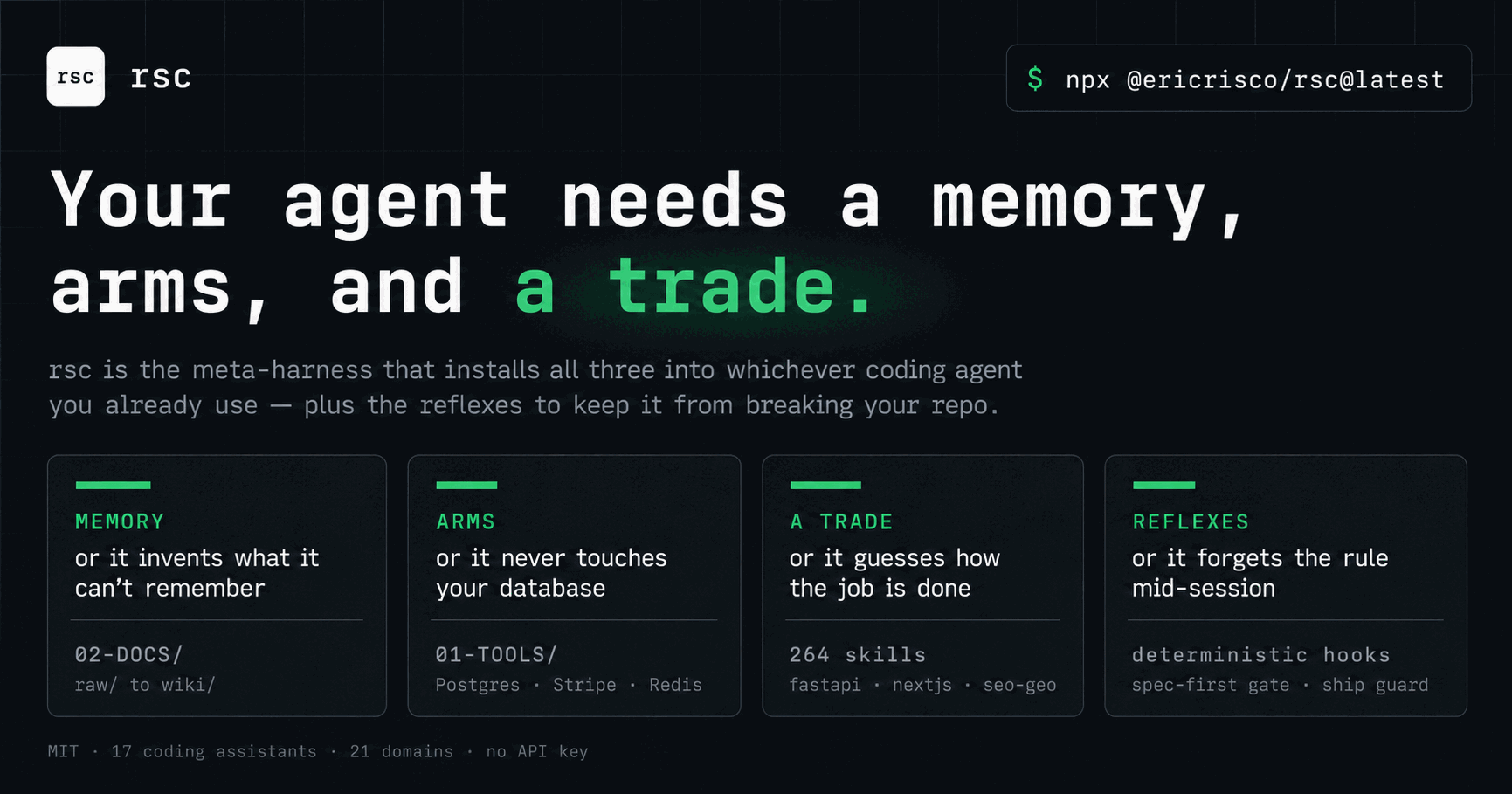
rsc-harness — You decide what to build. It builds your agent's harness.
You decide what to build. rsc-harness builds your agent’s harness. Tell it whether you are shipping software, running operations, researching, creating content, or mixing them. Its wizard reads the project, applies strict best practices, and shows the exact harness plan before writing.
Give this URL to your agent:
Read https://ericrisco.github.io/rsc-harness/ and set up rsc for this project.
Ask me the onboarding questions, show me the exact plan, and wait for my acceptance before writing.
Or start from the terminal:
npx @ericrisco/rsc@latest onboard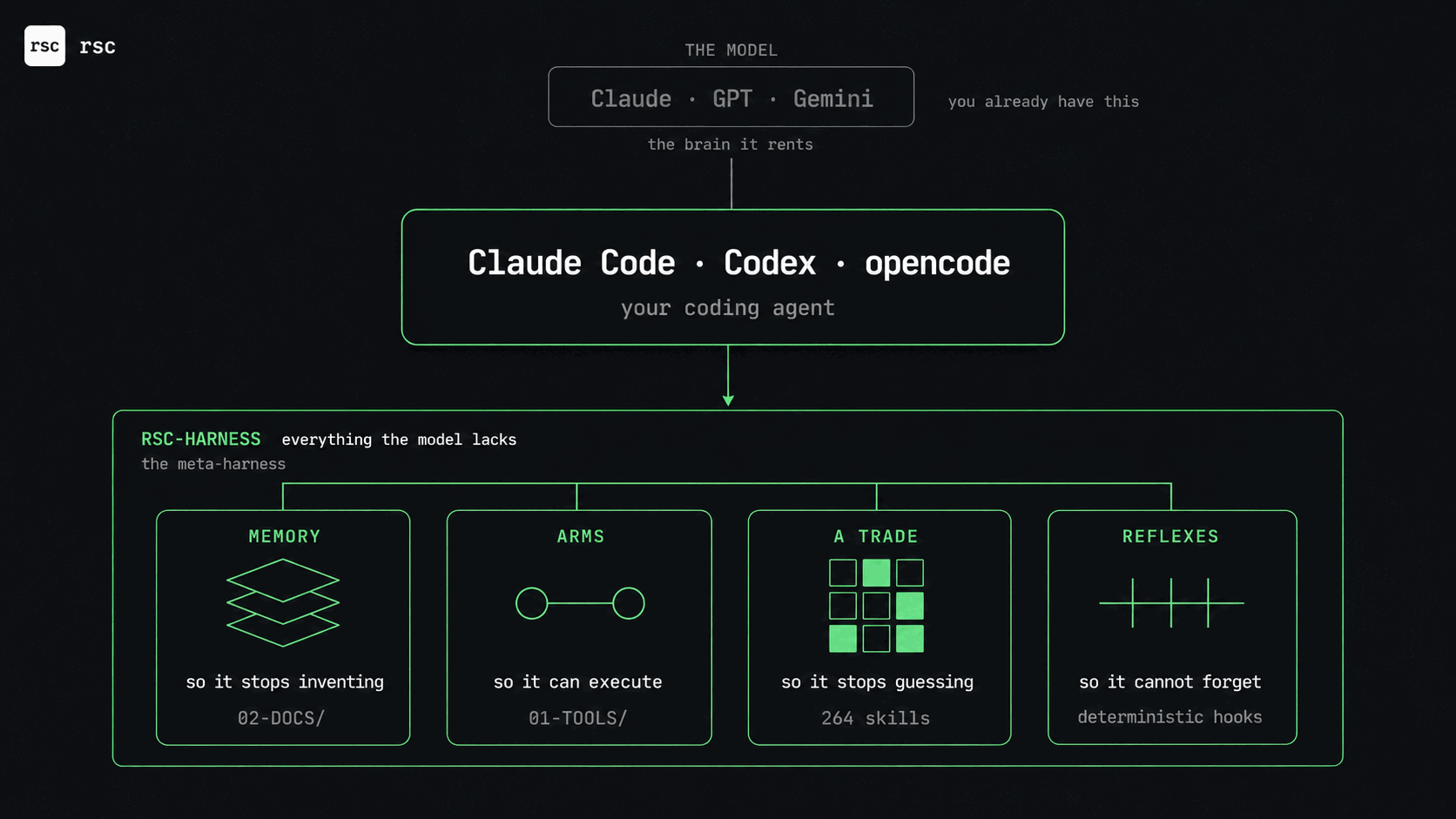
Your agent needs a harness. It should not improvise one.
A model is only the brain. Real work also needs project memory, tools, domain knowledge, rules and repeatable workflows. Add those pieces ad hoc and the result becomes a Frankenstein harness: duplicated instructions, unrelated skills, premature hooks, unnecessary MCPs and no clear owner.
Open standards already cover individual parts — Agent Skills, MCP and AGENTS.md — but they do not decide which complete harness this project needs. rsc-harness does that job through one guided flow:
- You state the outcome. No skill, hook or MCP vocabulary required.
- The wizard reads only the project root and asks technical level, accompaniment, project kind,
- A proportional plan explains every choice. Selected, deferred and excluded pieces all have a
- The result is verified. Shared sources prevent duplication; knowledge loads progressively;
- It grows from evidence. A deferred capability is proposed later only when the project actually
That is what “best practices” means here: a small, separated, project-bound and auditable harness — not a pile of whatever an agent happened to install.
🤖 For agents: "install this harness"
If you're an AI coding agent (Claude Code, Cursor, Copilot, Codex, Gemini…) and your user asked you to install rsc / this harness / these skills, run this in the **root of the project they're equipping* — not inside a clone of this repo (see the note under Install*):
npx @ericrisco/rsc@latest onboardThat launches the binding plain-language onboarding. It asks the user for technical level,
accompaniment, project kind and goal before it writes anything, reads only the selected project
root, and shows every selected or deferred skill, agent and hook with its reason. Relay those
questions to the user; never invent or default their answers. The first pass writes nothing and
prints a SHA-256 plan id. Only rerun with --accept-plan after the user accepts that exact plan.
If the project already has a skill of its own with a catalog name, the plan lists it under
Your own skills this plan replaces — tell the user before accepting; renaming their folder and
regenerating the plan keeps theirs.
For a non-interactive agent, collect the answers and preview the same plan explicitly:
npx @ericrisco/rsc@latest onboard --technical-level mixed --accompaniment L1 \
  --project-kind software --goal "small compound-interest website" \
  --software-scope small --target codex
After the user accepts the printed plan:
npx @ericrisco/rsc@latest onboard --technical-level mixed --accompaniment L1 \
  --project-kind software --goal "small compound-interest website" \
--software-scope small --target codex --accept-plan PRINTED_SHA256_ID- Choose assistants non-interactively: add
--target claude(comma-separate for several) toonboard. - Two assistants already installed? rsc asks instead of guessing.
--targetsettles it in one word. - Already installed, just refreshing skills + hooks:
rsc sync(or re-run the command above). - Add one skill by id:
rsc add· browse the catalog:rsc consult "or" rsc list.
rsc-suggest proposes the next skill as tasks appear, and in
Claude Code a hook re-asserts the lane decisor on every turn — so every request is classified
before anything is written.
🛣️ Three lanes, and the harness never picks the expensive one for you
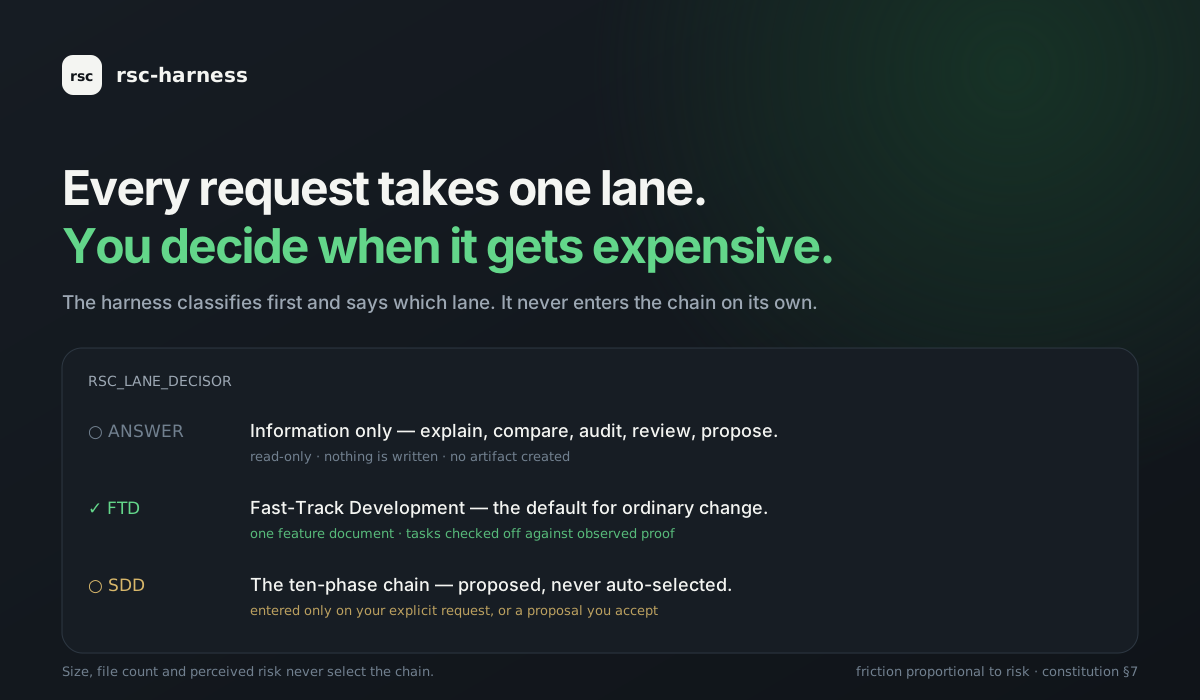
Every turn takes exactly one lane, and your agent names the one it took in a line.
- Answer. The request asks for information — explain, compare, investigate, audit, review,
- FTD — Fast-Track Development. The request authorises a change. This is the default for
- SDD — the ten-phase chain. Unchanged, and the harness never enters it alone. It proposes
Isolation cleans itself up. When a lane opens a branch or a worktree, you no longer have to
remember to retire it: a post-merge hook does it the moment the work lands on the trunk, on both
landing paths — a local merge and the pull after a forge merge. It removes only what is provably
landed and holds nothing unsaved; anything it refuses tells you why. The previous version asked an
agent to run the cleanup at the end of a long phase, and that step was skipped on both features that
reached it.
Earlier versions routed everything that sounded like building into the chain. That contradicted the project's own first rule — friction is proportional to risk — and a harness that interrupts the 80% that is harmless gets switched off, which protects nothing. Both lanes are still here; what changed is which one you land in by default, and who decides.
Why this exists
An improvised harness tends to grow by accumulation: more files, more context and more rules, with no method deciding whether each piece belongs. rsc-harness keeps that construction disciplined:
- Granular by default. The unit of installation is one skill. Install
fastapi without ever pulling go. Nothing you don't use touches your context.
- Self-recommending. Both the terminal (
rsc consult) and the chat
rsc-suggest, an always-on detector) watch what you're doing and propose the
next skill the moment a task needs it — a one-word confirm installs it.
- Not code-only. First-class support for running a company: bookkeeping,
02-DOCS/ knowledge loop that learns from your own results.
- Specialists follow the stack. The four base agents stay small; installing a
rsc add go, for
example, adds the Go pair without pulling reviewers for every other language.
- A new local session continues the old one. Claude Code, Codex, Gemini CLI
- Honestly good. Every skill was built by a research → spec → implement →
scripts/skill-rubric.md, written before any skill existed). The bar was
real: skills that scored 8.0 were sent back and fixed, not waved through.
skills/ is the single source of truth. There are no bundles to argue
over: you start with a tiny floor and grow one piece at a time.
New sessions pick up the latest local work
On supported local targets, rsc checkpoints observable repository state at safe boundaries: branch, worktree, HEAD, changed paths, commits and SDD ledger status. When a new session opens in the same checkout, that state is injected before the first agent action. A completed edit is preserved even if the previous client closed before its normal session-end event.
- Full: Claude Code, Codex, Gemini CLI and OpenCode. Codex asks you to inspect
/hooks; until then doctor reports that
trust is still required.
- Assisted: Cursor desktop. Its start hook is fire-and-forget, so rsc also
- Never cloud: Cursor Cloud, Codex Cloud, remote agents, cloud storage and
The journal never stores prompts, responses, tool output, file contents or
secrets. It stays in a git-excluded project-local path, retains 30 days, and
injects at most 4,096 bytes. Disable every memory surface for a project with
rsc memory off; re-enable it with rsc memory on.
Install
npx @ericrisco/rsc@latest onboardPrefer the short rsc command? Install once, globally:
npm install -g @ericrisco/rsc # then just: rscRun it inside any project and describe what you want. Working on the catalog itself? Clone and link:
git clone https://github.com/ericrisco/rsc-harness.git ~/rsc-skills
cd ~/rsc-skills && npm install && npm link
Run it inside the project you're equipping — not inside this repo. The
catalog's ownpackage.jsonis named@ericrisco/rsc, sonpx @ericrisco/rsc
from within a rsc-harness clone resolves to the local (unlinked) bin and
dies with sh: rsc: command not found. Working on the catalog itself? Use
node scripts/rsc.js …, thenpm linkabove, or pin the published build with
npx @ericrisco/rsc@latest ….The first run asks how technical the conversation should be, the accompaniment level, what the
project is for, its goal and the assistants to target. It then presents the complete plan. A small
website can defer SDD, agents and code guards; an operations harness does not receive them merely
because it lives in a repository. Deferred components record the evidence that would make rsc
recommend them later. rsc reassess reports that evidence but still cannot install anything
without a newly accepted plan.
Everything stays in the project, and the real skill files are written
once to .rsc/skills/. Each assistant you pick gets a lightweight
symlink back to that shared base — no copy is duplicated across IDEs. (If the
filesystem can't symlink, it falls back to a real copy automatically.)
On targets with file-based agents, the four base agents are installed too;
stack specialists remain selective. Native command targets receive only entry
points whose backing skill, agent or local-memory capability actually exists.
30-second tour
$ rsc onboard
 ██████╗ ███████╗ ██████╗     ← animated gradient wordmark
 ██╔══██╗██╔════╝██╔════╝
 ██████╔╝███████╗██║
  273 skills · one CLI · zero bloat
How technical should the conversation be?
How much accompaniment do you want?
What are you building or running?
What do you want this project to achieve?
RSC_ONBOARDING_PLAN
Plan id: <sha256>
Selected: …
Deferred: …
Accept this exact harness plan?
The terminal and chat adapters produce the same normalized answers and plan id. If project evidence
changes between preview and acceptance, rsc returns RSC_PLAN_CHANGED and writes nothing. After an
accepted application it verifies the receipt and managed state before printing RSC_ONBOARDING_READY.
That verdict is not just about the receipt: it also requires the harness floor to exist —
01-TOOLS/_TEMPLATE/, 02-DOCS/wiki/harness/, and the constitution when the plan selects SDD.
If the floor is missing, the install applied but prints RSC_ONBOARDING_INCOMPLETE with each
missing path and the action that creates it, because a plan that promised little used to be able to
report success with three markdown files.
The CLI
Fresh projects enter through rsc onboard. The direct add and install forms below
are maintenance controls for projects that already carry an .rsc.json declaration; they cannot
bypass onboarding in a new folder.
rsc onboard                         # binding plain-language onboarding (recommended)
rsc reassess                        # check persisted deferral triggers; never installs by itself
rsc add fastapi postgresdb           # install specific skills, by name
rsc add youtube-api remotion-video   # …grow a channel, edit with Remotion
rsc add fastapi --target claude,codex   # install into several assistants at once
rsc consult "I want to launch a SaaS"  # recommend only, no install
rsc registry refresh                 # write .rsc/skill-registry.{json,md}
rsc list                             # installed skills, agents and commands
rsc capabilities                    # installed/available surfaces + memory mode
rsc doctor                           # health, missing backing, hooks and local memory; exits 1 when unhealthy
rsc memory status                    # full / assisted / unsupported / degraded
rsc memory save --session handoff    # force a deterministic local checkpoint
rsc memory resume                    # print this branch/worktree continuation
rsc memory learn --text "…" --evidence "…" --confidence 0.8 --approve
rsc memory off                       # disable hooks, commands and injection project-wide
rsc sync --target claude,codex       # refresh managed skills/hooks from the current package version
rsc backups                          # list project-local snapshots
rsc restore latest --dry-run         # preview restoring the newest snapshot
rsc restore <snapshot-id>            # restore a project-local snapshot
rsc upgrade --dry-run                # show npm upgrade + sync commands
rsc uninstall postgresdb --dry-run   # preview a removal
👥 Sharing a harness with your team
The harness travels by git, but not all of it — and the split is the point.
Commit these:
| | |
| --- | --- |
| .rsc.json | The decision: which assistants, which skills, which catalog version, the developer tier, which gates you disarmed |
| 01-TOOLS/ · 02-DOCS/ | Your tooling and your wiki, if you use them |
| Skills and agents you wrote by hand | They are yours. rsc does not claim them, does not count them as drift, and does not touch them |
Do not commit these — rsc adds them to .gitignore for you:
| | Why |
| --- | --- |
| .rsc/ | Machine state: hook scripts, seals, logs and fallback session memory |
| 02-DOCS/raw/worklog/.rsc-memory/ | Preferred session journal when a local wiki exists; protected with git's local exclude |
| The skill entries rsc manages | Symlinks on macOS/Linux, real copies on Windows — two incompatible shapes of one thing |
Three files carry the harness through git: .rsc.json (what the team decided),
.claude/settings.json (the wiring), and .claude/rsc-bootstrap.mjs — the small file that
notices, in a clone, that the rest is not there yet. Commit all three. If your project
ignores the assistant's directory wholesale, rsc adds the lines that keep those files versioned —
verified against git, not against the pattern.
And say it plainly, because committing it is the point: .claude/rsc-bootstrap.mjs is code that
runs on every session and every shell call, so a pull request that edits that file runs on the
machine of whoever reviews the branch. That is true of .claude/settings.json already, and of any
hook-based harness — but it is worth knowing before you agree to commit a third one. Review changes
to it the way you would review a CI workflow.
Whoever clones runs one command and ends up with the same harness — at the version the
project pinned, which is the catalogVersion in its .rsc.json:
npx @ericrisco/rsc@<catalogVersion> syncYou do not have to know that, or find it. Open the project and the assistant tells you, in the first message: what is missing, what would be installed, and the exact command, naming the pinned version. It asks; it does not install anything on its own and it does not hold up whatever you sat down to do. Say no and it stops asking on that machine.
Not @latest, and the difference is the whole point of sharing: a teammate who clones in three
months gets what you had, not what shipped since. Upgrading is something a person decides, writes
into .rsc.json, and commits — and then it reaches everyone through git, like any other change.
When someone changes the harness and you git pull, rsc doctor tells you what no longer
matches. Nothing is ever written to your machine by a pull — you are told, and you decide.
Own skills. A skill your team wrote lives in the repo and already works for whoever clones,
with no command at all. rsc never installs, updates or overwrites it: its version is the commit.
Installing a catalog skill of the same name is refused rather than silently winning, and doctor
lists what is yours by reading the files themselves — no list to keep in .rsc.json, because a
list somebody has to remember to update is a list that goes quietly stale. Declaring a skill under
ownSkills still works and still reports when someone is missing it.
🩹 Something's off? One command
Recognise any of these? They are all the same fix.
| What you see | |
| --- | --- |
| "target": "codex" when you work in Claude Code | |
| This target has no hook injection and you did not expect that | |
| Skills appear that you never asked for | |
| A hook seems to run several times per turn | |
| Template lines showed up inside your hand-written AGENTS.md | |
(A fresh clone is not in this table any more: nothing is broken there, the harness was simply never built on that machine, and the assistant now says so itself — see sharing by git above.)
npx @ericrisco/rsc@latest repairSafe in any folder: with no rsc there, it says so and writes nothing. It shows what it
found before touching anything, keeps a recoverable copy, and running it twice changes
nothing the second time. Add --dry-run to see the whole pass without a single write.
What it fixes on its own — putting the harness back to what was already declared: dangling links from a clone, hooks wired several times, the 0.1 layout no assistant reads.
What it asks about — anything that changes a decision: moving the harness to another assistant, or touching files you already committed.
What it never touches: skills and agents you wrote by hand. rsc did not install them, so rsc does not repair, move or delete them — not even when rebuilding from scratch.
Update
rsc is an npm package, so updating is two steps — bump the package, then
re-sync what's already wired into your project:
npm install -g @ericrisco/rsc@latest   # global install: pull the newest catalog
rsc sync                               # refresh managed skills + hooks (auto-detects your assistant)
Not sure what a bump touches? Preview the exact commands without writing anything:
rsc upgrade --dry-run # prints the npm install + rsc sync lines for your targetRunning through npx (no global install)? There's nothing to upgrade —
npx @ericrisco/rsc@latest always fetches the latest published catalog; just run
rsc sync afterwards if the project already has skills installed.
Every sync snapshots the project first, so a bad update is always reversible:
rsc backups                            # list project-local snapshots
rsc restore latest --dry-run           # preview restoring the newest
rsc restore <snapshot-id>              # restore it
How recommendation works
Two faces, one catalog (manifest.json):
- In the terminal —
rsc/rsc consultrank the catalog against your words
recommends.
- In the chat —
rsc-suggestis a tiny always-on skill. When a task would
rsc add for you. It's the floor — installed with every profile.
Repo detection maps real signals to skills: package.json + next → nextjs;
go.mod → go; pyproject.toml → fastapi; *.sql/prisma/ → postgresdb;
Dockerfile/.github/ → docker/github-actions; and so on. An empty repo
just asks in plain language.
The catalog
273 skills, grouped by what you're trying to do. Click any skill to read its
SKILL.md. It fires on its own when a task matches.
🧭 Core & control plane
The front door and the workspace brain.init · harness · orient · suggest · bro · unslop · author-skill · sdd-init
harness is the Karpathy chaos→knowledge engine — a 01-TOOLS/ layer (one
folder per provider, each with a workingtest_connection) and a02-DOCS/
self-improving wiki. It governs software or a whole company. orient is the
always-on compass that keeps a non-technical human oriented after every step.
bro is installed with every profile and rewrites any answer in plain, natural
language when the user asks — without making its full body always-on.

Anything you drop in goes to inbox/ and is ingested; the wiki consolidates it as plain markdown you can open as an
Obsidian vault; and every skill reads it before acting, so the next session starts where the last one stopped. Raw
sources and the agent's own worklog stay underneath — present, never deleted, out of the way.
#### 📦 The 02-DOCS/ brain is now 100% Open Knowledge Format (OKF v0.1) conformant
> Google Cloud published the Open Knowledge Format
— a vendor-neutral standard for portable, agent-readable knowledge — built on the
same Karpathy LLM-wiki pattern our 02-DOCS/ engine has used from day one. We
independently converged on the same design, so adopting the standard cost almost
nothing. As of now, every 02-DOCS/wiki/ is a valid, portable OKF bundle:
> - Markdown + YAML frontmatter, type on every concept doc, OKF-standard
fields (title,description,resource,tags,timestamp).
- Standard markdown links (not wikilinks) form the knowledge graph — any OKF
consumer reads it, and it stays a native Obsidian vault (graph, backlinks,
Properties, Bases). Same files, no export step.
- Reserved files honored: index.md (no frontmatter) for navigation,
log.md (newest-first, ISO 8601) for history.
> Tarball a wiki/ and any OKF tool — including Google's own viewer — can read it.
And the brain now keeps your repo clean: a loose file it ingests (a PDF at the
root, anything ininbox/) is moved intoraw/, never left as clutter.
📐 Spec-Driven Development
Two lanes for change:ftd for ordinary work — one feature document, evidence, done — and the ten-phase chain when durable artifacts would settle a real ambiguity. Both ship with the harness.
ftd · sdd · constitution · idea-refinement · specify · clarify · plan · tasks · analyze · decision-challenge · implement · source-grounded-development · verify · review · simplify-code · ship · debug · worktrees · parallel
Two of those are not phases the chain walks on its own.idea-refinementis invoked —specifyruns its FRAME block before the first question round.decision-challengeis on-demand: it exists, it is good, and no phase calls it yet. Listed so you can reach for it, not because the chain will. And the limit of what FRAME buys you, stated rather than implied: a second reading by the same model breaks correlation of framing, not of model — it shares the priors it is checking.
💼 Run a business
finance-ops · invoicing · bookkeeping · pricing · sales-pipeline · lead-gen · cold-outreach · proposals · contracts · customer-support · client-onboarding · retention · hiring · people-ops · inventory · logistics-ops · procurement · meeting-notes · sop-builder · project-ops
💸 Raise & model money
pitch-deck · investor-materials · financial-model · fundraising · unit-economics · grants
⚖️ Legal, privacy & compliance
gdpr-privacy · terms-conditions · compliance · data-policy · ip-trademark
📣 Market & brand
marketing · seo-geo · content-engine · social-publisher · brand-voice · brand-identity · newsletter · landing-copy · ads · article-writing · case-studies · video-shorts · podcast · market-research · competitor-watch · press-kit · community · webinar · review-management
🎬 Grow a channel
Each with a02-DOCS feedback loop that learns from your own results. remotion-video edits programmatically — transitions, Whisper captions, silence removal.
youtube-api · youtube-strategy · youtube-ideation · youtube-thumbnails · youtube-packaging · remotion-video · tiktok-api · instagram-api · shortform-strategy · shortform-ideation · shortform-packaging · shortform-editing · viral-score · linkedin-api · linkedin-strategy · linkedin-content · linkedin-carousels · linkedin-outreach · medium-writing · medium-publishing · medium-strategy
🔌 Connect & automate
stripe · email-connector · google-workspace · notion-connector · whatsapp-telegram · automation-flows · api-connector-builder · webhooks · data-scraper · spreadsheet-ops · calendar-scheduling · document-processing · e-signature
⚙️ Automation
Operate the big automation platforms programmatically or via MCP — create and manage automations dynamically, not just design them on a canvas. automation-strategy decides whether / what / which platform; the platform skills drive the live REST API or MCP server (harness connectors ship for each). Complements automation-flows (visual design + importable workflow JSON).
automation-strategy · n8n · make · zapier · power-automate
📊 Data & analytics
analytics · dashboard · kpi-framework · reporting · ab-testing · forecasting · data-cleaning · business-intelligence
🤖 AI — build it in
building-agents · rag · embeddings-search · prompt-engineering · llm-pipeline · agent-eval · chatbot · ai-media · replicate-images · structured-extraction · agent-safety · cost-tracking
🛰️ AI — run it on
replicate · runpod · modal · huggingface · ollama · together-fireworks · fal
🎓 AI — train it
Train and adapt open models end to end: classic ML, deep learning, NLP, fine-tuning (with Unsloth), building training datasets, choosing open-weight models by license/size, and serving them at throughput with vLLM. Facts that move monthly (versions, model licenses) are verified at author time and hedged.
machine-learning · deep-learning · nlp · finetuning · training-data · unsloth · open-weights · vllm
🗣️ Languages
typescript · python · java · csharp-dotnet · php · ruby · cpp · elixir · bash-scripting · sql · go
🏗️ Frameworks & app stacks
fastapi · nextjs · react · react-native · vue-nuxt · angular · svelte · astro · solid-js · htmx · nodejs · nestjs · django · laravel · rails · spring-boot · phoenix · flutter · swift-ios · kotlin-android · compose-multiplatform · expo · tauri · electron · rust · wordpress · shopify · no-code-app · chrome-extension · api-design
🎮 Game development
Three engines + engine-agnostic disciplines. Every engine skill pins the current version and bans deprecated APIs, so the agent stops emitting stale Godot-3 / legacy-Unity code.
godot · unity · unreal · game-design · game-storytelling · level-design · gamedev-shaders · gamedev-multiplayer · gamedev-physics · gamedev-pathing · gamedev-shipping
🗄️ Databases & data layer
postgresdb · mysql · mongodb · redis · supabase · neon · planetscale · sqlite-turso · prisma-orm · drizzle-orm · firebase · dynamodb · vector-db · clickhouse-analytics · duckdb · db-migrations · backups
☁️ Ship & operate — platforms
vercel · netlify · cloudflare · railway · render · fly-io · coolify · hetzner · digitalocean · aws-essentials · gcp-essentials
🛠️ Ship & operate — devops
docker · github-actions · git-workflow · domains-dns · monitoring · email-deliverability · scaling · deployment · deprecation
🔒 Ship & operate — quality & security
code-review · security-scan · secure-coding · testing-py · testing-web · testing-go · e2e-testing · accessibility · performance · error-handling · observability
🌀 Motion & interface craft
motion-craft · ui-engineering · variant-explorer
🎨 Design & content craft
design-loop · design · design-dna · presentations · course-storytelling · course-builder · technical-writing · translation-l10n
🧠 Knowledge & meta
knowledge-ops · codebase-onboarding · research-ops · decision-records · continuous-learning · skill-scout · context-budget · roast-me · show-me · eli5 · fable-operator
Multi-target
skills/ is the catalog source. On install the real files land once
in the project at .rsc/skills/; each assistant you pick gets a symlink
(or a converted file) back to that shared base — pick several and nothing is
duplicated. The wizard asks which ones; --target a,b does it non-interactively.
| Target | Skill destination (→ .rsc/skills/) | Always-on detector |
| --- | --- | --- |
| claude | .claude/skills/ → symlink (copy on Windows) | SessionStart hook in .claude/settings.json |
| codex | .codex/rsc/ → symlink | block in AGENTS.md |
| copilot | .github/rsc/ → symlink | block in .github/copilot-instructions.md |
| cursor | .cursor/rules/ (converted) | always-apply rule |
| gemini | .gemini/rsc/ → symlink | block in GEMINI.md |
| windsurf | .windsurf/rsc/ → symlink | rule in .windsurf/rules/rsc-suggest.md |
| cline | .clinerules/rsc/ → symlink | rule in .clinerules/rsc-suggest.md |
| antigravity | .antigravity/rsc/ → symlink | block in .antigravity/AGENTS.md |
| zed | .zed/rsc/ → symlink | block in AGENTS.md |
| continue | .continue/rsc/ → symlink | rule in .continue/rules/rsc-suggest.md |
| roo | .roo/rsc/ → symlink | rule in .roo/rules/rsc-suggest.md |
| amp | .amp/rsc/ → symlink | block in AGENTS.md |
| opencode | .opencode/rsc/ → symlink | block in AGENTS.md |
| jules | .jules/rsc/ → symlink | block in AGENTS.md |
| junie | .junie/rsc/ → symlink | block in .junie/guidelines.md |
| kiro | .kiro/rsc/ → symlink | doc in .kiro/steering/rsc-suggest.md |
| aider | .aider/rsc/ → symlink | block in CONVENTIONS.md |
codex,zed,amp,opencodeandjulesall share the one root
AGENTS.md; the block is idempotent, so picking several writes it once.The richer surfaces are intentionally narrower than skill support:
| Targets | Stack agents | Native commands | Local session continuation |
| --- | --- | --- | --- |
| Claude Code | yes | agent + memory entries; skills already invoke natively | full |
| Codex | yes | no separate project-command surface | full after /hooks trust |
| Cursor desktop | yes | yes | assisted |
| Gemini CLI, OpenCode | yes | yes | full |
| GitHub Copilot | yes | yes | unsupported |
| Junie, Kiro | yes | unsupported | unsupported |
| Windsurf, Cline, Roo | unsupported | yes | unsupported |
| Antigravity, Zed, Continue, Amp, Jules, Aider | unsupported | unsupported | unsupported |
manifest.json is the generated public inventory: 33 agents (4 base + 29
selective specialists) and 53 command entries (20 fixed + 33 stack aliases).
Unsupported means rsc writes nothing for that surface; it does not emulate a
provider feature with an unverified file.
Skill format
Each skill is a directory under skills/ whose SKILL.md frontmatter
drives both triggering and the installer's recommendations:
---
name: my-skill
description: Use when [specific triggers]… Triggers: 'phrase', 'frase'. NOT x (that is sibling).
tags: [keyword, keyword]        # what the consult advisor searches over
recommends: [sibling-skill]     # what the system offers to install next
profiles: [core, full]          # optional: named-profile membership
origin: risco
---
The full agent-skill spec lives at agentskills.io/specification.
Repo layout & contributing
skills/ is the single source of truth — every skill is authored
there, once. After editing any skill:
npm run manifest      # regenerate manifest.json from skills/*/SKILL.md
npm run validate      # ajv-validate frontmatter + check recommends integrity
npm test              # unit + integration tests
bash scripts/eval-lint.sh   # validate every skills/*/evals/cases.yaml
manifest.json is generated, never hand-edited; CI runs npm run manifest:check
and fails if it's stale or the skill count drifts. Adding a skill is: create
skills/ with tags + recommends, run npm run manifest, done —
the rubric to hold it to is scripts/skill-rubric.md.
This is a personal catalog. Bug reports welcome via GitHub issues; PRs fixing detector patterns, provider endpoints, or typos are appreciated.
Third-party skills
Most of this catalog is written here. These are not, and they keep their author's credit:
| Skills | Source | License |
| --- | --- | --- |
| design-eng · animate · animate-expo · review-animations · improve-animations · find-animation-opportunities · animation-vocabulary · apple-design · prototype · pick-ui-library · write-swift · ask-sonner | emilkowalski/skills by Emil Kowalski, commit d23d7f8 | MIT |
| part of the AI-tell corpus in design | Leonxlnx/taste-skill | MIT |
Adapted, not mirrored: each one carries rsc frontmatter, routing evals, hand-offs to its siblings and — where it declares a binding rule — a checker with a test. The craft bar in them is the original author's. If you want the source of the motion material rather than this adaptation, go to animations.dev.
License
MIT. See LICENSE.