
layout: docs title: Overview of DIYbiosphere permalink: /docs/introduction/overview/

:tada: Welcome to the DIYbiophere repository :tada:
We really appreciate your interest in our project and we would :heart: your contributions!
About
The DIYbiosphere is a open-source project to connect Do-It-Yourself Biology (DIYbio) initiatives from all over the world. The goal is to have a shared and common platform that can connect people and ideas in all its possibilities and encourage the DIYbio community to work on a project together.How it works
The platform functions similar to a wiki, hosting the raw _files_ at https://github.com/DIYbiosphere/sphere and building/rendering _webpages_ at http://sphere.diybio.org via Jekyll and NetlifyEach DIYbio initiative has its own entry which are organized into eight collections: _projects_, _startups_, _labs_, _incubators_, _groups_, _networks_, _events_, and _others_. An entry is added by creating its own folder in its respective collection, and adding a _text file in markdown syntax_ with a _YAML front matter_, which is then rendered into its webpage. For example, the file _projects/MyDIYbioProject/MyDIYbioProject.md could look like this:
---
This is the front matter in YAML; between two lines of three consecutive dashes (---)
title: My DIYbio Project
start-date: 2000
type-org: non-profit
website: http://my-diybio-project.io
tags:
  - open hardware
  - citizen science

This is the text in Markdown syntax; after the front matter
My DIYbio project is about open hardware and citizen science.
The _front matter_ includes several key: value pairs that render into different elements in the webpage. The Avocado Lab is an example entry for pedagogical purposes. You can check out the raw file raw file rendered into this webpage. See the rendered image below, and by its side the different elements of the page labeled.
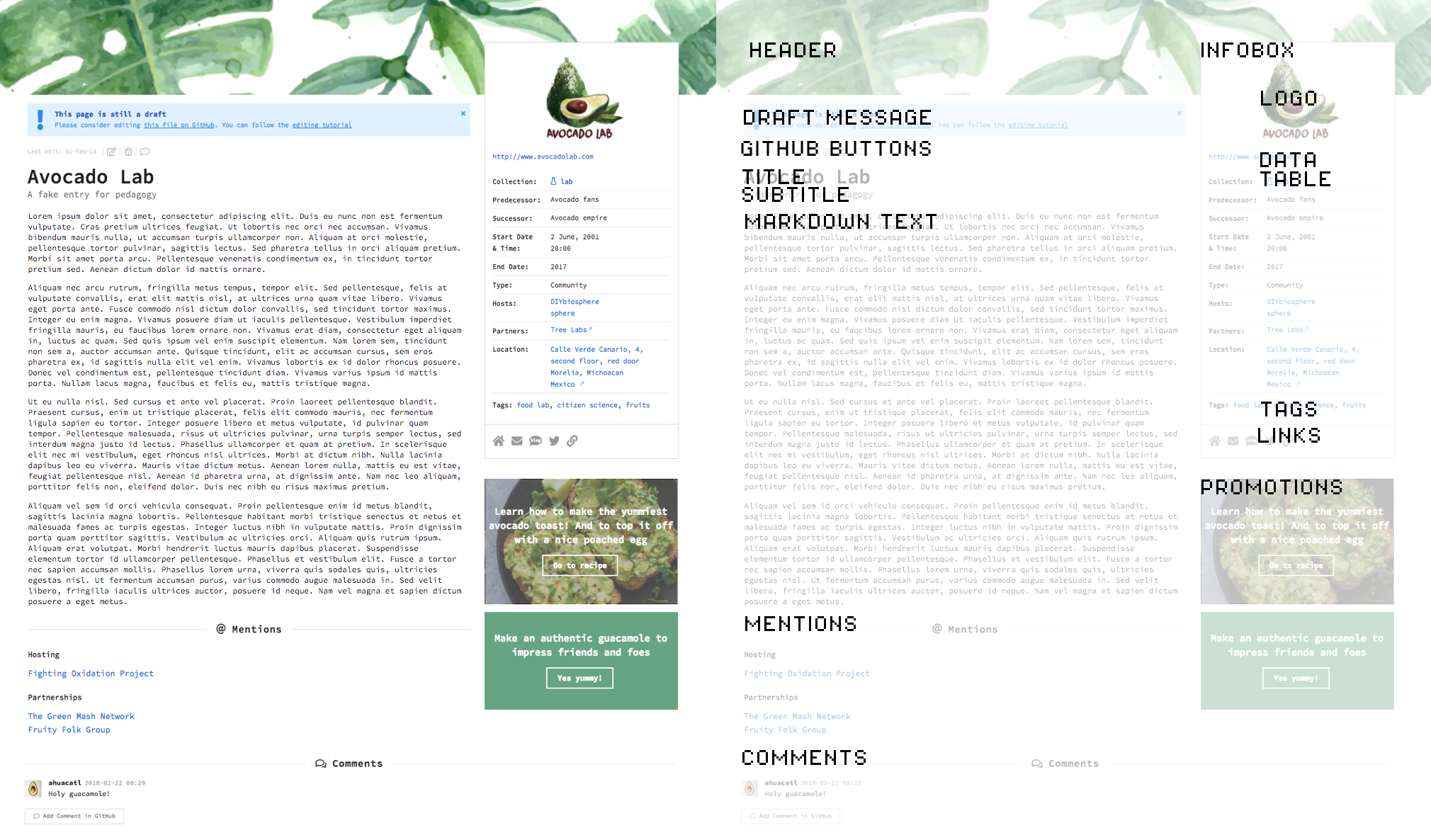 {:.ui.fluid.image}
Contribute
To contribute, you need a GitHub account (sign up).You also need to abide to our Code of Conduct (COC) and consent to our Contributor Terms (CT) determined by our Terms of Use (_aka_ Copyrights)).
TL;DR (Too Long; Didn't Read)
- COC: Be kind and respectful. Gross, rude or inappropriate behavior will not be tolerated. Confront wrongdoers directly or report them to the board of directors.
- CT: You freely share your contributions to the repository under the MIT license. If your contributions are displayed in the website, you freely waive authorship rights of these contributions (public domain; CC0), otherwise you will specify their copyright. You will also note contributions on behalf of third parties and specify their copyright.
In increasing order of engagement you can contribute to DIYbiosphere by:
- SHARING THE LOVE
- WRITING ENTRIES
- PARTICIPATING IN THE ISSUES
- GETTING INVOLVED
Copyright
In short: the work in DIYbiosphere is freely available to use, modify and distribute. More specifically:- Files in the Repository are available under the MIT License
- Content in the Website is shared under the public domain by CC0 License
You can review our Terms of Use for a human-readable version of the copyrights, and our Contributor Terms to understand in legal terms the rights granted and/or waived from your Contributions. For further detail you should read in full both MIT and CC0 licenses.