
EdgarTools — Python Library for SEC EDGAR Filings








EdgarTools is a Python library for accessing SEC EDGAR filings as structured data. Parse financial statements, insider trades, fund holdings, proxy statements, and 20+ other filing types with a consistent Python API — in a few lines of code. Free and open source.
!EdgarTools SEC filing data extraction demo
Why EdgarTools?
SEC EDGAR has every filing back to 1994, free — and almost none of it is ready to use. EdgarTools turns any filing into a typed Python object, so a 10-K's revenue is one line instead of an afternoon of XBRL parsing.
# Apple's latest income statement — rendered, standardized, done
from edgar import Company
Company("AAPL").get_financials().income_statement()
 Financial Statements Income, balance sheet, cash flow in one call XBRL-standardized for cross-company comparison |
 Every Filing Type 13F holdings, Form 4 insiders, 8-K events, funds, proxies Typed objects + pandas DataFrames for 20+ forms |
 Built for Pipelines & AI Rate-limit aware, smart caching, enterprise mirrors Built-in MCP server + LLM-ready text for RAG |
How It Works
Everything starts with a Company or a Filing. Call .obj() and you get a typed object built for that form — its data ready as pandas DataFrames and clean text.
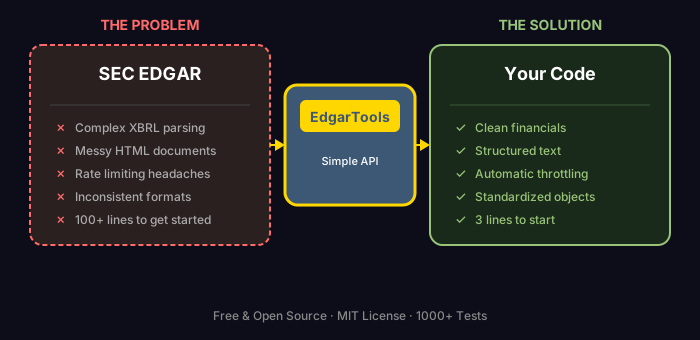
The same typed output that reads cleanly in a notebook drops straight into a pipeline: DataFrames for your warehouse, LLM-ready text and an MCP server for your AI stack, rate-limit and enterprise-mirror aware for scale.
Quick Start
1. Install
pip install edgartools2. Identify yourself to the SEC — EDGAR requires an email with every request. No key, no signup, no rate-limit tier; set it once:
from edgar import *
set_identity("[email protected]")
3. Get data — every filing is now a few lines away:
# Standardized financial statements, straight from XBRL
Company("AAPL").get_financials().income_statement()
The latest insider Form 4 as a structured object
Company("AAPL").get_filings(form="4").latest().obj()!Apple SEC Form 4 insider transactions parsed into a structured Python object
Next: explore the Use Cases below, or dive into the documentation and Quick Guide.
Use Cases
Financial statements from 10-K and 10-Q filings
financials = Company("MSFT").get_financials()
financials.balance_sheet()     # all line items
financials.income_statement() # revenue, net income, EPSInsider trading from SEC Form 4
form4 = Company("TSLA").get_filings(form="4").latest().obj()
form4.to_dataframe() # insider buy/sell transactions13F institutional holdings & hedge fund portfolios
thirteenf = get_filings(form="13F-HR").latest().obj()
thirteenf.holdings # every portfolio position as a DataFrame8-K current reports & corporate events
eightk = get_filings(form="8-K").latest().obj()
eightk.items # reported event itemsXBRL financial data across companies
facts = Company("AAPL").get_facts()
facts.query().by_concept("Revenue").to_dataframe() # revenue history as a DataFrameKey Features
|
Financial data
|
Filings & text
|
EdgarTools supports all SEC form types including 10-K annual reports, 10-Q quarterly filings, 8-K current reports, 13F institutional holdings, Form 4 insider transactions, proxy statements (DEF 14A), S-1 registration statements, N-CSR fund reports, N-MFP money market data, N-PORT fund portfolios, Schedule 13D/G ownership, Form D offerings, Form C crowdfunding, and Form 144 restricted stock. Parse XBRL financial data, extract text sections, and convert filings to pandas DataFrames.
Comparison with Alternatives
EdgarTools is a Python library that talks directly to SEC EDGAR. sec-api is the best-known hosted API that returns JSON. Both parse filings — the difference is how you work with the data, and what it costs you.
| | EdgarTools | sec-api |
|---|------------|---------|
| Cost | Free, MIT | $49+/mo |
| Data format | Typed Python objects → DataFrames | JSON you parse yourself |
| Where it runs | In your process — no key, no quotas, no vendor lock-in | Hosted API — key + rate tiers |
| Filing coverage | 20+ typed forms (10-K, 8-K, 13F, N-PORT, proxy…) | 15+ structured endpoints |
| AI / MCP |  Built in |
  |
| Open source | Inspect, fork, self-host | Proprietary |
|
| Open source | Inspect, fork, self-host | Proprietary |
Bottom line: in Python, EdgarTools gives you typed objects, AI-native output, and the full SEC corpus — free, open, and inspectable, with no keys or bills. pip install edgartools and you're querying filings in two lines.
Library or hosted?
EdgarTools is the open-source library — SEC-filing primitives you compose in your own code, free and self-run.
edgar.tools is the hosted platform built on that same open engine: the full SEC corpus as a managed service, so your team gets the data without running the pipeline — and without the black box of a closed API.
Reach for the library when you want control in your own stack; reach for edgar.tools when you'd rather not operate it yourself.
AI Integration
Use EdgarTools with Claude Code & Claude Desktop
EdgarTools includes an MCP server and AI skills for Claude Desktop and Claude Code. Ask questions in natural language and get answers backed by real SEC data.
- "Compare Apple and Microsoft's revenue growth rates over the past 3 years"
- "Which Tesla executives sold more than $1 million in stock in the past 6 months?"
Setup Instructions
Option 1: AI Skills (Recommended)
Install the EdgarTools skill for Claude Code or Claude Desktop:
pip install "edgartools[ai]"
python -c "from edgar.ai import install_skill; install_skill()"
This adds SEC analysis capabilities to Claude, including 3,450+ lines of API documentation, code examples, and form type reference.
Option 2: MCP Server
Run EdgarTools as an MCP server for any AI client -- Claude Desktop, Cline, or your own containerized deployment.
Add to Claude Desktop config (~/Library/Application Support/Claude/claude_desktop_config.json):
{
  "mcpServers": {
    "edgartools": {
      "command": "uvx",
      "args": ["--from", "edgartools[ai]", "edgartools-mcp"],
      "env": {
        "EDGAR_IDENTITY": "Your Name [email protected]"
      }
    }
  }
}
Requires uv. Alternatively, pip install "edgartools[ai]" and use python -m edgar.ai.
See AI Integration Guide for complete documentation.
❤️ Support This Project
EdgarTools runs in production at hedge funds, fintechs, and research desks — MIT-licensed, no keys, no subscriptions, and maintained by one person.
The SEC amends filing formats every quarter and ships a new XBRL taxonomy every year. Sponsorship is what keeps 20+ parsers current and funds new extractors as fresh disclosure types appear.


Recurring sponsorship + corporate tiers via GitHub · One-time thanks via Buy Me a Coffee
For teams running EdgarTools in production
If EdgarTools is in your data pipeline, GitHub Sponsors offers corporate tiers from $250 to $1,500/mo with:
- Response SLAs (24h–48h first response on critical issues)
- Quarterly strategy calls and roadmap input
- Logo placement in this README
- 7-day early access for internal regression testing
- Annual invoicing through GitHub — procurement-friendly
Community & Support
Documentation & Resources
Get Help & Connect
- GitHub Issues - Bug reports and feature requests
- Discussions - Questions and community discussions
Contributing
Contributions welcome:
- Code: Fix bugs, add features, improve documentation
- Examples: Share interesting use cases and examples
- Feedback: Report issues or suggest improvements
- Spread the Word: Star the repo, share with colleagues
Professional Services
Need help building production SEC data infrastructure? The creator of EdgarTools offers consulting for teams building financial AI products:
- SEC Data Sprint (1–3 days) — Working prototype on your data
- Architecture Review (1–2 weeks) — Pipeline audit with prioritized fixes
- Pipeline Build (2–4 weeks) — Production-ready code, tests, and handoff
EdgarTools is distributed under the MIT License