

The open-source thread-plane for Angular agents.




Threadplane is the open-source thread-plane for Angular agents. Chat, durable
threads, persistence, human approvals, tool progress, subagents, and generative UI — built on
Angular Signals and dependency injection, for Angular 20–22. Your backend stays
where it is: Threadplane adapts a LangGraph or AG-UI agent into a runtime-neutral
Agent contract that the UI consumes, and renders generated UI with the design
system components you already own.
MIT · Angular 20–22 · no account, no cloud
Experimental native React previews are available through the docs' Example UI
selector. The AG-UI JSON Render preview
uses the existing airline agent, six authored read-only views and native shared
state. These React packages remain private source builds; from a checkout, run
npx nx build cockpit-ag-ui-json-render-react and the matching npx nx e2e target.
Install
npm install @threadplane/chat @threadplane/langgraph @langchain/core @langchain/langgraph-sdk markedTalking to an AG-UI endpoint instead:
npm install @threadplane/chat @threadplane/ag-ui @ag-ui/client @ag-ui/core markedPeer dependencies:
@angular/core              ^20.0.0 || ^21.0.0 || ^22.0.0   # every Angular package here
marked                     ^15.0.0 || ^16.0.0              # @threadplane/chat
rxjs                       ~7.8.0                          # @threadplane/chat and both adapters
@langchain/core            ^1.1.33                         # @threadplane/langgraph
@langchain/langgraph-sdk   ^1.7.4                          # @threadplane/langgraph
@ag-ui/client              ^1.0.1                          # @threadplane/ag-ui
@ag-ui/core                ^1.0.1                          # @threadplane/ag-ui
Each package README lists that package's full peer set.
First success: a chat surface with no backend
Start with the fake agent. It streams a canned reply in the browser, so the UI can be built and tested before a server, a graph, or an API key exists.
// app.config.ts — no server, no LLM, deterministic output
import { ApplicationConfig } from '@angular/core';
import { provideFakeAgent } from '@threadplane/langgraph';
export const appConfig: ApplicationConfig = {
  providers: [
    provideFakeAgent({ tokens: ['Hello', ' from', ' Threadplane'] }),
  ],
};
// support-agent.component.ts
import { Component } from '@angular/core';
import { injectAgent } from '@threadplane/langgraph';
import { ChatComponent } from '@threadplane/chat';
@Component({
  imports: [ChatComponent],
  template: <chat [agent]="agent" />,
})
export class SupportAgentComponent {
  protected readonly agent = injectAgent();
}
agent.messages() and agent.status() are Angular Signals. Bind them directly
in a template — no subscriptions, no async pipe, no zone.js required. The same
fake agent is what tests run against: swap the transport, never the component.
Walkthrough: Try without a backend.
One UI, two adapters
When the UI works, point it at a real runtime. Only the provider changes — the
component above is untouched, because @threadplane/chat consumes the
runtime-neutral Agent contract rather than any adapter type.
// LangGraph Platform, or a local langgraph dev server
import { provideAgent } from '@threadplane/langgraph';
provideAgent({ apiUrl: 'http://localhost:2024', assistantId: 'agent' });
// Any AG-UI-compatible endpoint
import { provideAgent } from '@threadplane/ag-ui';
provideAgent({ url: 'http://localhost:8000/agent' });
Which one to pick: Choosing an adapter.
See it running
- demo.threadplane.ai — the LangGraph demo:
- ag-ui.threadplane.ai — the same chat surface
Packages
Published packages follow a patch-only 0.0.x release policy: no minor or major
bump silently changes a lockfile.
| Package | Purpose | License |
|---|---|---|
| @threadplane/chat | The Angular agent chat surface: @threadplane/langgraph | LangGraph adapter; provideAgent() / injectAgent() expose a LangGraph run as Angular Signals | MIT |
| @threadplane/ag-ui | AG-UI adapter; bridges any @ag-ui/client-compatible backend into the same chat surface | MIT |
| @threadplane/render | @json-render/core-backed Angular render engine that maps JSON specs to your own components | MIT |
| @threadplane/a2ui | A2UI protocol types, streaming parser, and dynamic-value resolver; pure TypeScript, no Angular dependency | MIT |
| @threadplane/middleware | Backend middleware for client-declared tools; the /langgraph entrypoint targets LangGraph.js | MIT |
| @threadplane/telemetry | Explicit Node and browser capture helpers for applications that choose to send events | MIT |
Generated UI renders through a registry you control:
import { provideViews, views } from '@threadplane/render';
provideViews(views({ KpiCard: KpiCardComponent, DisruptionsTable: DisruptionsTableComponent }));
An agent can render those components and nothing else, so generative UI stays inside your design system.
Architecture
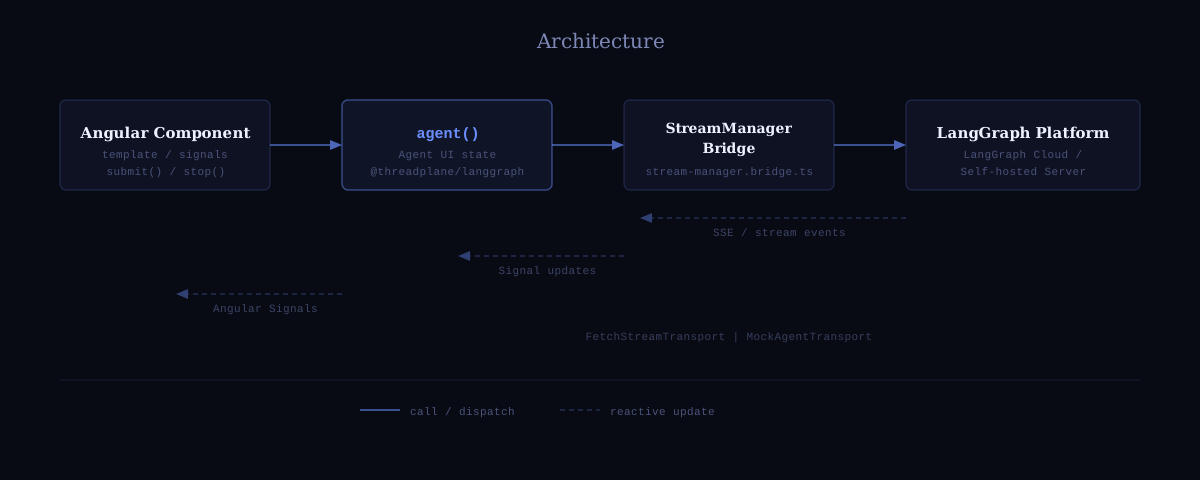
provideAgent() creates the agent's internal BehaviorSubjects at
injection-context time — once, when the provider factory runs. injectAgent()
retrieves the configured agent in any component. The StreamManager bridge (the
only file that touches @langchain/langgraph-sdk internals) pushes stream events
into those subjects. toSignal() converts each subject to an Angular Signal,
also at construction time. Dynamic actions (submit, stop, switchThread)
push into the existing subjects — no new subjects are ever created after
construction. This architecture is required because toSignal() must be called
in an injection context and cannot be called again later.
The runtime-neutral Agent contract is the stability boundary between adapters
and the chat surface. @threadplane/chat consumes Agent — not
LangGraphAgent — so swapping @threadplane/langgraph for
@threadplane/ag-ui requires no changes to chat components or templates.
Reliability: every pull request runs the "Library — lint / test / build" CI
job across all packages. Testing uses MockAgentTransport to swap the transport
layer, so injectAgent() itself never needs to be mocked — just substitute the
transport.
The Signals surface
injectAgent() is the Angular counterpart to LangGraph's React useStream()
hook, projected through the runtime-neutral Agent contract.
| Capability | injectAgent() (Angular) | useStream() (React) |
|---|---|---|
| Streaming state as reactive primitives | Angular Signals | React state |
| Messages signal | messages() | messages |
| Loading state | isLoading() | isLoading |
| Error state | error() | — |
| Runtime-neutral status | status() — 'idle' \| 'running' \| 'error' | partial |
| Interrupt / human-in-the-loop | interrupt() (runtime-neutral) / langGraphInterrupts() (raw plural) | interrupt / interrupts |
| Tool call progress | toolCalls() | toolCalls |
| Branch / history | branch() / history() / experimentalBranchTree() | branch / history / experimental_branchTree |
| Pending run queue | queue() | queue |
| Subagent map and lookup | subagents() — Signal / getSubagent(toolCallId) | subagents / helper methods |
| Reactive thread switching | switchThread(id) | prop |
| Submit | submit(values, opts?) | submit(values, opts?) |
| Stop | stop() | stop() |
| Regenerate response | regenerate(assistantMessageIndex) | — |
| Reload last submission | reload() | — |
| Custom transport (for testing) | MockAgentTransport | mock fetch |
| Angular ResourceRef compatibility | Full duck-type parity | N/A |
| Angular 20–22 Signals API | Native | N/A |
| SSR / Server Components | Client-side only | React Server Components (React) |
Documentation
- Try without a backend
- LangGraph quickstart
- AG-UI quickstart
- Choosing an adapter
injectAgent()API- Chat introduction
- Human approvals and interrupts
- Durable threads
- Subgraph and subagent streaming
License and data handling
Every published package in this repository is released under the **MIT License** — free for commercial and noncommercial use, modification, and redistribution with the required notice.
There is no account to create and no Threadplane service between the application and the agent backend: adapters talk to the endpoint that is configured. How Threadplane handles data on its own properties is described at threadplane.ai/privacy.