
Most corporations, from social media and tech firms to retailers and defense companies, outsource their data labeling to companies that specialize in it. And most of those data labeling firms look for inexpensive labor.
“How that manifests in reality is that companies outsource that work to the Global South — Kenya, Indonesia, Colombia and elsewhere,” Ma said. “So you have folks around the world who have to read paragraph after paragraph of AI-produced child pornography, bestiality, violent content or whatever else, just to try to train AI to be safe.”
That, Ma says, is the essence of AI colonialism — the extraction of difficult, low-paid labor from the Global South for profit in the West.
Mapping the power structure
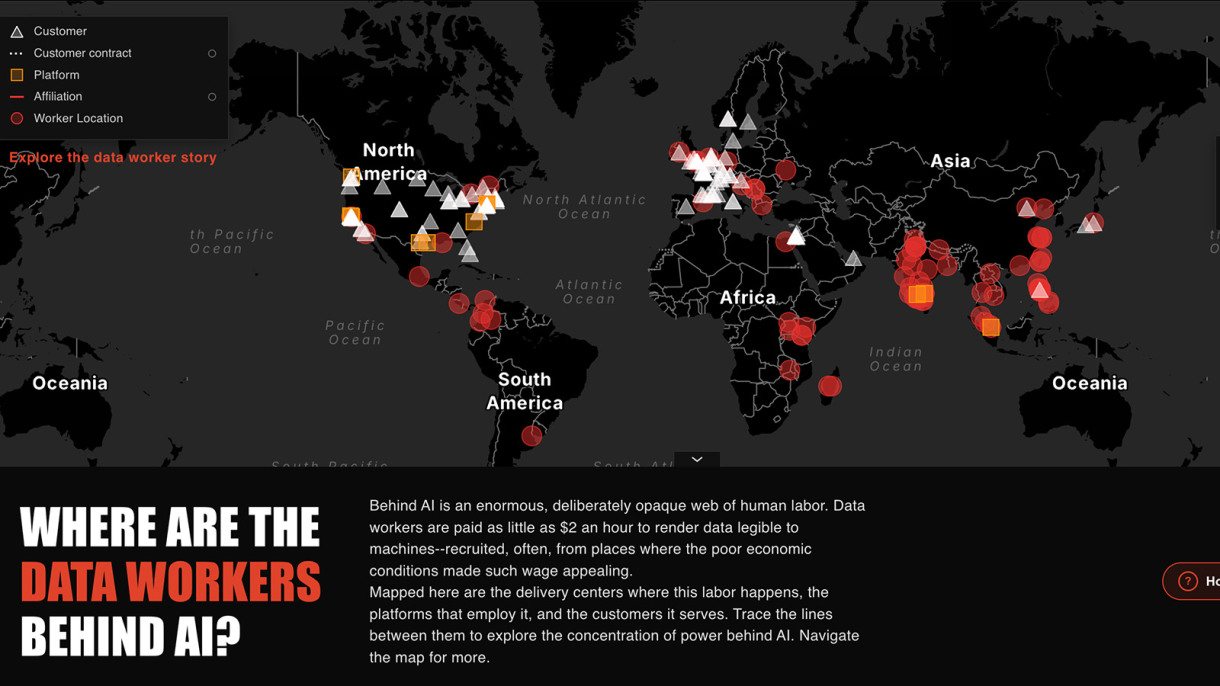
Ma’s goal was to uncover that chain of AI labor, which she says is intentionally kept opaque to avoid accountability. She used existing databases of data labeling firms and their corporate customers, as well as her own original database of data labeling firms’ delivery centers, a proxy for where data workers are located. The map draws the lines that connect those nodes. In its current form, it reveals links between 13 data labeling companies, 141 of their corporate customers and 31 countries that contain data worker sites. The map isn’t a comprehensive look at chains of AI labor, Ma says, but she hopes it’s an illustrative one.
“One purpose for this is as a public education tool,” she said. “When people want to learn about AI and its social impact, the map puts it in the context of this larger economic and political structure.”
Suresh Venkatasubramanian, a computer science professor at Brown who leads the Center for Technological Responsibility, Reimagination and Redesign and is Ma’s advisor on the project, says work like this can help people better understand that underneath the algorithms, AI is really an aggregation of human knowledge, understanding and effort.
“It’s all humans underneath,” Venkatasubramanian said. “That’s the real story behind the generation of AI. The problem with a lot of current discourse around AI is that it seeks to ignore that. The result is that we start constructing stories around AI as its own sentient being, as something that’s alive. But it’s not. It’s something that’s built — something that’s constructed by us, by people, all across the world.”
Ma says she hopes to continue expanding the map of AI labor, and to map other aspects of the materiality that lies beneath the algorithms. Soon, for example, she hopes to map the labor implicated in the semiconductor industry. As a social analysis and research concentrator, Ma sees this technique, known as power mapping, as an effective means of understanding how global power structures influence the distribution of labor worldwide.
For now, she sees her map as a potential means for workers to connect to each other.
“One of the things about this is that it’s distributed,” Ma said. “People don't even know about their fellow co-workers. That makes unionizing or anything like that just kind of impossible. Maybe they can use a future iteration of the map to identify each other.”
Ultimately, Ma hopes that these illustrations of the power structures beneath AI might make for a more equitable distribution of AI labor and its spoils.