

Wood Mackenzie’s latest global report on levelized cost of electricity (LCOE) shows that advancing technologies and market dynamics continue to drive divergent prices, with four-hour battery storage now less expensive than open-cycle gas turbines in all 43 markets where both technologies were modeled.
In the Middle East and Africa, where utility-scale solar already leads at $37/MWh, four-hour storage is forecast to fall a further 33% to $80/MWh by 2035, displacing gas peaking on cost across every gas market in the region. China remains the global storage cost benchmark at more than 55% below the rest of Asia Pacific average, illustrating how manufacturing scale is redrawing the global cost map.
“This economic shift is decisive and widening,” said Ahmed Jameel Abdullah, principal analyst at Wood Mackenzie. “Gas turbine shortages and rising fuel volatility are driving up peaking costs, while expanding battery manufacturing continues to push storage costs down.”
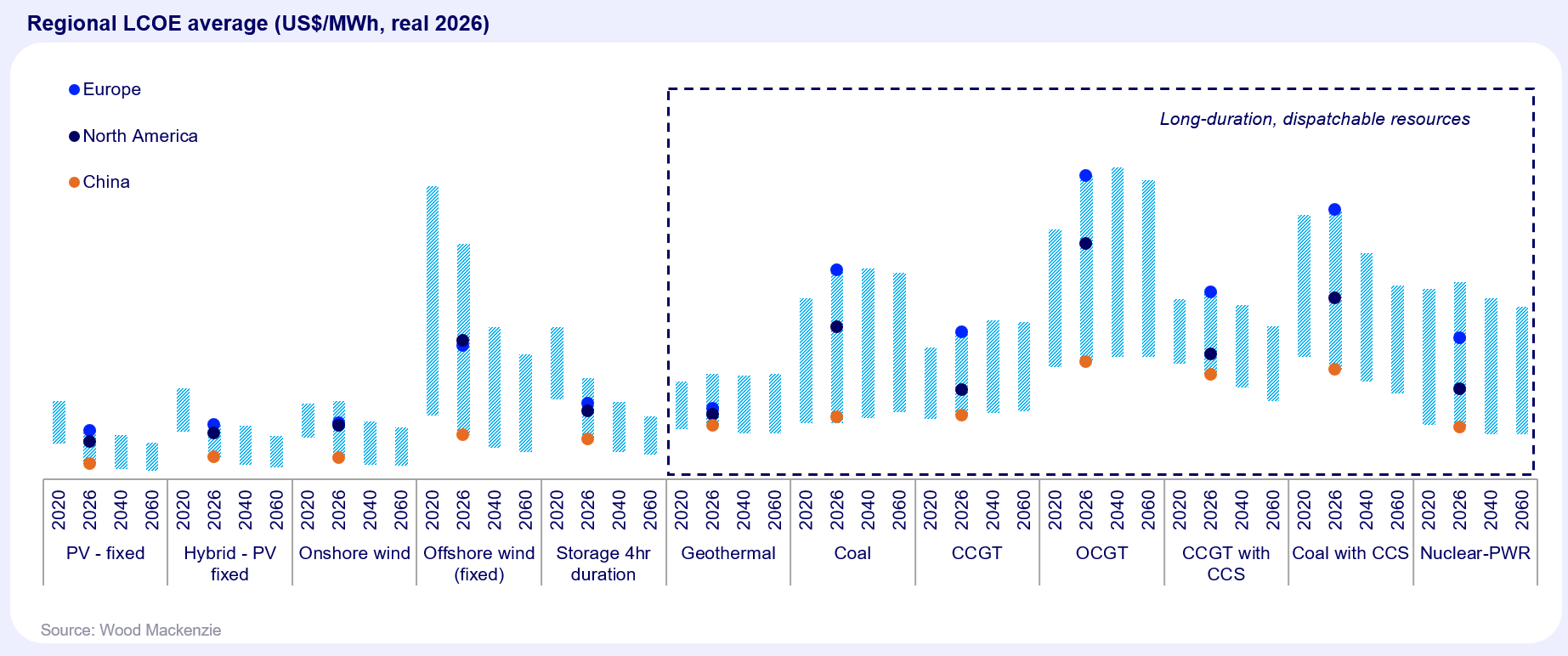
Abdullah noted a similar transformation has already reshaped baseload economics. Single-axis tracker solar is now the lowest-cost new-build technology in 43 of 48 modeled markets, with onshore wind leading in five. In the most competitive markets, Saudi Arabia and the UAE, solar LCOE is on track to fall below $20/MWh by 2033.
The Wood Mackenzie reports cover the regions of Europe, North America, Latin America, Asia Pacific and the Middle East and Africa.
Latin America
Solar PV with single-axis tracking remains the lowest-cost generation technology in Latin America in 2026, with average costs expected to fall 38% by 2060. Brazil, Chile and Mexico hold a structural cost advantage driven by world-class solar resources and high-capacity factors. Onshore wind costs are also on a steep downward trajectory, with the regional average LCOE falling nearly 21% by 2030, from $73/MWh to $58/MWh, as Chinese OEM expansion intensifies pricing competition and larger wind turbines lift energy yields.
Grid-scale battery storage is expanding rapidly across the region, underpinned by storage mandates tied to renewable energy projects and standalone procurement for grid stability. Storage LCOE is forecast to fall 42% by 2060 as deployment scales and regulatory frameworks mature.
Offshore wind remains a longer-term opportunity, with the regional average LCOE expected to approach combined-cycle gas turbine parity, before firming, only in the early 2040s, though development activity in Brazil and Colombia is beginning to stimulate local supply chains.
Asia Pacific
Utility-scale solar PV remains the most cost-competitive power source in Asia Pacific, but regional disparities are stark. In 2026, solar generation in the highest-cost market is more than 200% more expensive than in the lowest; a gap expected to widen to 250% by 2030, even as every market improves. Onshore wind is emerging as one of the most cost-competitive power sources in the region, though costs range more than six times between the cheapest and most costly markets in the region. Growing penetration of Chinese turbine OEMs and the deployment of higher-capacity models are expected to sharply narrow the gap with coal across South and Southeast Asia.
China leads the world on grid-scale storage costs, with a benchmark LCOE more than 55% below the rest of Asia Pacific average of $134/MWh. This is driven by domestic supply chain integration and manufacturing at scale. Competitive Chinese supply is expected to pull the rest of Asia Pacific average down to $92/MWh by 2036, though markets including Japan, Australia and the Philippines will remain at a premium due to import duties, elevated installation costs and domestic manufacturing policies. Offshore wind costs outside China remain under near-term pressure, with meaningful declines expected from the early 2030s as supply chains mature and turbines upsize.
Europe
Solar PV retains its position as the cheapest power technology in Europe, with fixed-tilt LCOE forecast to fall 22% by 2060 as capital costs decline and technology improves, despite a 14% capex increase in 2026 driven by higher PV module costs. Onshore wind capex is declining at an average annual rate of 2.5% through the remainder of this decade as OEMs leverage financial stability and compete for growing demand, with rising capacity factors taking over as the primary LCOE driver after 2030, pushing costs to $60/MWh by 2060.
Battery storage turnkey capex rose about 2%, the first increase in three years, as battery cell prices rebounded around 10% from their 2025 low on stronger demand and higher lithium prices. Capex is forecast to fall 12% by 2031, before the pace moderates as lithium prices roughly double in 2029 when oversupply clears and demand outgrows new mine and refining capacity.
Europe carries the highest fossil-fuel generation costs of any modeled region, with levelized carbon costs projected to surpass fuel costs by 2030. Meanwhile, offshore wind costs are expected to decline from the 2030s as supply chains stabilise and turbine prices fall, supported by competitive CfD tenders providing a more predictable demand trajectory.
North America

High Mesa Solar and Storage site in Parachute, Colorado. Credit: Holy Cross Energy
Near-term solar costs are under pressure from a wave of tariffs, anti-dumping and countervailing duty actions, and new Sec. 232 import restrictions, with distributed generation facing the greatest exposure. Utility-scale solar is partially protected by 168 GW of safe-harboured capacity, though module prices are still expected to rise around 5% annually through 2030. Residential and commercial projects face a more constrained environment, with module prices forecast to increase 6% in 2027 and a further 14% in 2028. For onshore wind, continuous capex and opex improvements are expected to drive LCOE down 16% by 2060, despite near-term uncertainty from policy changes and potential Sec. 232 impacts on turbine pricing.
Tax credits continue to provide a competitive advantage for storage, partially counteracting the impact of foreign entity of concern (FEOC) restrictions and supply chain constraints. A cost spike is anticipated following the phase-out of the investment tax credit (ITC) credits from 2038, but over the long-term new battery chemistries, hardware commoditisation and domestic supply chain expansion are expected to drive storage LCOE down 10% by 2060. Investment in gas generation capacity is entering a supply deficit cycle through the late 2030s, driven by data centre load growth, a dynamic that keeps thermal capital costs elevated and reinforces the long-term economic case for renewables and storage.
Middle East and Africa
Renewable LCOEs across the Middle East and Africa remain among the cheapest globally in 2026, with utility-scale solar clear price setter. Single-axis tracker solar comes in at $37/MWh regionally, falling to $24/MWh by 2035, with Saudi Arabia and the UAE on track to fall below $20/MWh by 2033. The largest cost improvement in this update is from onshore wind, as Chinese turbines become cost-competitive across the region, with Egypt and Morocco recording particularly low costs on capacity factors from 40% to 45%.
Grid-scale battery storage costs are now decisively cheaper than gas peaking across the region. Four-hour storage reaches $120/MWh in 2026 and is forecast to fall 33% to $80/MWh by 2035, cementing its role as the enabling technology for solar and wind integration. This shift means storage is displacing open-cycle gas turbines on cost in every gas market across the region, marking a significant structural turning point for power system planning across both the Gulf and Africa.
“The structural shift we are tracking is no longer just about renewables becoming competitive,” said Abdullah. “It is about storage and solar together redefining what the economics of a power system look like. From Latin America to Asia Pacific, the combination of falling storage costs and world-class renewable resources is closing off the economic case for new gas peaking capacity, while long-term contracted renewables increasingly set the ceiling rather than the floor on power costs.”
News item from Wood Mackenzie